|
|
|
|
|
|
 |
 |
 |
Early Soda & Mineral Water Bottles |
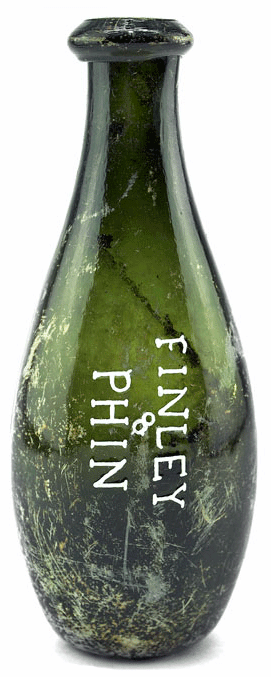
1830-1839 On the CuspDuring the 1830s several new attempts were made to bottle mineral waters and the introduction of a bottling machine leads to one of the first successful ventures in bottling mineral waters. Up to this point the embossed bottles are only found from Philadelphia, but now we start to see activity in other cities including New York, Charleston, and Albany. Each city will be address separately. At the end of this decade, the fuse is lit that will lead to the explosion of artificial soda and mineral water bottlers. Charleston, South CarolinaFinley & Phin were druggists in Charleston South Carolina. James Edwards Burr Finley was a physician in Charleston and was the son of James Edwards Burr Finley, a Massachusetts surgeon who served in the Revolutionary War and later removed to Charleston. Finley was an 1829 graduate of the recently established Medical College of South Carolina in Charleston. The college opened November 8, 1824, with the first commencement exercises April 4, 1825. Finley partnered with Dr. D. D. Graves under the firm name of Graves & Finley at 48 Broad Street. In the 1835 Charleston Directory, he is listed as a doctor at 4 Church. Alexander C. Phin was a Scottish emigrant who was born in Dundee February 17, 1810. He was listed as a chemist in the 1835 Charleston Directory at Chalmers St., op. the Depository. In the same directory, Graves & Finley were listed as druggists 50 Broad Street. At this point Finley and Phin were not partners. Later in this same year, on October 18, 1835, the the firm
of Graves & Finley dissolved. It appears that Dr. Graves
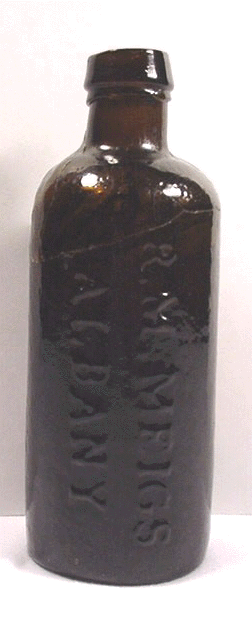
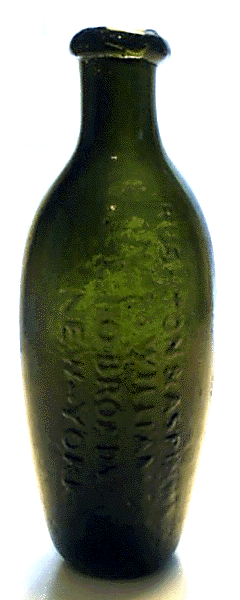
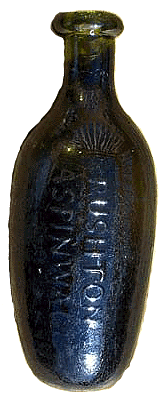
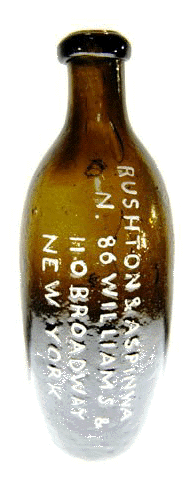
purchased THE Firm of Drs. GRAVES & FINLEY, was dissolved, by mutual consent, on the 18th October last. Dr. Graves having purchased the entire Stock, will continue the business on his own account, at the Store lately occupied by them, No. 48 Broad-street. All persons to whom the Concern is indebted, will render in their accounts for settlement; and those indebted, will make payment to either of the Subscribers. No doubt it took some time for Finley and Phin to get their store furbished and to get supplies ordered and shipped to Charleston. The first ad for Finley & Phin, with an operating store, appears in the March 31, 1836 edition of The Charleston Courier and ran for several months. I doubt this bottle dates to 1835 as some have put forth. Bottling of mineral water was basically a summertime business with bottlers primarily operating from Memorial Day to Labor Day. Since Finley & Phin did not partner until November of 1835 and they needed some time to get their store furbished and stocked, and since the 1835 bottling season was over, it just does not make sense that this bottle dates to that year. This idea is supported by the following advertisement in the Charleston Daily Courier on April 22, 1836: THE SUBSCRIBERS, HAVING fitted up their SODA FOUNTAINS on a new and improved method, they flatter themselves, from its superior construction, to be able to supply their friends and the public with that refreshing Beverage, in its greatest perfection. They are also fitting up a Machine, constructed expressly for bottling, and will in a few days be able to supply the ladies and other individuals to whom public resort may be unpleasant, with Water equal, if not superior to that from the Fountains. By July of 1836, with the publication of the Charleston Directory Supplement, Finley & Phin are listed as druggists at 31 Broad Street in Charleston. In the 1837 Directory, they are listed as both Finley & Phin and Phin & Finley druggists at 31 Broad Street. The following ad in the Charleston Courier on January 8, 1840 records the breakup of Finley & Phin on January 1 and Phin being the successor: DISSOLUTION OF PARTNERSHIP.-The business heretofore carried on in the name of FINLEY & PHIN, is this day dissolved by mutual consent. All demands against them are requested to be presented; and those indebted, to make payment to either of them. The name of the firm will only be used in settling the same. In the 1840 directory, Alexander C. Phin is listed alone as a druggist at 31 Broad Street and Finley continued on as a physician. Phin continued to operate alone as a druggist and selling medicines in Charleston until ill heath caused him to sell the business to Allan & Fayssoux in 1845. The following ads recording this event appeared in the Charleston Courier on July 4, 1845: CARD.-The subscriber gratefully returns his sincere thanks to his friends and customers for the very liberal patronage bestowed upon him for the last nine years, and respectfully informs them that on account of bad health he has disposed of his business to Drs. Allan & Fayssoux, and sincerely solicits a continuance of the same patronage in their behalf. After selling his business, Phin appears to have been involved in political activities and traveling overseas. In the 1850 Charleston Census, Phin is listed as a farmer. Soon he was back in business. In January of 1853, Phin formed a partnership with Charles H. Panknin. The following ad appeared in the Charleston Courier on January 28, 1853. CO-PARTNERSHIP NOTICE. This partnership continued until 1859. They are listed in the Charleston Directory that year, but were dissolved shortly thereafter as documented in the ad in the Charleston Mercury on January 5, 1859: DISSOLUTION OF COPARTNERSHIP. Charles H. died soon after and it appears that Charles F. Panknin, son of Charles H., was the sole proprietor by 1861. Charles F. went on to be successful druggists and by 1906 the firm was known as the C. F. Panknin Drug Company and is reported to have operated until 1909. Phin also continued in the drug business. Soon after the above split, shipments started appearing to in the Shipping News sections of newspapers for Phin & Dorn. This firm formalized their partnership with the following ad in the Charleston Mercury on June 20, 1859: COPARTNERSHIP. The partnership of Phin & Dorn survived the Civil War and continued thru 1866, when again Phin was selling another one of his established drug stores. This time Phin & Dorm sold to E. C. Kellers & Company, which was made up Dr. E. H. Kellers and Dr. H. Baer, who purchased the drug store at 131 Meeting Street. The following notice appeared in the Charlestown Daily News on July 20, 1866: AN OLD DRUG STORE UNDER A NEW NAME.-We take pleasure in calling the attention of our readers to the advertisement of E. H. KELLERS & CO., in another column. This new firm has succeeded to the well-known concern of PHIN & DORN, at the same old stand in Meeting-street, near Market, and are determined to keep up the reputation of their store. In addition to a large and well assorted stock of drugs, they have a fine soda-water fountain, where customers can be served with the most refreshing beverage at any hour of the day. We wish them all success. The add for Kellers & Company was right above an ad for Panknin's Herpatic Bitters, which they sold. C. F. Panknin was the proprietor and he was located just 4 doors away at 123 Meeting Street. In the 1870 Census he is again listed as a farmer. Briefly in the middle 1870s, Phin was working as druggist, but did not own his own store. In the 1880 Census he was again listed as a farmer in Blackville, South Carolina. He is never again listed in the Charleston Directories and he died on June 5, 1895 at 85 years of age. The only information found specifically connecting Finley & Phin with bottling of mineral water was the April of 1836 advertisement supporting the fact that this bottle dates no earlier than 1836 to possibly as late as 1839. Albany, New YorkRichard Montgomery Meigs was a druggist in Albany, New York. The following is from a biography found on Ancestry.com: Richard Montgomery Meigs, third son of Major John Meigs and Elizabeth Henshaw, was born at Middletown, Conn. In 1796 he moved with his father and family to New Hartford, Conn. In 1802 he was sent to Albany, NY and lived for some years with his uncle Daniel Henshaw, on North Pearl Street, near State Street, and was a student in the office and drug store of Dr. Thaddeus Pomeroy, to whose business he afterward succeeded. In October, 1842, he moved with his family and a part of friends and neighbors of Albany and along the Hudson, to Wisconsin. Some remained in Milwaukee, others bought and took up land between there and the Indian Reservation, mostly between Waukesha and the Nashota Mission, forming a neighborhood of mostly New York State and New Jersey people. In 1859 he returned East, and spent the remainder of his life between New York City and the village of Knox in the Helderbergs. He lived the quiet life of such a town, and was a very congenial man, and known to every one of that Burgh; held no public position except at Sergeant-at-Arms of the New York State Senate for some years and as Treasurer of the Albany Female Academy... Mr. Meigs died at the age of ninety-six, retaining to the last his interest in public affairs. I found Meigs was born on August 8, 1787 in Middletown, Connecticut. As early as 1813, he is listed in the Albany Directory as a druggist. He married Maria Keeler in 1814 at Albany. From some time prior to 1819 and after 1825 the firm was known as R. M. Meigs & Company. From some time prior to 1830 to1839, Meigs was on his own until he became the Sergeant at Arms in the State Assembly in 1839. The following year, T. Pomeroy was listed as Meigs successor at 4 Exchange Street. In the 1850 Census, Meigs was listed as a farmer in Ottawa, Wisconsin. In the 1860 and 1870 Censuses, he is listed as living in Knox Township, New York. He died there on January 11, 1884. The Meigs' bottle is somewhat atypical of soda and mineral water bottles of this period. It is also embossed "PURE SODA WATER" on the reverse and this is the earliest appearance of the word "soda" on an American glass or pottery bottle. The bottle appears to be styled after the Saratoga Springs bottles of this period, but on a much smaller scale. Note the use of a double tapered collar, which is rare on soda water bottles, but is prevalent on Saratoga Springs bottles. It was likely manufactured by one of the upstate New York or Vermont glass houses based on the coloration of the glass. The time period that Meigs was in sole control of the business was from 1833 to 1840. Even though I was able to find many ads for Meigs selling products in Albany and moving his store, very few were related to selling soda or mineral waters. He was selling Congress Water both wholesale and retail in 1839 based on a deal he had with John Clark. This bottle likely dates to the period 1837-1839. This date is supported by a few advertisements run in May of of 1837 that Meigs ran in the Albany Evening Journal. One dated May 4, briefly states: SODA WATER will be prepared and sold by R. M. MEIGS, 46 State street, in its purity, throughout the year. mh30 Note the use of "purity" in this advertisement, which matches his use of "pure" on the glass bottle and seems to confirm the approximate dates of this bottle. New York City, New YorkRushton & Aspinwall were leading druggist of their time in New York City. In 1827, William L. Rushton opened a drug store at 81 William Street, which was previously the dry goods store of Reuben & Henry M. Sikes. James S. Aspinwall does not appear in the directories prior to the partnership. Rushton and Aspinwall joined forces in late 1830 at the 81
William The 1836 and 1839 advertisements mention that their bottled
waters
were available for shipping. The English style bottles were conducive
to shipping as their bottoms were As mentioned previously, the move from 81 to 86 William Street is
important in dating Rushton & Aspinwall bottles. The
earliest bottle bears the addresses of 86 William and 110 Broadway
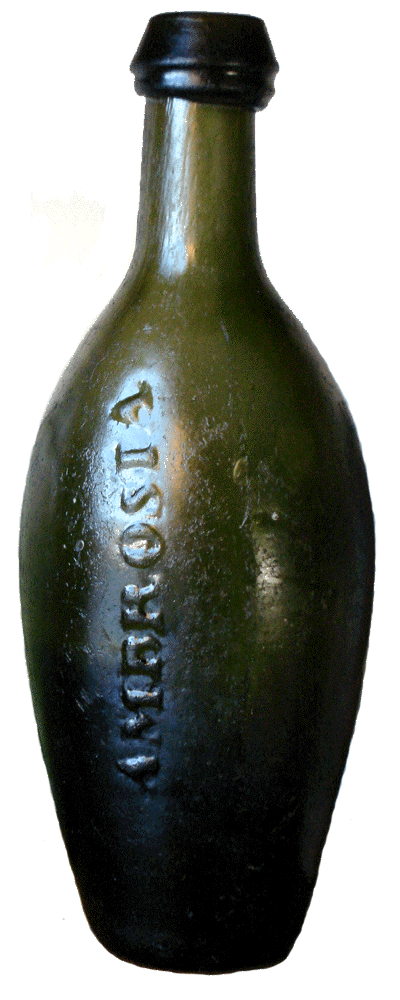
and not An early bottle marked Byran's Ambrosia New-York has been
found. The bottle is a dark olive
green color and has a neatly formed double tapered top, which is unusual for soda
water bottles. Ambrosia was a beverage that is often
associated with fruit and honey. A recipe for Ambrosia was mentioned
in the Knickerbocker Magazine in 1836. I have not been able to find any
absolute evidence of its proprietor, but new research, by Adam
Woodward has uncovered that the likely proprietor as Sobrias Watson
Bryham. Adam believes that either a mold makers error or
anti-English sentiments and ensuing New York City riots (the English
Bryham being "Americanized" as Bryan), resulted in "Bryham"
being engraved as
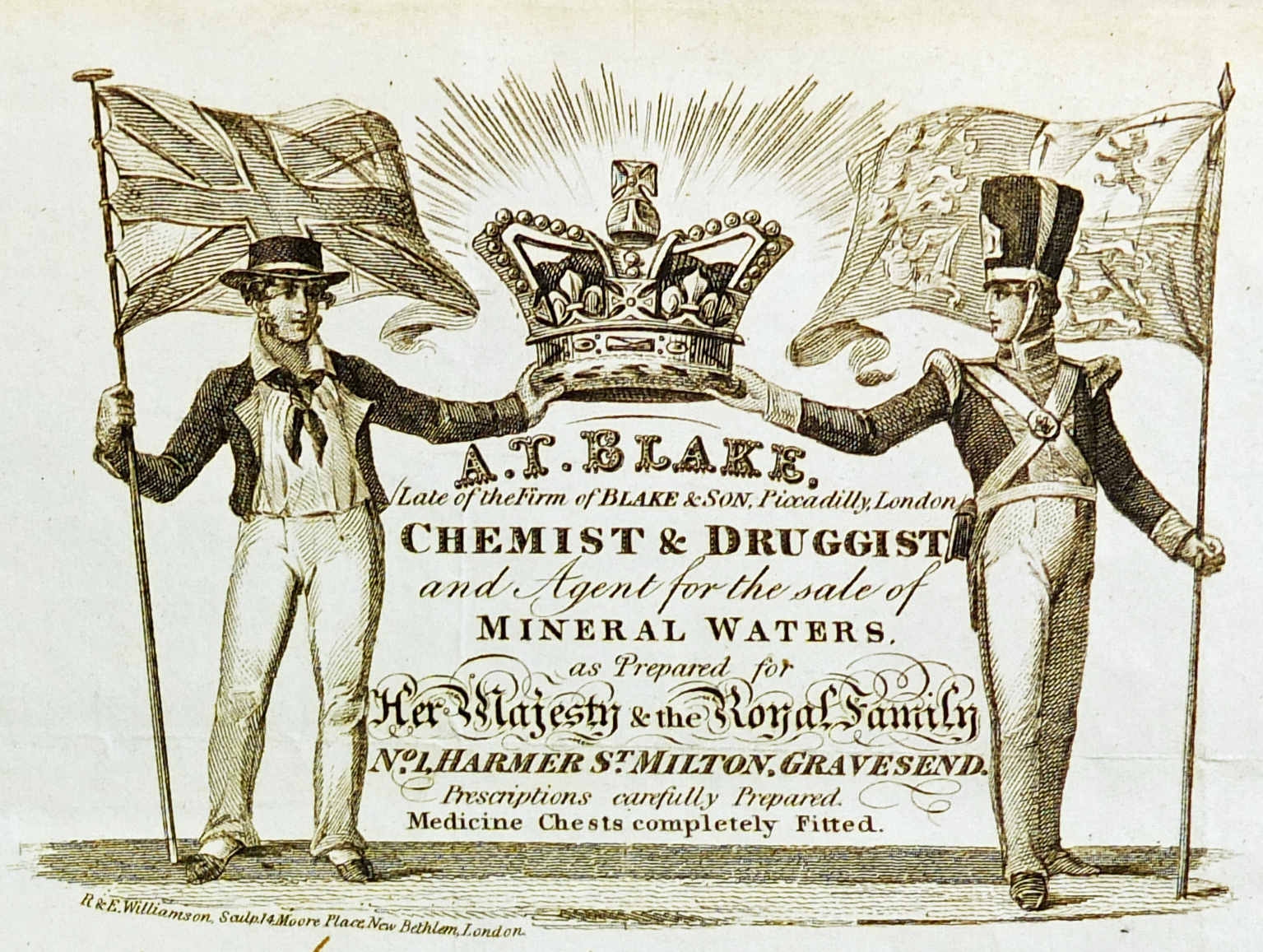
"Bryan" in the mold. Bryham first surfaces as a druggist in Philadelphia in 1831 at Seventh & Callowhill Street. Interestingly another Bryham is also in Philadelphia at the same time. In summer of 1832, Mrs. M Bryham was advertising the Rail-Road and Spring Garden Refreshment Pavilion across from the depot. The Philadelphia Inquirer on August 8, 1832 list the beverages that she offered including: Improved Soda and Mineral Waters, prepared by Mr. J. Wilbank; Carbonated English Ginger Pop, a new article,-very superior; Beverage, Porter, Ale, and Champagne Cider; English Ginger Pop, prepared by M'Kennell & Smith; Lemonade, prepared in a new style, and very much approved of; Patent Soda Beer; Wines of the first quality, from the vaults of Mr. P. Wager, of every description: Ice Creams; Confectionary; Fancy Cakes; Raspberries and Cream; and every article in Season. The name Bryham is limited to these two in Philadelphia during this period and it is probable that "Mrs. M. Bryham" was Sobrias' wife Margaret (McClenahan) Bryham. The importance of this association with refreshments and confectionary establishes a relationship between Bryham and carbonated beverages and confectionary. Bryan was in New York City by October of 1834, when he shows up as a member of the vigilance committee for the Second Ward. Bryham is identified as a druggist at 208 Bowery in 1835, a continuation of his occupation in Philadelphia. His first advertisement in New York was for a Compound of Sarsaparilla, being sold at the confectionary store at 208 Bowery. In September of that year, he is looking for confectioners and a couple of weeks later he announced his "Bowery Steam Confectionery… is in full operation." He had introduced steam machinery to improve the manufacturing process. In February of 1836, he opened a "branch store" on 239 1/2 Grand Street in New York City and in August he "built a commodious Saloon attached to his Bowery Steam Confectionery… where he pledges himself to furnish Ice creams of every variety, Lemonade, Soda Water and Mead Syrup, Orgeat, and other beverages suited to the seasons of the richest and most wholesome description." Soon Bryham closed the Grand Street branch, but in December 1836, he announces the opening of new branch store at 276 Grand Street which would be known as the "Grand Street Steam confectionery and Saloon”. He was also seeking two journeymen to work at the branches "who will find constant employment." For reasons unknown, but perhaps over expansion, Bryham announced "that since he has sold out his store in Grand Street, he has completed his enlargements and alterations at his original establishment, No.208 Bowery. Retail and Wholesale." He then appears to have brought in a partner, a Benjamin Baker, on March 17 and announces to "his friends.. opened a new establishment, 60 1/2 Division Street." This location soon results in conflict with his new partner and this new store was sold at sheriffs sale on June 10 due to a mechanics lien. This resulted in the follow advertisement run by Baker, in the New York Herald on June 12, 1837: NOTICE TO THE PUBLIC. The contents of the Confectionery store, No.60 1/2 Division street was sold by order of the Sheriff on Saturday the 10th, for a claim of carpenter work held against us of $150, which money I gave to BRYAM two months previous to pay the said claim, but he spent it in rioting and dissipation. The whole stock and fixtures was bought in by Bryam’s assignee… We have been in business together since the 17th of march last, and during that time he has swindled me out of $300, which I can prove. I have bound him over for threatening to set the said store on fire and on Saturday evening last I have him taken to the watch house and kept him there until morning for treating to shoot me with a brace of pistols to which a dirk was attached, and were taken to the station house. The character of this monster is too well known to the public to require any further disgrace from me than by simply saying he is an Englishman and a scoundrel and deserves not the patronage of the American public. The residence of this villain is 208 Bowery, and known as the Bowery Steam Confectionery, which is a great bore as was ever puffed by any foreigner to deceive the public. He has made an assignment of his property and tells his creditors that he has stopped specie payment till the banks resume again. Since his failure he has shown me upwards of $1,000 at a time which he has concealed in a belt round his person and defy anyone to get it. -B. BAKER. The bolding is mine to highlight anti-English sentiment that existed at the time as communicated to me by Adam. Another Englishman, Alexander T. Blake, landed in New York in the middle of these riots quickly parted for the Mid-West where he established a mineral water bottling establishment in Cincinnati. He also had poor business and closed up after six months and returned to England after earning the necessary funds. Bryham responded in the New York Herald on June 13: TO THE PUBLIC The advertisement signed "B. Baker" in yesterday's Herald, is through a statement of the most malicious set of falsehoods a most depraved individual could possibly invent… he has endeavored to injure my reputation by false representations. The particulars are as follows:In March I took him with me after he had been watching the pit door at Cooke's Circus, as I thought to help him get into business. We bought the property of Mrs. Gaion (60 1/2 Division) and paid cash $250 each his part. He borrowed of Mr. Labutout, mahogany merchant. I became the responsible partner as he had no means and a single man without responsibility ... he had got me involved for $1,100 when he commenced keeping the sales of said store and appropriating them to his private use, leaving nothing to pay the debts of the store. To save the creditors I stopped all further operations and brought the business to a close. When the store was sold he had the same opportunity of buying... he had not the friends or the money, as it was a cash sale. ...The books speak for themselves and are laying open at 208 Bowery for public inspection at all times. His representing me as an Englishman, if I were one I would not deny my country but that is also false. He himself though is English and only four years in the country. It is useless to state further particulars ... my character stands unimpeached. My creditors have never lost anything by me. B. Barker is at present time under bail of $1000 for a very aggravated assault and battery on my wife; he is also under bonds for striking myself with intent to kill the session report will tell more particulars in time. S.W. Bryham Again the highlighting is mine to point out accusations and denying being English. Interestingly the Herald sided with Bryham during this dispute. Bryham was a heavy advertiser in their paper. The partnership between Baker and Bryham, was announced as officially dissolved with the following ad published in the New York Herald on August 9, 1837: NOTICE The copartnership formerly existing between S.W. Bryham and Benjamin Baker, in the confectionery line, at the store No.60 1/2 Division st., was fortunately dissolved on the 10th day of June, 1837. This is to give notice that I will not be responsible for any debts of said Baker's contracting. S.W. Bryham, No. 208 Bowery. An advertisement in the September 14, 1837 in the New York Herald indicates that Bryham was continuing to expand his business: BRYHAM'S SALOON ENLARGED.-A CARD.-S. W. BRYHAM of the Bowery Steam Confectionary and saloon for ladies and gentlemen, respectfully informs his numerous friends and the public, that he is always prepared with Ice Creams, Lemonades, Meads, Sodas, Ices, &c. &c., various delicacies as they come in season, for their accommodations, as also the best assortment of pure and wholesome confectionaries, manufactured on the improved principals. ... S. W. B. intends to devote his whole and sole attention to his Bowery Establishment, as also Mrs. B. to the confectionary department and with the united exertions of both, hope to still merit a continuance of patronage already so extensively experienced with many thanks for past favors. S. W. BRYHAM. This advertisement proves that Bryham's wife Margaret was very involved and experienced in this business and was likely the Mrs. Bryham in Philadelphia five years earlier. His last directory listing was in the Longworth's New York Director for 1838-39 and published in July, 1838. On April 12, 1838, Bryham made his "declaration of intent" to support the Constitution of the United States and reject the Queen of England (he was really English). According to a biography, a William T. B. was born to Sobrias and Margaret on December 6, 1836. It was noted that William's father died in his early childhood and his mother remarried a Mr. Nicholson and moved to Philadelphia. It is likely that Sorbias died in later 1838. This is supported by the fact that Bryham is listed in the "Dead Letter" section of the papers at the end 1838 and early 1839 and his wife appears in this section in 1840, when she likely moved back to Philadelphia. Note the similarity of the Bryan bottle to the Rushton & Aspinwall bottles. The Bryan bottle dates to the mid 1830s and if Bryham's bottle, which seems likely, dates 1836-37. It was likely manufactured by an Upstate New York or Vermont glass manufacturer. Adam found his bottle three blocks from the Bryham's Steam Confectionary at 208 Bowery. Bryham was advertised heavily and usually individuals that went to the trouble of having a private mold made were big advertisers. It would be a lock if an advertisement for the Ambrosia could be found from Bryham. Cincinnati, OhioAlexander Thomas Blake was an Englishman whose family had a long association with producing and bottling of mineral water. Alexander Thomas (A. T.) appears to have been the adventurer and his brief stint in the United States produced the earliest documented soda water bottle from the Midwest. Alexander Thomas Blake was born on May 20, 1811 to
Alexander (A.) Blake and Ann Ovey in the West Indies. A. Blake was an early
London druggist and chemist who was in the partnership of Kernot &
Blake in 1806 at 33 St. James' Street. By July of 1811, A.
Blake moved into the old established drug store at 56 Piccadilly
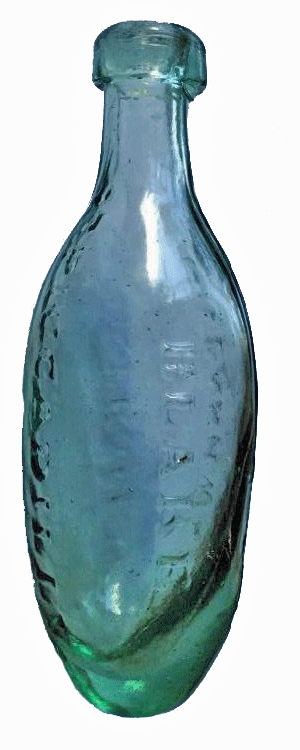
In 1834, if not earlier, A. Blake brought his son A. T. Blake into the firm and it was known as A. Blake & Son. At this same time, we find the operation was manufacturing carbonated waters. The following ad appeared in London's Morning Post on May 2, 1834: CARBONATED WATERS of SODA, POTASH, MAGNESIA, AMMONIA, &c.--Medical Gentleman who wish their patients to drink the Carbonated Waters, and others who use such, are informed that the above are prepared with the greatest precision, and will be found worthy especial notice. The use of Potash in preference to Soda Water is strongly recommended, particularly to those subject to calculous (sic) complaints, in which it has proved exceedingly beneficial. Prepared and sold by A. Blake and Son, Chemists and Druggists, No. 47, Piccadilly, London With his newfound stature as a partner of a successful medicine and chemical business, A. T. Blake married Selina Taylor, the daughter of the late Major Taylor, on July 13, 1834. The firm of A. Blake and Son continued until February of 1837, when it was dissolved and A. Blake took total control of the operations. The senior Blake continued to produce carbonated beverages, but also bottled them in marked bottles. The following ad appeared in London's Morning Chronicle on June 4, 1839: PURE WATER.--AERATED POTASH WATER, made from pure distilled water, was originally prepared by A. Blake, Chemist, 47, Piccadilly, corner of Albany, under the direction of one of the most eminent physicians in London, and has by its excellence, won its way to the tables of the most distinguished personages, where it is now very generally preferred to soda water: in flavour it is equal, or indeed more delicious, while as a salutary beverage (especially for those suffering under calcareous complaints) its superiority is undisputed. A. Blake begs to caution the nobility, gentry, and others, who have honored him with their commands for the much-admired Aerated Potash Water, made from pure distilled water, against imposition: he has, in consequence of a spurious article being offered to the public, had the words "Aerated Potash Water, Blake, 47, Piccadilly, "engraved on the bottles, which he trusts will secure to his customers, without any difficulty, the genuine article. From the Superiority of the much-approved beverage, A. B. has received her Majesty's commands for a regular supply. He also manufactures superior soda water, from the purest sesqualcarbonate of soda, which he sells in bottles bearing his name and address, as well as the following aerated waters;-Magnesia, Seltzer, Ammoniated, Orangeade, and Lemonade. A. B. recommends his syrups of Lemons, Oranges, Ginger, Cepillaire, and Raspberry Vinegar as very pleasant additions to Potash and Soda Water. After his father bought him out, A. T. Blake set out for America,
hoping to succeed in the
United States as his family had in London. He arrived on May 3, 1837 in New York City;
a sensible place to establish a business.
However, he left for reasons unknown to us at this
time, but the summer of 1837 was the height of the English Riots in
New York City and thes SODA WATER, Blake's foray into the bottled soda water business does not appear to have
been successful in Cincinnati. Perhaps the Panic of 1837, a
public that was not interested in his product, or a lingering
distaste for Englishman at this time contributed to his struggles.
In 1839, if not in the Fall of 1838, he used his knowledge of pharmacy and chemistry to
secure
a
job at Burdsal's drug store, one of the leading firms in the city.
His 1839-40 directory listing bears
On his return to England, A. T. does not rejoin his father and younger brother in the business. Younger brother Charles T. joined the family business by 1841, and in that year, the firm traded as another incarnation of Blake & Son. This firm became Blake, Sandford & Blake in 1845 and this firm continued to produce aerated beverages well into the early Twentieth century. By 1840, A. T. Blake made his way to Gravesend in Kent, England and was selling mineral waters in addition to being a druggist and chemist. He remains in Gravesend thru 1847, but for some reason he and his wife traveled back to the United States in 1846. It is interesting that in that year only an A. Blake was operating a feather store in Cincinnati. In 1851 A. T. is in Surry. The last viable references that I can find for A. T. was his arrest for allowing gambling in his hotel, the Lord Nelson Inn, in June of 1852 and a listing in a 1856 London Directory. The Blake bottle dates to 1838 and is peculiar in form, color, and finish. The bottle's form is an egg shape, but not a well formed bottle as compared to the English bottles of the same period that would have been familiar to Blake. Perhaps Blake had difficulty in describing the form of the bottle to the mold maker. The color is a bluish aquamarine, again unusual, and the top bears a double taper, which again is contrary to the typical finish to the English bottles. Perhaps this was the only finish tool available to the glass blowers at the factory. It is interesting that the same type of lip finish was used by another Englishman, Bryan, in New York. Based on the age, it would seem that the bottles were blown at Pittsburgh, but could have been made at an early Ohio glass manufacturer. Philadelphia, PennsylvaniaMuch more history of Elias Durand is available in the
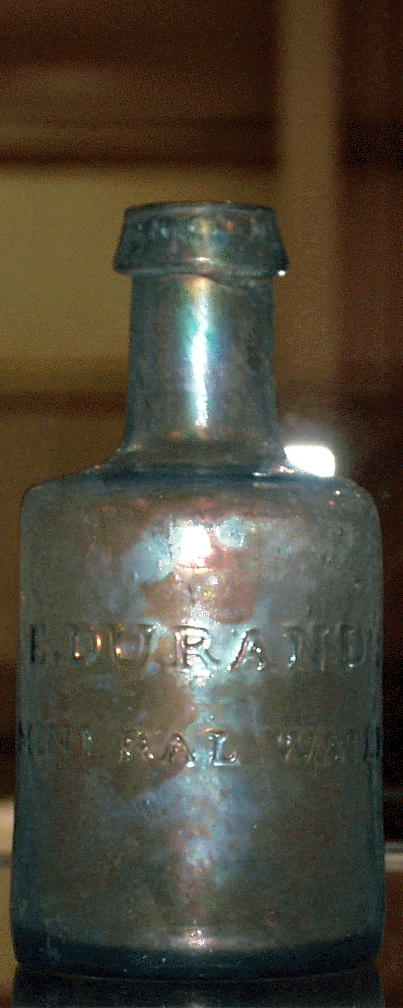
previous chapter. The Durand bottles of this period are small, which matches the
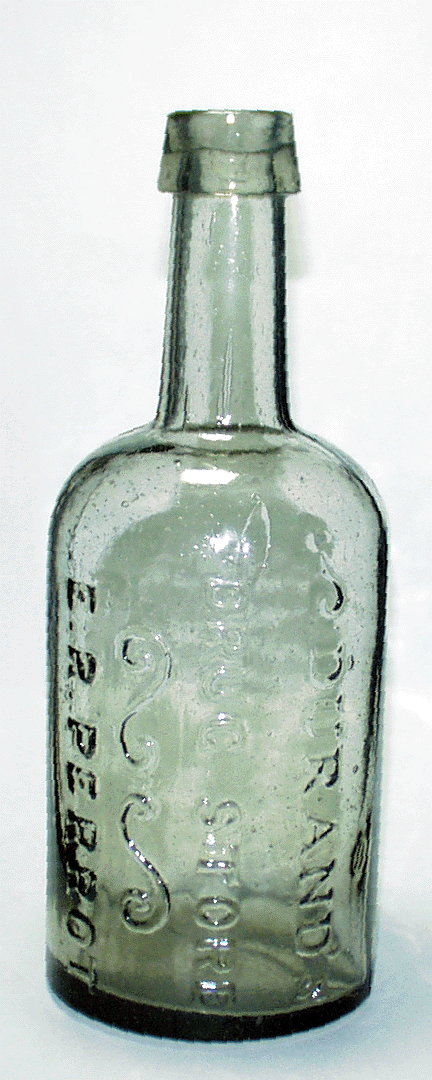
description in the period It also appears that a run of the larger sized bottles was made
during this decade. I have excavated a shard of a quart sized
Durand bottle, that is noticeably different in color that his
earlier bottle. Unfortunately, neither the base nor the lip
was found. I have heard of another damaged example of this
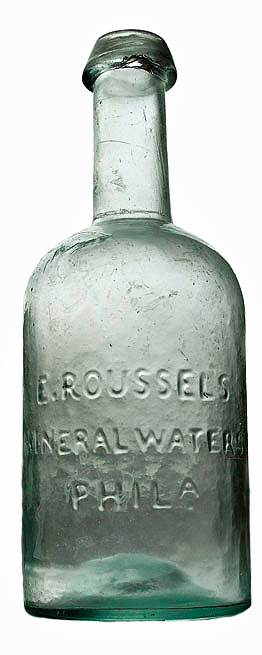
bottle and perhaps it has a story to tell. The large sized mold was kept at Durand's drugstore after he abandoned the bottling business in 1837. The business passed into the hands of his son, Alfred B., and Emil Tourtelot as Durand & Tourtelot in 1852. They moved the store to 718 Chestnut to make way for the Howell Building, which was constructed on the site at Sixth & Chestnut in 1854. This building was later modified to become the Public Ledger Building. In 1857, Tourtelot left the firm to start a business of his own in Germantown and Alfred continued the business on Chestnut Street. The following year, he moved to 1228 Chestnut Street and he sold the business to one of his employees, E. R. Perrot, in 1860. So what does this have to do with the mold? Well Durand's large sized mold, likely brought from France in 1825, and used during the 1830s made its way from the store at Sixth and Chestnut, to the store at 718 Chestnut, and then to the store at 1228 Chestnut, where it was sold to Perrot, who had the mold modified to add his name so he could sell bottled mineral water. That makes this one of the most interesting and likely longest use of a bottle mold of which I am aware. Eugene Roussel de Prunay was born in about 1811 in France.
His family seat was the Chateau de Condi Vailly sur Aisne, which his
family held since 1647. During his early years, Roussel worked for
the firm of Laugier Pere & Fils in Paris and was the director
there. He fought against the French Government and was compelled to
leave the country. He left from Harve, France on the ship Sully and
arrived in New York on July 11, 1838. He soon after traveled to
Philadelphia and established a perfume store at 75 Chestnut Street,
below Roussel started the bottling of mineral water in 1839. His first bottles are aqua in color and unlike later bottles do not have the word "Patent" on the reverse and are very light in weight. Roussel was soon to unleash a craze the likes of which the soda water business had not seen and whose reverberations would be felt until the present time. The fuse had been lit and the soda water business was about to explode! <<= Previous Next =>> |
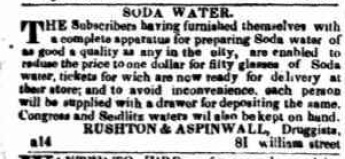 Street location. In 1833 they opened a second location
at 110 Broadway. In August of 1833, they first advertise the
sale of soda water, but at this point it appears that they only
operated a fountain and did not bottle. They sold the water on
a ticket system, which appears to have been popular at the
time. Fifty tickets could be purchased for one dollar and
could be redeemed at the 81 William Street store. It is
important to note that they moved their William Street store from 81
to 86 William in 1835 and in 1836 they added a third location at 10
Astor House.
Street location. In 1833 they opened a second location
at 110 Broadway. In August of 1833, they first advertise the
sale of soda water, but at this point it appears that they only
operated a fountain and did not bottle. They sold the water on
a ticket system, which appears to have been popular at the
time. Fifty tickets could be purchased for one dollar and
could be redeemed at the 81 William Street store. It is
important to note that they moved their William Street store from 81
to 86 William in 1835 and in 1836 they added a third location at 10
Astor House.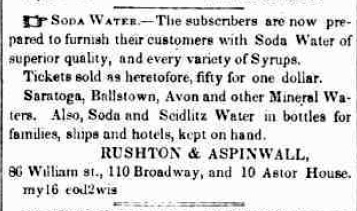 In May of 1836, we find the first mention of soda waters being
bottled by Rushton & Aspinwall. Soda and Seidlitz waters
were mentioned as being sold. The Seidlitz name comes from
the Seidlitz Saline Springs of Bohemia, which were popular as a mild
cathartic to assist in bowel movements and were a combination of
tartaric acid, sodium bicarbonate, and potassium sodium tartrate.
A July 1839 advertisement again mentions soda water in bottles and
there is on mention of Seidlitz water. The history of this
firms bottling of soda water will be continued in the next chapter.
In May of 1836, we find the first mention of soda waters being
bottled by Rushton & Aspinwall. Soda and Seidlitz waters
were mentioned as being sold. The Seidlitz name comes from
the Seidlitz Saline Springs of Bohemia, which were popular as a mild
cathartic to assist in bowel movements and were a combination of
tartaric acid, sodium bicarbonate, and potassium sodium tartrate.
A July 1839 advertisement again mentions soda water in bottles and
there is on mention of Seidlitz water. The history of this
firms bottling of soda water will be continued in the next chapter. 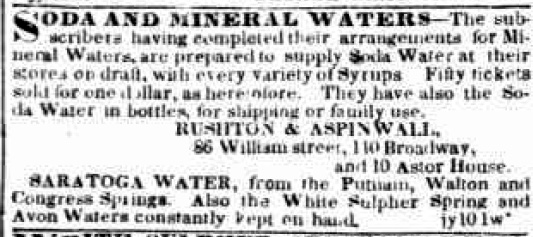
 corner of Albany (47 after renumbering in 1820) in London. The
store was operated by R. Haywood for a couple of years and previous
to that, for many years by Edmund Lardner, whose recipes A. Blake had
acquired. It appears that A. Blake had worked for Lardner
earlier and had developed some of these compounds, such as a prepared
charcoal dentifrice, that Lardner was selling.
corner of Albany (47 after renumbering in 1820) in London. The
store was operated by R. Haywood for a couple of years and previous
to that, for many years by Edmund Lardner, whose recipes A. Blake had
acquired. It appears that A. Blake had worked for Lardner
earlier and had developed some of these compounds, such as a prepared
charcoal dentifrice, that Lardner was selling.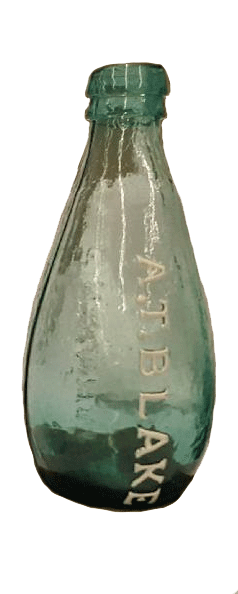
 "(Eng)"
in the text, which stands for England, the location of his origin. Other
entries in this directory record the state the listed party came
from. A. T. appears to have returned to England on the
Steamship British Queen at the beginning of August in 1839.
"(Eng)"
in the text, which stands for England, the location of his origin. Other
entries in this directory record the state the listed party came
from. A. T. appears to have returned to England on the
Steamship British Queen at the beginning of August in 1839.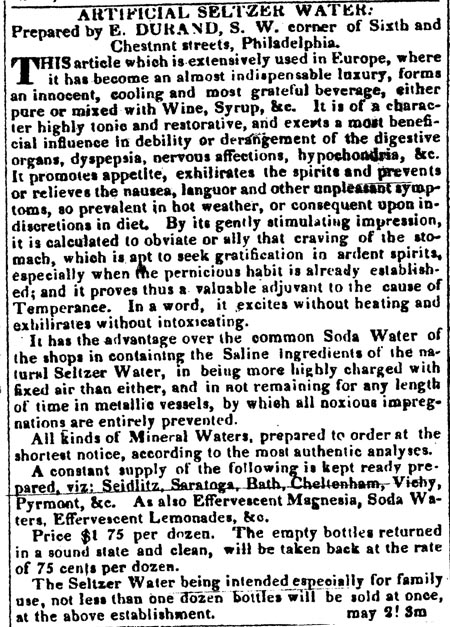 In 1835, Durand stated bottling of mineral water and
opened a large establishment on Sixth Street above Arch. The
apparatus for manufacturing the waters, and especially that part of
it for bottling under pressure, was his own invention and superior
to any then in use in France or the United States. The
illustrated advertisements for mineral water in bottles were found in 1835 and
1836 newspaper advertisements. This business was in
full and successful operation when the money crisis of 1837 hit and
Durand, with a great loss, was forced to close this branch of
his business. Correspondingly, no ads were found for the
mineral waters in 1837. After this experience,
he adhered closely to his pharmacy profession until his retirement
and he sent the bottling apparatus to the Société de Pharmacie,
where it was placed into use in Paris.
In 1835, Durand stated bottling of mineral water and
opened a large establishment on Sixth Street above Arch. The
apparatus for manufacturing the waters, and especially that part of
it for bottling under pressure, was his own invention and superior
to any then in use in France or the United States. The
illustrated advertisements for mineral water in bottles were found in 1835 and
1836 newspaper advertisements. This business was in
full and successful operation when the money crisis of 1837 hit and
Durand, with a great loss, was forced to close this branch of
his business. Correspondingly, no ads were found for the
mineral waters in 1837. After this experience,
he adhered closely to his pharmacy profession until his retirement
and he sent the bottling apparatus to the Société de Pharmacie,
where it was placed into use in Paris.