|
|
|
Bottle Attributes Soda & Mineral Water Bottle Closures
The closure used on a bottle can say something about a bottle's age. Regional preferences and traditions help to
dictate what closures were popular and for how long. Patented stoppers
can be no earlier than their submission and most were not used for very
many years.
There were a great number of patented closures for soda bottles, but few
were used and even fewer were successful.
The closures shown below were actually used on soda and mineral water
bottles until about 1920. Some, like the crown cork and siphon are
in use today. The
most popular stoppers by era are presented first, followed by those that
were less popular earliest to latest.
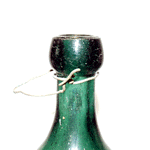 |
Cork, circ: pre-1600-1905,
By far the most common closure used on soda and mineral water bottles until about 1885 when the
Hutchinson stopper became standard. Initially,
a string or wire was used to secure the cork to the bottle. Later, a wire
bail became the standard. Some bottlers still used corks into
the Twentieth Century.
Corks for soda and mineral water bottles were about two inches long.
Example shows wire used to retain a cork in the bottle. |
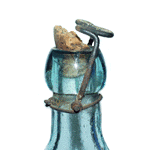 |
Putnam Closure, circ:
1859-1905,
Invented by: Henry William Putnam,
American Patent: March 15, 1859, Number: 23,263,
American Patent Reissued: January 19, 1864, Reissue Number: 1,606,
This cork fastener was the standard used on corked soda and
mineral water bottles during the1860s, 1870s and early 1880s when it was replaced with the
Hutchinson stopper. The bail was reusable and the bottler was not
required to rewire the cork with every refilling of the bottle. |
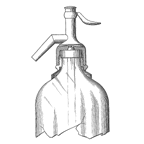 |
Siphon Closure, circ:
1860-1920,
This closure has patents going back until the early 1800s in
both England and France. Highly pressurized soda water
was expelled up a tube through a spigot that was opened and
closed by either a lever of screw based faucet. The earliest
American patents date to the mid-nineteenth century and were
minor improvements to the established European designs that by
that time were in the public domain. |
 |
Gravitating Closure, circ: 1864-1890,
Occurs on 360 bottles,


Invented by: Albert Albertson, John Matthews and Joseph Conner,
American Patent: October 11, 1864, Number: 44,684,
American Patent: November 1, 1864, Number: 44,912,
American Patent: August 13, 1867, Number: 67,781,
American Patent: April 15, 1873, Number: 137,941,
American Patent: October 26, 1886, Number: 351,496,
This was the first successful internal stopper. This
closure consisted of a glass rod that was tipped with a rubber
nipple. The glass rod fitted into the neck of the bottle and the
attached rubber nipple sealed the contents when the pressure of
the carbonated contents pushed the rubber nipple against the
base of the neck. To open the bottle, the glass rod was pushed
down to break the seal. The bottle had to be filled upside down
so that the glass rod could fall into place. Although
there are a few bottles that date to the 1860s, most date to the
1870s when improvements were made to this stopper. Examples of
bottles with this stopper occur across the United States, Canada
and the Caribbean. This stopper was replaced in popularity
by the Hutchinson closure during the early 1880s. Many of the
Gravitating bottles were reused with Hutchinson stoppers as
bottlers made the transition to this stopper. |
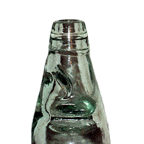 |
Codd Closure, circ: 1872-1920,
Occurs on 220 bottles,
Invented by: Hiram Codd,
English Patent: November 24, 1870, Number: 3,070,
English Patent: August 22, 1871, Number: 2,212,
American Patent: July 23, 1872, Number: 129,652,
English Patent: September 3, 1872, Number: 2,621,
American Patent: April 29, 1873, Number: 138,230,
American Patent Reissued: August 13, 1878, Reissue Number: 8,372,
This closure was introduced in North America from England.
A marble stopper in the neck was pushed up against a rubber
gasket in the lip to seal the bottle. It was marked as the
Globe Stopper in England. The pressure of the
carbonated beverage inside kept the marble in place. These
bottles had to be filled upside down in order for the marble
properly seat. The indentations in the neck kept the marble from
clogging when the contents were poured out. This closure
was not nearly as popular in North America as it was in the rest
of the world, but did achieve a moderate level of success.
Examples can be found throughout the period of use in similar
numbers. This bottle type had to be filled upside down. |
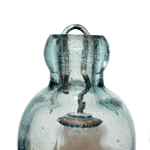 |
Hutchinson Closure, circ: 1879-1915, Occurs on over
20,000 bottles,
Invented by: Charles G. Hutchinson,
American Patent: April 8, 1879, Number: 213,992,
American Patent Reissued: June 17, 1879, Reissue Number: 8,755,
American Patent: September 16, 1879, Number: 219,729,
American Patent: March 16, 1880, Number: 225,476,
This closure was the standard in North America during the later
Nineteenth and early Twentieth Centuries, but had very little
market penetration in the rest of the world. This was an
improvement to Matthews' gravitating stopper and worked on the
same principle. When the stopper was raised, the pressure of the
carbonated contents sealed the rubber gasket against the base of
the neck. Unlike Matthews, it was cheaper and more efficient to
use. Also, the bottle did not have to be filled upside down. To
bottle, the stopper was put in the downward position, the
contents were injected into the bottle with a nozzle. This
nozzle contained a hook that grabbed the top loop of the stopper
and pulled it upward thus sealing the bottle. Health laws
and bottle filling automation sealed the fate of this stopper,
which tended to accumulate dust and dirt above the stopper and
had to be filled manually. It was replaced by the crown
cork closure did not have the sanitary problems and was well
suited to automatic bottling machines, which allowed for reduced
costs. |
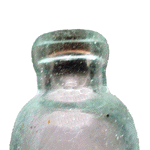 |
Roorbach 1885 or Twitchell
Floating Ball Closure, circ: 1885-1905, Occurs on 115 bottles,
Invented by: William L. Roorbach, Selden Twitchell,
American Patent: June 23, 1885, Number: 320,701,
American Patent: August 4, 1885, Number: 323,737,
American Patent: April 10, 1888, Number: 380,957
This stopper was an improvement to Roorbach's 1883 patent. The
improvement consisted of a floating hollow composite rubber
ball that pressed against a rubber washer imbedded in the lip
of the bottle. Examples of this closure can be found
across the United States and bottles often have the patent
dates embossed in a ring around the base of the bottle and
have the letters, "F. B. S." for "Floating Ball
Stopper" on the base. The stopper was marketed by
Twitchell & Brother, a bottlers supply company of
Philadelphia. |
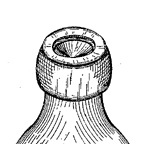 |
Bottle Seal or Baltimore Loop Seal Closure, circ: 1885-1905,
Invented by: William Painter,
American Patent: September 29, 1885, Number: 327,099,
This stopper enjoyed moderate success, but was more popular in
some areas of than in others. It consisted of a disk, made
of a flexible material, that was inserted into a thin groove in
the lip of the bottle. It was replaced by Painter's
more popular crown cork stopper. |
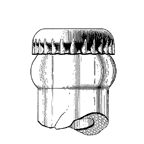 |
Crown Cork Seal Closure, circ: 1892-1920,
Invented by: William Painter,
American Patent: February 2, 1892, Number: 468,226,
This stopper did not enjoy immediate success. It consisted
of a metal cap that had a crimpled edge that when compressed
secured the cap to a specially designed lip. A cork liner
prevented contamination of the contents from the metal cap. By Prohibition, it was the standard as it was
easily adapted to automated bottling lines.
|
The following closures achieved moderate market success and were used
on between 5 and 100 different bottles:
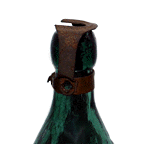 |
Allender Closure, circ: 1855-1865, Occurs on
17 bottles,
Invented by: Jonathan Allender,
American Patent: July 24, 1855, Number: 13,338,
This stopper is the earliest known application of an cork
retainer stopper. It consisted of a sheet metal bail that
secured the cork inside the neck of the bottle. The gauge
of the metal varies greatly on this closure. Some
stoppers are impressed on the collar " ALLENDERS PATENT JULY 24 1855 / MANUF'D BY S. A. BAILEY / NEW LONDON CT". |
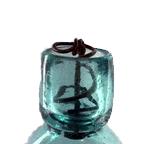 |
Albertson Closure, circ: 1862-1865, Occurs on 21 bottles,
Invented by: Albert Albertson,
American Patent: August 26, 1862, Number: 36,266,
American Patent Reissued: October 30, 1866, Reissue Number: 2,386,
This stopper is the earliest known application of an
internal stopper. It consisted of a spring that pushed a
disk against the inside neck of the bottle. Being
cumbersome to fill and dispense, this stopper never achieved any
level of success and was not used by any bottler for an extended
period of time. The Gravitating closure was the successor
product and was adopted by some of the Albertson users. |
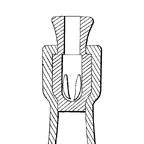 |
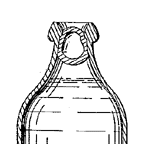
Combination Bottle Closure, circ: 1863-1865, Occurs on 5 bottles,
Invented by: William A. Shaw,
American Patent: December 17, 1861, Number: 33,964,
American Patent Reissued: November 24, 1863, Reissue Number: 1,576,
This stopper was only used in the Boston area. All of
the bottles bear the patent date and have a unique inverted lip
with a groove in it. |
 |
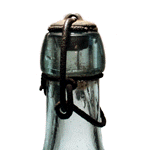
ABC Closure, circ: 1864-1867,
Occurs on 13 bottles,
Invented by: Edward Hamilton,
American Patent: January 5, 1864, Number 41,067,
American
Patent: April 5, 1864, Number 42,188,
An early stopper that consisted of a hollow soft rubber ball
that was pushed into the neck of the bottle by the pressure of
the contents. The patent
was assigned to the Automatic Bottle Closing Company of New
Haven, Connecticut and all known bottles bear the "A. B. C. Co."
embossing. These bottles
are distinctive in shape and are also marked with the patent date.
A number of different bottlers experimented with this closure,
but none adopted it. |
 |
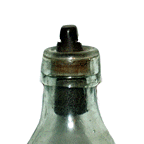
Lightning Closure, circ:
1875-1910,
Invented by: Charles De Quillfeldt, assigned to Karl Hutter,
American Patent: January 5, 1875, Number: 158,406,
American Patent Reissued: June 5, 1877, Reissue Number: 7,722,
This stopper revolutionized beer bottling and was an almost
instant success for Karl Hutter who acquired the patent rights
and popularized this stopper when it was reissued in 1877. In
1878, Henry Putnam also acquired and interest in this stopper
and in 1882 adapted it for use on fruit jars. There were many
imitators of this patent over the years, but they all worked on
the same principle of leveraging a rubber disk into the lip of
the bottle to make a seal. This closure was occasionally
used on soda and mineral water bottles and most often on quart
sized bottles. |
 |
Christin Closure, circ: 1875-1880,
Occurs on
24 bottles,
Invented by: Arthur Christin,
American Patent: April 13, 1875, Number 161,863,
This stopper was an adaptation of the Gravitating closure.
The variation was that the stopper was longer and could not
invert when installed and had grooves that allowed the stopper
to be pulled into place. Although the patent says the
stopper was to be of glass, it was quickly switched to a
composite rubber material. Also unlike the Gravitating it had an
imbedded rubber ring in the lip of the bottle where the stopper
wedged against creating the seal. |
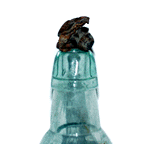 |
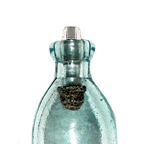
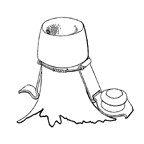
Bullet Closure, circ: 1879-1900, Occurs on 5 bottles,
Invented by: Henry Barrett & John Bailey,
American Patent: May 6, 1879, Number: 214,987,
This was another English import that was very popular in England
and the British Empire, but never achieved success in North
America. Two examples are known form Philadelphia and the
rest are from Canada. The stopper on the example is
sitting on the top of the bottle. Normally, the stopper
would be in the neck to make the seal. |
 |
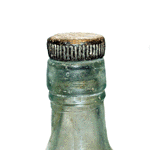
Susemihl Closure, circ:
1879-1885, Occurs on
10 bottles,
Invented by: Herman Susemihl,
American Patent: July 8, 1879, Number: 217,425,
This closure was another variation of the bail stopper.
The stopper consisted of a brass disk with a rubber disk that
was attached to a securing wire around the neck on one side and
could swing over the top of the lip and was secured by a clip on
the other side. This closure was marketed as the
"favorite Stopper." |
 |
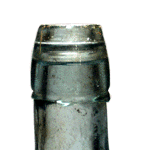
American Screw Closure, circ: 1880, Occurs on 78 bottles,
Invented by: Henry Barrett,
American Patent: August 3, 1880, Number: 230,605,
Another English import, this stopper was never popular in the
United States, however it was widely accepted in England and its
colonies. A composite stopper was screwed into the lip of the
bottle, which had screw threads on the inside. In the United
States this closure was known as the "American Screw Stopper." |
 |
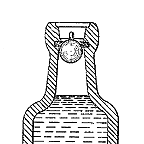
Roorbach 1883 Closure, circ: 1883-1885, Occurs on
10 bottles,
Invented by: William L. Roobach,
American Patent: February 20, 1883, Number: 272,775,
This closure was the first successful idea of William Roorbach
and was only used in the metropolitan Philadelphia area.
It was quickly replaced by Roorbach's 1885 patents, which were
much more successful. The stopper was a solid marble that
sealed against an imbedded rubber washer in the lip. These
bottles also have two indents near the base of the bottle where
the marble would lodge when pouring the contents out of the
bottle. |
 |
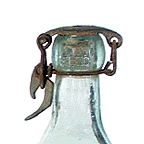
Sykes Closure, circ:
1883-1885, Occurs on
9 bottles,
Invented by: Richard Sykes and William W. Macvay,
English Patent: February 22, 1877, Number: 738,
American Patent: May 15, 1883, Number: 277,758,
This was another English import.
This closure was a variation of the Codd closure. Instead
of the marble being secured in the neck, there were indentations
in the base that held the marble when the contents were being
poured out. Another improvement was a soft metal washer
that screwed into the lip of the bottle and could be removed to
extract the marble. All of the American bottles were manufactured
at the Hawley Glass Works in Northeast Pennsylvania. |
 |
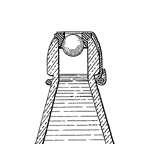
Thatcher Closure, circ: 1883-1895, Occurs on 37 bottles,
Invented by: Frederick B. Thatcher and Joseph W. Johnson,
American Patent: August 21, 1883, Number: 283,436,
American Patent: March 3, 1885, Number: 313,253,
This stopper was was a deviation of earlier bail stoppers and
was only used in the New England area. It was one of the
few bail style closures that was used on soda and mineral water
bottles. The latter patent was assigned to the Aetna
Stopper Company of Pawtucket, Rhode Island. |
 |
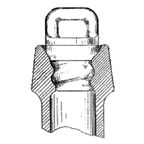
Stewart Closure, circ: 1885-1890, Occurs on
15 bottles,
Invented by: William Stewart,
American Patent: Jun 16, 1885, Number: 320,189,
American Patent: April 6, 1886, Number: 339,592,
This closure was a floating ball stopper. The floating
ball stopper sealed against a rubber washer secured in the lip
of the bottle. This stopper was a competitor to the
Twitchell Floating Ball Stopper, which was much more successful. |
 |
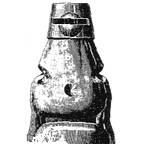
Riley Screw Closure, circ:
1885-1915, Occurs on 22 bottles,
Invented by: Frederic George Riley,
English Patent: July 7, 1885, Number: 8,198,
This closure was another English import that never became
successful. Riley improved the inside
screw stopper by adding a protrusion to the top of the stopper
that allowed for easier opening. |
 |
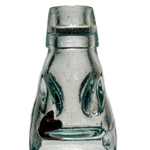
Rylands' Acme Closure, circ: 1886-1900, Occurs on
5 bottles,
Invented by: Dan Rylands,
English Patent: February 8, 1886, Number: 1,811,
This closure was sold by Dan Rylands of Barnsley, England.
This closure was an improvement to Rylands earlier Reliance
patent. The improvement consisted of a dimple in the neck.
This dimple and the lugs were meant to restrain the marble when
the bottle was being cleaned with a brush. |
 |
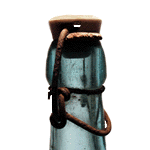
Niagara Closure, circ:
1887-1930, Occurs on
18 bottles,
Registered by: Barnett & Foster,
English Registration: January 15, 1887, Number: Rd
65,433,
This closure was sold by Barnett & Foster of London, England.
This closure was not patented, but the design was
registered. It was an improvement on the Codd closure, which
consisted of lugs on both sides of the neck to hold the marble
stopper when the contents were poured out. |
 |
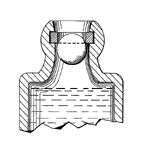
Hutter Closure, circ:
1893-1920,
Invented by: Karl Hutter,
American Patent: February 7, 1893, Number 491,113,
American Patent: June 16, 1896, Number 562,225,
American Patent: April 13, 1897, Number 580,456,
This stopper was an improvement to the Lightning stopper and was
extremely popular and eventually replaced the Lightning as the
preferred beer bottle stopper. A tapered porcelain plug was
fitted with a rubber washer on the bottom and forced into the
lip of the bottle to seal it. This stopper was replaced with the
crown cork. It was rarely used on soda and mineral water bottles
and was mostly used on quart sized bottles. |
 |
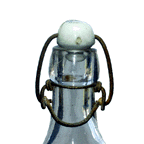
Thomas or Thasmo Closure, circ: 1895-1905, Occurs on
37 bottles,
Invented by: Frederic R. H. Thomas,
American Patent: April 23, 1895, Number: 537,946,
American Patent: December 10, 1895, Number: 551,102,
This closure was another improvement to the glass ball stopper
that sealed against a rubber disk in the lip of the bottle.
The improvement was that the marble jammed in the shoulder of
the bottle when the contents were poured out. |
 |
Strebel's Globe Closure, circ:
1903-1920,
Occurs on
13 bottles,
Invented by: Louis Strebel,
American Patent: April 14, 1903, Number 725,505,
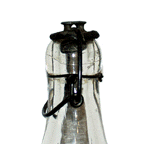
This stopper was a slight deviation from the Hutter closure.
Instead of the inverted cone shaped porcelain stopper of
Hutter, this one has a rounded top. This was an
accommodation
for Strebel's bottling machine patented number 723,065 on
March 17, 1903. According to the patent, the stopper was
meant for carbonated beverages or for use on bottles that used
the Hutter stopper. The stopper was advertised as the
"Globe" and together with his bottling machine were
advertised as late as 1915. |
 |
Strebel Closure, circ: 1903-1905,
Occurs on
6 bottles,
Invented by: Louis Strebel,
American Patent: May 12, 1903, Number 728,142,
This stopper was a slight deviation from the Lightning
closure. The variance being in the stopper portion of
the closure, which consist of a different style of the loop
that holds the eccentric. This closure was also connect
to one of Strebel's bottling machines. According to the
patent a "forked shoe" in the bottling machine would
engage the stopper to lift and close it. The stopper and machine were intended for the bottling of carbonated
beverages. |
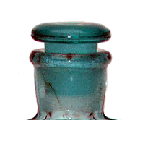 |
Ground Glass Closure, circ:
1905-1920, Occurs on
17 bottles,
This closure was utilized on later mineral and spring water
bottles of a gallon and larger sizes. |
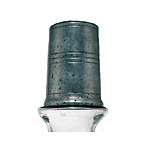 |
Metal Cap Closure, circ:
1850-1920, Occurs on 41 bottles,
This closure was utilized on syrup bottles that serviced soda
fountains. These caps could be used to measure the syrup
that was placed in the glass prior to filling it with
carbonated water. |
The following closures were used to seal soda bottles, but never achieved and level of success
or market penetration. They occur on from 1 to 5 bottles. Some were only used by the inventor.
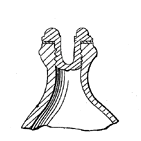 |
Stone Closure, circ: 1861, Occurs on 1 bottle,
Invented by: Amasa Stone,
American Patent: August 7, 1855, Number:
13,402,
American Patent: June 16, 1861, Number:
32,590,
This 1861 patent is actually for a device to insert an inside
screw cap into the bottle and utilized Stone's 1855 patent for a
device to tool the threads into the neck of the bottle. Only one example has
been found and it like that it was a salesman's sample as it is
not embossed with a bottlers name. |
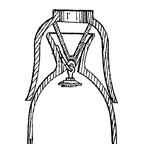 |
Robinson Closure, circ: 1865, Occurs on 1 bottle,
Invented by: Robert Robinson,
American Patent: March 14, 1865, Number: 46,864,
This closure was the first of two stoppers that were attempted
by Robert Robinson of Brooklyn and has to be the most
impractical of the stoppers ever to see commercial use. It
consisted of cup that covered the neck that flared to about two
inches. Inside the neck was rubber disk that was attached
to a hinged metal fingers that pressed against the outward
flaring neck and pulled the rubber disk into the base of the
neck securing the contents. Only one example has ever been
found and it is damaged. |
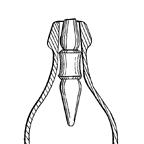 |
Robinson Closure, circ: 1867, Occurs on
2 bottles,
Invented by: Robert Robinson,
American Patent: April 16, 1867, Number: 63,942,
This closure was the second commercial application by Robert
Robinson of Brooklyn. The stopper consisted of a glass rod
that was covered at on end with a composition material.
The stopper sealed the content when it was wedged in the neck of
the bottle.. . |
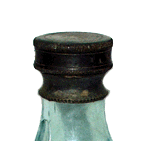 |
Wattis Closure, circ: 1868, Occurs on 1 bottle,
Invented by: Edward Wattis, Jr.,
American Patent: January 21, 1868, Number:
73,680,
This patent is actually for attaching metal threads to a glass
bottle. Only one example has
been found and it is likey that it was a salesman's sample as it is
not embossed with a bottlers name. This closure is more
commonly found on whiskey flasks embossed with Wattis' name on
the base. |
 |
Weatherbee Closure, circ:
1869-1880, Occurs on
3 bottles,
Invented by: Ephraim Weatherbee,
American Patent: May 11, 1869, Number: 90,037,
American Patent: April 11, 1871, Number:113,603,
This closure was an improvement on the popular Putnam cork
fastener by Ephraim Weatherbee of Worcester, Massachusetts. The improvement was to add a 90 degree bend to
the wire cage in a downward angle that covered the cork. This acted as stop
that centered the stopper over the cork and was done to address
a documented issue with the Putnam stopper where the wire cage
could over shoot its optimal position. Weatherbee followed
up with an improvement to his cork fastener in 1871. |
 |
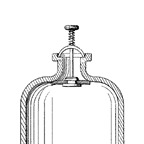
Otto Closure, circ: 1871-1895, Occurs on
1 bottle,
Invented by: George Otto and George W. Bauer,
American Patent: July 4, 1871, Number:
116,742,
This closure was an improvement on the popular Putnam cork
fastener by George Otto, a Washington, D. C. bottler, and George
W. Bauer, a Washington bowling saloon owner. The improvement was to add a 90 degree bend to
the wire cage in an upward angle that covered the cork. This
was to facilitate the opening of the bottle by providing a lever
the user could push with their thumb or finger. |
 |
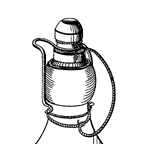
Schultz Closure, circ: 1872, Occurs on 1 bottle,
Invented by: Peter E. Malmstrom and Paul E. Dummer,
American Patent: February 20, 1872, Number: 123,920,
This closure appears on one bottle of F. Solyer of Galveston,
Texas and is marked with the name of Carl H. Schultz, who was
a mineral water manufacturer in New York
City and perhaps was trying to expand into the bottling supply
business. This closure was patented by Peter Malmstrom and
Paul Dummer both of New York city. The relationships between these
two individuals and Schultz is not known. It is interesting that Schultz did not use
the stopper that bears his name. |
 |
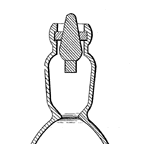
Schrink Closure, circ: 1875, Occurs on 1 bottle,
Invented by: John Schrink,
American Patent: June 22, 1875, Number: 164,879,
This closure was a variation on the cork stopper. It was
only used by a Wisconsin firm.
It consisted of a glass plug stopper with a composition band
that was forced into the mouth of the bottle by a Putnam style
wire bail. The composition band, between the stopper and the
mouth of the bottle, created the seal. The
bottle is indistinguishable from a Putnam closure without the
glass stopper. |
 |
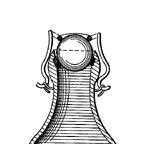
Kelley Closure, circ: 1878, Occurs on
4 bottle,
Invented by: William H. Kelley,
American Patent: February 5, 1878, Number: 199,980,
This closure was a variation of the gravitating stopper. It was
only used by Ephraim L. Billings of Sacramento, California.
It consisted of a glass teardrop shaped stopper that sealed
against a rubber washer in the neck of the bottle. The
bottle is accentuated by having a square neck. It is not
known how Kelley of Cleveland, Ohio and Billings of Sacramento
were related. |
 |
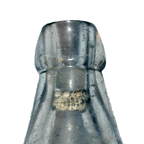
Anderson Closure, circ:
1879-1880, Occurs on
1 bottle,
Invented by: Henry Blossom Anderson,
American Patent: November 11, 1879, Number: 221,491,
This closure was a different application of a ball stopper and wire bail stopper.
The stopper consisted of a rubber gasket cemented in the
lip. On the top of the bottle a round glass or pottery
marble sat and sat in the rubber gasket forming the
seal. This marble was held in place with a wire bail mechanism.
This closure only appears to have been used by Anderson himself
in Saint Louis. |
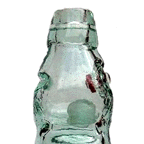
 |
Lamont Closure, circ:
1880-1910, Occurs on 1 bottle,
Invented by: John Lamont,
English Patent: June 19, 1880, Number: 2,488,
This stopper was a variation of the bullet closure. It
can be a glass or composition bullet shaped stopper with a rubber gasket attached to
one end that sealed the contents when it wedged in the neck of
the bottle. This stopper was only used in the United
States by Lo Bue &
Company of Buffalo, NY. |
 |
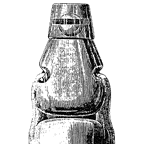
Rylands' Valve Closure, circ:
1881-1890, Occurs on 4 bottles,
Invented by: Hiram Codd and Dan Rylands,
English Patent: July 8, 1881, Number: 3,252,
English Patent: October 25, 1882, Number: 2,118,
English Patent: 1882, Number: 3,525,
American Patent: January 9, 1883, Number: 270,392,
English Patent: November 19, 1883, Number: 5,445,
English Patent: November 20, 1884, Number: 15,281,
English Patent: January, 1885, Number: 348,
English Patent: January 14, 1887, Number: 649,
English Patent: January 20, 1887, Number: 876,
American Patent: May 24, 1887, Number: 363,768,
English Patent: July 12, 1887, Number: 9,771,
American Patent: January 24, 1888, Number: 376,916,
This closure was sold by Dan Rylands of Barnsley, England.
This closure consisted of a glass valve with rubber washer that
was on the side of the neck. Releasing the valve relieved
the pressure and allowed the marble stopper to fall freely from
its seal in the lip. This bottle was only used by the
Tahiti Lemonade Works and its successor the Tahiti Lemonade
Works Company in Sunny South on Oahu Island in Hawaii. |
 |
Rylands' Reliance Closure, circ:
1884-1890, Occurs on 1 bottle,
Invented by: Dan Rylands,
English Patent: January 10, 1885, Number: 348,
This closure was sold by Dan Rylands of Barnsley, England.
This closure was a deviation of the Codd closure with two
smaller lugs on the side of the bottle. This bottle was
only used by the Tahiti Lemonade Works in Sunny South on Oahu
Island in Hawaii. |
 |
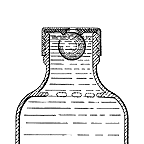
Bernardin Closure, circ:
1885-1920, Occurs on
2 bottles,
Invented by: Alfred L. Bernardin,
American Patent: March 24, 1885, Number
314,358,
This closure was only
found on soda and beer bottles intended for reuse and was mainly
used as a cheap cork fastener on wine and liquor bottles that
were not intended to be returned. The current example was
on a sample bottle given away at a jubilee in Chicago. Since the
stopper needed to be removed and there was no way to reattach it
as it was destroyed in the process, it is normally only found on
bottles that were never opened. |
 |
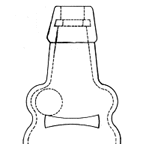
Beardsley Closure, circ: 1885-1886, Occurs on
1 bottle,
Invented by: William Beardsley,
American Patent: May 12, 1885, Number: 317,705,
This closer was only used by its inventor William Beardsley.
It was also based on a glass marble that sealed the contents.
In this case, the stopper sealed against a screw on cap that had
a hole in it. There were indentations on the side of the
bottle that held the marble as the contents were being poured
from the bottle. |
 |
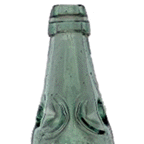
Rylands' Bulb Closure, circ:
1885-1890, Occurs on 2 bottles,
Invented by: Hiram Codd,
English Patent: October 16, 1885, Number: 12,337,
This closure was sold by Dan Rylands of Barnsley, England.
This closure was an improvement by Hiram Codd to his popular Codd
stopper, which was coming off its patent protection. The
improvement consisted of large bulb to restrain the marble
instead of lugs on the side of the neck. Rylands' use of
this closure is questionable. This closure was
only used by two bottlers in Hawaii. |
 |
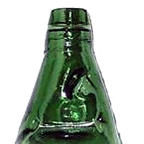
Rylands' Premier Closure, circ:
1885-1890, Occurs on 2 bottles,
Invented by: Dan Rylands and Hiram Codd,
English Patent: Unknown,
This closure was sold by Dan Rylands of Barnsley, England.
This closure was an improvement to the Codd stopper and was
first used while Codd and Rylands were still partners.
Unlike the Codd, the marble stopper was not trapped in the neck,
but could fall to the base of the bottle. Some versions
have the indentations at the base of the bottle. This closure was
only used by two bottlers in Hawaii. |
 |
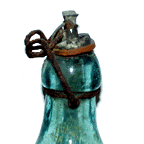
Rylands' Safe Groove Closure, circ:
1886-1915, Occurs on 1 bottle,
Invented by: Dan Rylands,
English Patent: Unknown,
This patent was not for the closure, but for the tool used to
form the groove in the lip that held the rubber gasket.
Bottles with this marking were sold by Dan Rylands of Barnsley, England.
Rylands filed the patent because he lost a lawsuit brought by
Hiram Codd for infringement of Codd's 1873 patent for a tool
to make the groove. Unless so marked, Safe Groove
bottles are undistinguishable from the
nxcormal Codd or globe closures. This
closure was only used by one bottler in California. |
 |
Lloyd Closure, circ: 1886-1895, Occurs on
5 bottles,
Invented by: Edwin L. Lloyd,
American Patent: July 20, 1886, Number: 345,910,
This closure was a variation of bailed closures. The
stopper was attached to the bail via a loop on it. This
stopper was only used on soda bottles unlike his earlier stopper
that was used on beer bottles. |
 |
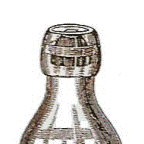
Beardsley 1887 Closure, circ: 1887-1888, Occurs on
1 bottle,
Invented by: William Beardsley,
American Patent:
July 5, 1887, Number: 365,961,
This closer was only used by its inventor William Beardsley.
It was an improvement on his earlier 1885 patent.
He got rid of the screw stopper and replaced the seal with a
rubber gasket in the lip of the bottle. There continued to
be indentations on the side of the bottle that held the marble
as the contents were being poured from the bottle, but these are
not illustrated in the patent drawings. This bottle was a
very close infringement on the Codd and some of the related
patents. |
 |
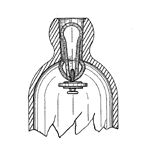
Haley's Automatic Bottle
Stopper, circ: 1888-1890, Occurs on
2 bottles,
Invented by: Charles C. Haley,
American Patent Applied: approx: December 22, 1887,
This closure was invented by Charles C. Haley. This bottle
was to be used with Haley's Duplex Filling Machine, which he
applied for a patent on December 22, 1887. This filling
machine mentions bottles with internal stoppers and Haley
advertised his new stopper with his new filling machine in the
January 1, 1888 in the National Bottlers' Gazette. He
stated that both were patented, even though the filling
machine was not granted a patent until over a year later on
January 29, 1889. We have to assume that the patent for
the bottle was never granted. The stopper was comprised
of a "half sphere of hard rubber, fitted with an
ingenious valve stem" that allowed the pressure to be
relieved when pressed. The stopper was sealed against a
rubber washer in the lip of the bottle. Both examples of
Haley's that used this stopper had indentations in the base of
the bottle. |
|
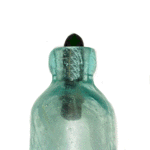
H. & H. H. Closure, circ:
1889-1895, Occurs on
2 bottle,
Invented by: Charles C. Haley,
American Patent: April 23, 1889, Number: 402,078,
American Patent: June 17, 1890, Number: 430,285,
This stopper was a variation of the Hutchinson closure.
The improvement was in that the stopper had two loops that
attached to a disk that could swing, unlike the Hutchinson
disk, which was fixed. Both patents were assigned to
Henry A. Haussling and Adell A. Haley, both of Newark New
Jersey. This stopper was marketed by the E. Berghausen
Chemical Company of Cincinnati, Ohio. |
 |
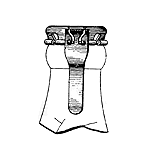
Roorbach 1890 Closure, circ: 1890, Occurs on
4 bottles,
Invented by: William L. Roorbach and George W. Tucker,
American Patent: June 3, 1890, Number: 429,482,
This stopper was a variation of the Gravitating closure.
The improvement was in that the stopper was made of a composite
rubber material and floated instead of sank like glass stopper
of the Gravitating closure. This stopper was only used by
George W. Tucker of Philadelphia, who was on of the patentees.
This stopper became the Trademark of the Pennsylvania Bottling &
Supply Company of Philadelphia and is embossed on their bottles. |
 |
Kork-N-Seal Closure, circ:
1911-1945,
Occurs on 1 bottle,
Invented by: George Albert William,
American Patent: June 5, 1906, Number 822,567,
When he cut his hand while trying to open an ginger ale
bottle, George Williams vowed to invent a better
closure. He got his idea in 1901 and continued to refine
it as a pass time. He patented it in 1906, organized the
Williams Sealing Corp. on October 19, 1909, refined the
machinery to make the closure, and sold them commercially
starting in 1911. An initial reseller was the Illinois
Glass Company in 1911 as illustrated in their catalogue of
that year. The initial factory was located
in Waterbury, CN, but a factory was later opened in Decatur.
IL, to be closer to the customers. The closure became
popular as a resealing device on crown top beer and soda bottles and was being
used during the Second World War. It was used as a
primary closure on medicine and cosmetic bottles. |
| Want more information? Get a book: |
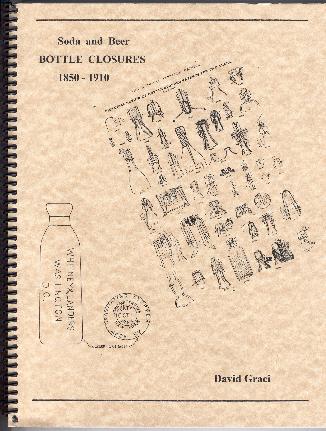 |
Soda and Beer Bottle Closures 1850-1910 David Graci 2003 This book covers the subject of mainly American soda and beer bottle closures that were used by bottlers and brewers. A decade by decade history is provided as well as numerous illustrations and pictures. |
$24.95
 |
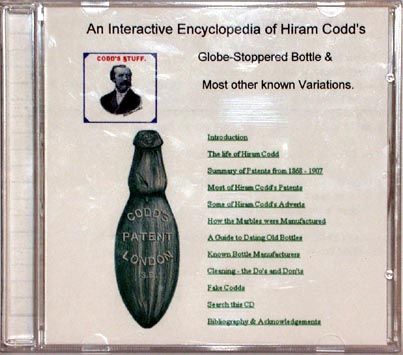 |
Codd's
�tuff Mark Potten 2007 An interactive encyclopedia of Hiram Codd's Globe
stopper bottles and most other known variations. This CD-based web site covers Hiram Codd's
life, a summary of over 150 known UK mineral water bottles, original patents and advertisements, marble
manufacture, dating old bottles, bottle makers, cleaning, fake Codd bottles and much, much more. |
�15.00
|
|
|





