|
|
|
Bottle Attributes Beer & Soda Bottle Manufacturers
A bottle's manufacturer can say something about a bottle's age.
The following is a list of manufacturers that marked pottery
and glass soda and beer
bottles, a brief history, their years of operation, and
manufacturer marks. Click to view geographically.
Click to view
directory listings of selected glass making regions.
If you have additional information on the works listed below, have a
picture of a factory, find a
mistake or disagree with the information that is provided please feel
free to email us at Sodas and Beers.
The following manufacturers appear on pottery soda and beer bottles:
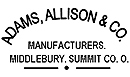 |
Adams, Allison
& Company,
(approx: 1868-approx: 1872),
Akron, OH, United States,
Occurs on
2 bottles, 
Manufactured beer bottles. Frank Adams
was a sewer pipe manufacturer in Middlebury, which later
became a part of Akron. Byron Allison was mustered out of the
Union forces in 1864 and in 1870 was listed as a stoneware
manufacturer. He later went on to form what became Akron Fire
Brick Company in 1873 with Delos Hart as Allison & Hart. Adams was know to be involved in
a number of ventures in Middlebury and it appears that
sometime about 1870 he partnered with Allison to set up this
company. Beer bottles and fruit jars are known
products. The impression is usually
near the base of the bottle.
Notes |
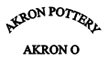 |
Akron
Pottery,
(1861-1887),
Akron, OH, United States,
Occurs on
6 bottles,
Manufactured beer bottles. Edwin H. and Henry
E. Merrill established the Akron Pottery in 1861 in Akron,
Ohio. The company was incorporated into the E. H.
Merrill & Company in 1887. The impression is usually
near the base of the bottle. |
 |
Aliff, Noah,
(approx: 1868-approx: 1875),
Mound City, Il, United States,
Occurs on
2 bottles,
Manufactured beer bottles. The Mound
City Pottery was established by Cornwell Kirkpatrick in 1857.
Kirkpatrick was no doubt attracted by an inexhaustible supply of superior potters' clay.
This venture failed in 1859 due to mismanagement of the
managing company and Kirkpatrick went to Anna and established
a successful pottery business. By 1860, H. H. Hainer owned the
pottery and attracted Moses Aliff from Westbrook, Maine, where
Moses was a potter for at least 10 years at John T. Wilson's
pottery. In late June or early July of 1860 Noah Aliff
left Gardiner, Maine and joined Moses in Mound City. In
Gardiner Noah worked at Frank A. Plaisted's pottery. About
1865, a Mr. Koch operated the Mound City pottery, but by 1866
the firm was known as M. & N. Aliff. By 1870, Noah
was listed as operating the stoneware factory in Mound City,
was living with Moses' wife, and Moses could not be
found. In 1880, he and two nephews were listed as
potters, not manufacturers, in Pulaski Precinct. No
other records were found other than Moses shows up in Larned, Kansas
in 1895. The impression is on the shoulder of the bottle.
Notes |
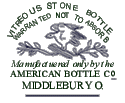 |
American Bottle Company,
(approx: 1890-approx: 1910),
Middlebury, OH, United States,
Occurs on
1 bottle,
Manufactured beer bottles. Not sure if
this company is associated with the American Bottle Company
that made glass bottles in Newark, Ohio. The impression is
near the base of the bottle. |
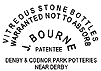 |
Bourne,
Joseph,
(1812-approx: 1851),
Denby, Derbyshire, England
(1812-approx: 1851),
Occurs on
5 bottles,
Belper, Derbyshire, England (approx:
1823-1834),
Codnor Park, Derbyshire, England (1833-approx: 1851, closed
1861),
Shipley, Derbyshire, England (1845-approx: 1851, closed 1856),
Manufactured beer bottles. Joseph
Bourne came from a long line of potters. His grandfather,
Richard Bourne, was associated with the Eastwood pottery in
the mid-Eighteenth century. His father, William Bourne,
took over the Belper Pottery in 1800. In 1806, workmen
excavating a road near Denby found a fine clay in that
area. William Bourne leased the land in order to mine
the clay and have it shipped to the Belper Pottery. In 1809, William
directed an associate, a Mr.
Jager, to set up a small shop and kiln at Denby to be closer to
the clay's source. In 1812, William's son Joseph took over the operations at
Denby, and the two potteries were run in
association with each other. Joseph received patents in
1823 and 1848 for kiln improvements, and became a valuable
asset to the pottery firm. William's last listing in the Pigot
directory is in 1828, although company archives from the Denby
pottery claim that he died in 1823. In 1833, Joseph next
acquired the Codnor Park pottery, established in
1820 and operated by William Burton. In 1834, the Belper pottery was closed and its
operations consolidated at Denby. By 1839, a sales
office was established in London. In 1845, Joseph
acquired the pottery at Shipley, established in 1825. In
1856,
these works were closed and operations moved to
Denby. About 1852, Joseph brought his son Joseph
Harvey Bourne into the firm, and it was known as J. Bourne &
Son. Joseph Bourne died in 1860 and the firm carried on as J. Bourne and Son
. In 1861, the Codnor Park
pottery was closed and its operations moved to Denby. Joseph
Harvey died in 1869, and the company was run by his
widow, Sara Elizabeth Bourne. Sara expanded and diversified the
company's product lines to include insulators and limited
productions of art pottery. She ran the pottery until her death in
1898, when operations were taken over by her nephews Joseph
Bourne Wheeler and John Topham. Topham withdrew from
the firm in 1907 and Joseph Wheeler ran the firm until
his death in 1942. Under Wheeler's guidance, the firm
expanded its wares and modernized its facilities. In 1916, the firm
became a limited liability company and in 2009 celebrated its bicentennial.
Impressed bottles exits from the Bourne firms include the
"Belper & Denby Potteries (1812-1833)," "J.
Bourne, Belper, Denby and Codnor Park Potteries
(1833-1834)," "J. Bourne, Denby and Codnor Park
Potteries (1834-1851)," "J. Bourne & Son, Denby
and Codnor Park Potteries (1852-1861)," and "J.
Bourne & Son, Denby Pottery" (1861-1916),"
Although Shipley was a factory it does not appear impressed on
any bottles. Impression is from a description and may
not be exact.
The impression is
near the base of the bottle.
Notes |
 |
Brady & Ryan,
(1882-1900+),
Ellenville, NY, United States, occurs on
1 bottle,
Manufactured beer
bottles. This pottery was reportedly established in 1829
by Horace Weston.
The business went through a series of owners until January of
1882 when the firm of Brady & Ryan succeeded the short lived
firm of Brady & Craft. Samuel Brady and John J. Ryan were
the owners and were experienced craftsmen. The business
was moderately successful and Brady was still potting in 1900.
The business likely closed soon after and the property was sold
in 1905. The impression is on the reverse of the bottle.
Notes |
 |
Brantford Stoneware Manufacturing Company, Limited,
(1894-1906),
Brantford, ON, Canada, occurs on
3 bottles,
Manufactured beer
bottles. This pottery was established in 1849 as Morton
& Company, with John Morton being the principle and was
located at the corner of Clarence and Dalhousie Streets in
Brantford.
The business went through a series on owners until August 11,
1894, when Dr. David Lowrey, John Hemphill, and Henry Schuler incorporated
the business as the Brantford Stoneware Manufacturing
Co. The business was dissolved in 1906 and the plant
sold in 1907. The mark is on the
heel of the bottle or on the stopper.
Notes |
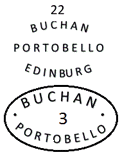 |
Buchan, Alexander W., &
Company,
(1878-1972),
Portobello, Midlothian, Scotland, occurs on
7 bottles,
Manufactured beer bottles. This pottery was erected in the later part of the Eighteenth century. The business passed thru several owners and eventually became a soap works. In the early Nineteenth century, it reverted back to a pottery for the manufacture of stoneware. In 1867, Alexander Buchan
acquired a lease for the property and partnered with T. F. Murray
and for the next ten years potted under the name of Murray &
Buchan. In 1878 Murray withdrew and the firm became A.
W. Buchan & Company. The firm continued well into the Twentieth century. The Portobello pottery closed in 1972, and operations were moved to Crieff,. This location closed in 1999. The impression is near the
base of the bottle.
Notes |
 |
Clark, John, &
Company,
(1826-1828),
Troy, NY, United States, occurs on
1 bottle,
Manufactured beer
bottles. There is not much original source documentation
available on this firm, but many sources state that the firm
only existed for a few years. The impression is on the
shoulder of the bottle.
Notes |
 |
Clark, Nathan, Jr.,
(approx: 1843-1891),
Athens, NY, United States, occurs on
1 bottle,
Manufactured beer
bottles. The Athens Pottery was established soon after
the founding of Athens by Nathan Clark and his brother-in-law
Captain Thomas Howe between 1805 and 1809, according to
various sources. Howe died in 1813 and Clark continued
alone until about 1829, when he partnered with Ethan S. Fox as
Clark & Fox. This partnership lasted until 1838,
when Fox bought the works and continued alone. Later he
sold the works back to Clark. Clark's son, Nathan Jr., was in
control of the works in 1843. The works operated on a
large scale and branches were either established or purchased
in Lyons, Mount Morris, and Rochester, New York. Nathan
Clark Jr. died in 1891 and his son, Nathan E., continued the
works, but was not listed in the pottery business in 1900. The impression is on the
heel of the bottle.
Notes |
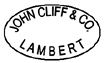 |
Cliff, John,
& Company,
(1857-1869),
Lambeth, London, England, occurs on
1 bottles,
Manufactured beer
bottles. The Imperial Pottery was operated by Stephen Green & Co.
until 1857. In that year, the firm became John Cliff
& Company. When the Metropolitan Board required the
property of the works in 1869, John Cliff moved the operation to
Runcorn after gaining full control of the firm. The impression is
near the base of the bottle.
Notes |
 |
Cowden & Wilcox,
(approx: 1862-aprox: 1885),
Harrisburg, PA, United States, occurs on
3 bottles,
Manufactured beer
bottles. Cowden & Wilcox were first listed together
in a September 1, 1862 Federal Tax list in Harrisburg.
The pottery was located on the banks of the Pennsylvania Canal
at Herr Street.
In the 1860 Census, John Cowden was listed as a journeyman in
Harrisburg and Isaac Wilson resided in Lyons, New York, possibly
working at Thompson A. Harrington's pottery. In 1867,
Cowden's son, Frederick H. Cowden, who worked at the
pottery since 1862, joined the firm as a partner. John
Cowden died in 1872 and Frederick took his father's
place. Isaac Wilcox retired in 1885 and the firm was
soon after renamed F. H. Cowden. From 1895 to 1915 the pottery was
known as F. H. Cowden & Son. The impression is on the shoulder of the bottle.
Notes |
 |
Crolius, Clarkson,
(approx: 1797-1837),
New York, NY, United States, occurs on
3 bottles,
Manufactured beer
bottles. Clarkson Crolius was one in a long line of
stoneware potters that started with Georg Corcilius who immigrated
to America between 1718 and 1724. His daughters Veronica and Anna, married Johan
Willem Crolius and Johannes (John) Remmi (Remmey).
Johannes Crolius, born in 1733, was the fourth child of Johan
and Veronica Crolius. Johannes (John) Crolius and Maria
Clarkson were the Parents of Clarkson, who was born in
1774. The Crolius' pottery was located on Reade Street
near Broadway at a location called Potter's Hill.
When the Hill was to be leveled due to development, Clarkson
Crolius, Sr. moved the works to 65 and 67 Bayard Street.
Clarkson Sr. retired from the business in 1837 and Clarkson
Crolius, Jr. took over the business. He discontinued the
manufacture of stoneware at Bayard Street sometime between
1845 and 1849, and the pottery was afterwards demolished.
The impression is below the shoulder of the bottle. |
 |
Darrow & Sons,
(approx: 1854-approx: 1872),
Baldwinsville, NY, United States,
occurs on 2 bottles,
Manufactured beer
bottles. John Darrow built an earthenware pottery
between the Erie Canal and Seneca River on the North side of
Baldwinsville about 1845. Three years later, Darrow
moved the pottery to a spot where Crooked Brook Creek crosses Van Buren Road
as a large bank of red clay, used in the production of
earthenware or redware, was found there. About 1852,
stoneware production started with clay shipped from Perth
Amboy, New Jersey. Shortly afterwards, Darrow's sons, Lansing
S. and Edwin S., joined the business as Darrow &
Sons. In 1867, the Darrows installed semiautomatic machinery for the production of flowerpots
and other decorative ware using the red clay next to their
factory. About 1872, Edwin left the firm and it became
J. Darrow & Son. Sometime later and before the works
closed in 1876, Lansing was in sole control of the firm.
The impression is on the shoulder of the bottle.
Notes |
|
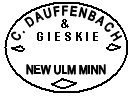
Dauffenbach & Giesecke,
(1870-1873),
New Ulm, Minnesota, United States,
occurs on
1 bottle,
Manufactured beer bottles. When the firm
of Dauffenbach, Stoeckert & Co. dissolved about in
1870, Christian Dauffenbach partnered with William Giesecke as
Dauffenbach & Giesecke. Giesecke was a retired
farmer and was the county sheriff. By 1874, this firm dissolved
and Giesecke's share was acquired by William Winkelmann.
Giesecke went on to be a successful cattle dealer. The impression is
below the
shoulder of the bottle.
Notes |
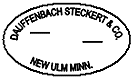 |
Dauffenbach, Stoeckert & Co.,
(1866-1870),
New Ulm, Minnesota, United States,
occurs on
1 bottles,
Manufactured beer bottles. This pottery
was established by Christian Dauffenbach, John Stoeckert and
Franklin Friedmann, who was the silent partner. The
three were immigrants; Dauffenbach and Stoeckert were from
Germany and Friedmann was from Alsace Lorraine. Before
coming to New Ulm, all three were experienced potters.
Dauffenbach worked in Milwaukee as a potter for Frederick Herman.
Stoeckert may have been operating a pottery in Milwaukee in
Milwaukee in 1860 as he had two boarders who were
potters. Friedmann was a potter in Goshen, Indiana, as
he was the only potter listed in that township in the
1860 Census he may have been operating a pottery there.
All three served in the Civil War. Afterwards, Freidman
and his family moved to Cedar Falls, Iowa for about a
year. There he met up with Dauffenbach and they went to
New Ulm in 1866 and teamed up with Stoeckert to found the
pottery there. The three remained together until the
later part of 1870. In the 1870 Industrial Census, the
pottery employed three workers and produced vessels with the
capacity of twenty-eight thousand gallons valued at $3450.
When the firm split up, Dauffenbach partnered with William
Giesecke to continue operating the pottery until about 1873,
when he formed a partnership with William Winkelmann as
Winkelmann & Dauffenbach. They also produced
firebrick. By 1880, Dauffenbach was back in Milwaukee
working as a potter. Friedman went on to be a huckster
and later operated a general store. Stoeckert went on to
operate a second pottery in New Ulm and with his son operated
the pottery into the 20th Century. The impression is
below the
shoulder of the bottle.
Notes |
 |
Denver Stoneware Company,
(1897-1901),
Denver, CO, United States,
occurs on 1 bottle,
Manufactured soft drink jugs. This pottery started about
1881 as the Denver Architectural Terra Cotta Company and went
thru several name changes ending up as the Denver Porcelain & Stoneware Company
in 1896. The following year, it became the Denver
Stoneware Company and remained so until 1902 when Owens Thomas
was listed as the successor to Denver Stoneware Company.
The factory was located at the Northeast corner of Ellsworth
and Santa Fe Avenues. The impression is on the shoulder of the bottle.
Notes |
 |
Doulton & Company, (1854-1956),
Lambeth, England,
occurs on
6 bottles,
Manufactured beer bottles. Prior to 1854
this pottery was operated by Doulton & Watts. This
pottery manufactured a wide variety wares from simple inks and
ginger beer bottles to its elaborate Royal Doulton ware.
The impression is on the heel of the bottle. |
 |
Ebey, George,
(1836-1866),
Winchester, IL, United States,
occurs on 1 bottle,
Manufactured beer bottles. George Ebey came to Illinois in
1828 and worked at a pottery in Springfield, likely that of
his older brother John Neff Ebey, for three years. In
January of 1832 he returned to his native state of Ohio for
about a year and a half and married Matilda J. Kilpatrick.
The couple moved back to Illinois and settled at Manchester,
likely at his brother John N. Ebey's pottery. The
following year, 1834, Ebey bought the Harrison Pottery in
Winchester. Two years later Ebey purchased land 1 mile
North East of Winchester, where he built a stoneware pottery
and operated it with Thomas. M. Kilpatrick. It is not
known how long this partnership lasted, but Ebey was listed as
a sole proprietor until 1866, when the firm name became Ebey
& Davis. Ebey was continues to be listed as a potter
thru the 1880 census. The impression is on the shoulder of the bottle.
Notes |
 |
Ebey, John
Neff,
(1828-1855+),
Springfield, IL (1828-1832),
Manchester, IL (1832-1833),
Ripley, IL (1833-1855),
Winchester, IL (1855+),
occurs on 1 bottle,
Urbana, IL (-1857+),
Chapin, IL (1859-1860),
Winchester, IL (1861-1864),
White Hall, IL (1864-1870),
Manufactured beer bottles. John Neff Ebey had a long
career as a pottery, but was much more transient that his
younger brother George. He came to Illinois in 1828 and
settled in Springfield and appears to have operated a pottery
there until about 1832, when he moved to Manchester in Scott
Count, where he met up with his brother George in 1833.
In that same year, he moved to Ripley in Brown County and
established a pottery for 12 years; his longest time at any
location. He then moves back to Scott County, likely
Winchester, where there is a thriving pottery industry and
near where his brother George was operating. In 1857, he
shows up in Urbana as a pottery with his son. He then
unsuccessfully attempts to establish a pottery at Chapin, in
Morgan County in 1859. In 1861, he is back at Winchester
as John N. Ebey & Co. John Ebey then relocated to
White Hall in 1864 and remained there until his death on
November 20, 1893. Originally the firm was J. N. & L. C.
Ebey, but in 1866 it became Ebey & Bro. The impression is
near the face of the bottle.
Notes |
 |
Eichenlaub, Valentine,
(1853-1857),
Cincinnati, OH, United States,
occurs on 1 bottle,
Manufactured beer bottles. Eichenlaub operated a stoneware
pottery from 1853 to 1857, which he sold and purchased a queens-ware store. The impression is
near the base of the bottle.
Notes |
 |
William Geiger,
(approx: 1860-1870),
Schuylkill Haven, PA, United States, occurs on 1 bottle,
Manufactured beer bottles. Geiger purportedly came to
the United States from W�rttemberg in 1837. He
spent some time in Philadelphia, but by 1850 he was a potter
in Longswamp in Berks County Pennsylvania. By 1860, he
had relocated to Schuylkill Haven and operated a pottery there
until 1870, when he moved to Mahonoy City and continued to run
his pottery and later ran a nursery. Both businesses
operated until 1900, when Geiger died. His widow carried
on the nursery business until 1914. The impression is on
the shoulder of the bottle. Notes |
 |
Glass Brothers & Company,
(1888-1893),
London, ON, Canada, occurs on 1 bottle,
Manufactured beer bottles.
This pottery was an attempt to establish the first large scale
pottery in Canada, similar to works in Ohio. In fact
Samuel F. Glass, one of the founders of the London Crockery
Manufacturing Company, went to East Liverpool, Ohio, to buy
machinery and models in 1886. The lack of available raw
materials in Canada and the expense of importing them from
Canada and two successive fires proved its undoing.
William Glass, William Gray, Samuel F. Glass and Francis H.
Butler were the founding officers when the company was founded
in October, 1886. John H. Glass was the travelling
salesman. The following year, the John H. and Samuel F.
Glass organized the Glass Brothers & Company and acquired the
Works. John H. glass appears to have resigned from the
firm in late 1893 or possibly in early 1894 and it fell under
Samuel F. Glass' sole ownership. A fire in 1895 destroyed the
factory's warehouse and one in 1897 the factory sealed its fate. The impression is near
the base of the bottle. Notes |
 |
Henry Glazier, (approx:
1845-approx: 1875),
Huntingdon, PA, United States, occurs on 1 bottle,
Manufactured beer bottles. Glazier is purported to be the
first stoneware pottery in Central Pennsylvania. Peter
Hoffman was making pottery in Huntington as early as
1796. The exact start date of Glazier's business
is not known, but Henry Glazier was born about 1808 and was
living in Huntingdon in 1840 with other Glaziers. In
1850 he was listed as a potter and remained in the business
until after 1870. It is interesting that John Glazier,
Henry's father, was also a potter and lived next to him.
John was born about 1783 and was living in Huntington as early
as 1810. He may have been the son of David Glazier who
owned a tavern in Huntingdon in 1796. In the 1850
Census, John had a substantially larger real estate holdings then
Henry, but that reversed by 1860. John continued to be
listed as a potter when he was 87! Henry was listed as
retired in 1880 and died in 1888. The impression is on the shoulder of the bottle.
Notes |
 |
Goodwin & Webster,
(approx: 1808-1840),
Hartford, CN, United States, occurs on
3 bottles,
Manufactured beer bottles. There were two potteries on
Front Street in Hartford. The first was an earthenware
pottery built in the 1790's by John Souter at Front and
Potter. He sold it to Peter Cross, who converted it to a
stoneware pottery in 1805. Horace Goodwin and Mack C. Webster purchased this property some time before 1810 and
Cross built another pottery on Front Street. By 1830,
Goodwin & Webster acquired both Front Street potteries and
ran them until 1840 when the firm became M. C. Webster & Son.
The works continued through several owners until about
1900. The impression is on the
shoulder of the bottle. Notes |
 |
Goodwin
Brothers,
(approx: 1851-approx:1865),
Quebec City. QC, Canada, occurs on
2 bottle,
Appears on beer bottles. The Goodwin brothers, Henry and
George, were born in England and immigrated to Quebec
City. By 1851, they were operating a china store and
were later listed as importers and dealers in china and
stoneware. By 1871, the firm was known as George Goodwin
& Company. The impression is near the base of the bottle. Notes |
 |
Govancroft Potteries,
(1911-1982),
Glasgow, Scotland, England,
occurs on 1 bottle,
Manufactured beer bottles. The firm is listed as having
been formed in 1911 or 1912. They manufactured a wide
range of stoneware, but jam jars and whiskey jugs were a
specialty. In later years, decorative wares were
manufactured. The works were last listed at the 1855
London Road address in 1982. The impression is
near the base of the bottle. Notes |
 |
Gunther & Berns,
(1863-1866),
Sheboygan, WI, United States, occurs on 1 bottle,
Manufactured beer bottles. Peter Berns established a
pottery prior to 1860 in Sheboygan. Theodore Gunther
came to the United States in 1855 and initially worked in
Detroit and Milwaukee as a potter, a trade he learned in
France. Gunther & Burns partnered in June of
1863 and built a new pottery on the south side of Wisconsin avenue a short distance west of
Eighth street. The works were called the Eastern
Stoneware Factory. The two remained together until June
28, 1866, when Gunther took sole control of the
business. This was most likely due to the death of Berns,
whose widow remained in Sheboygan. Gunther remained in
business into the late 1880s. The impression is in the center
of the bottle. Notes |
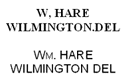 |
Hare, William, (approx:
1837-1885),
Wilmington, DE, United States, Occurs on
2 bottles,
Manufactured beer bottles. hare was purported
to have come to Wilmington and purchased an existing pottery
on French Street. Hare was listed in the 1845 Wilmington
Directory as a potter on French Street between 2nd and
3rd. Later the address was identified as 212 French
Street. Between 1850 and 1860 his capacity tripled
according to Census records. The last directory listing
was in 1885. The impression appears on the
face or near the base of the bottle. |
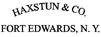 |
Haxstun & Company,
(approx: 1875-1882),
Fort Edward, NY, United States,
Occurs on 1 bottle,
Manufactured
soda jugs. Andrew King Haxstun entered the pottery trade
as a member of Haxstun, Ottman & Company in 1867 and was a
member of the firm until 1872, when he started a wheel
manufacturing business under the name of Haxstun & Griffin.
In 1875, he started another stoneware pottery in Fort Edward
as a part of the firm Haxston & Company. This
company remained in business for eight years until 1882, when Haxstun
left to work in a paper mill. He later manufactured
neats oil. Andrew's son Richard was also involved in both of
the pottery operations and the neats oil business and
continued this after his father's death in 1890. The
impression is on the shoulder of the jug. Notes |
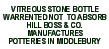 |
Hill, Boss & Company,
(approx: 1870-approx: 1872),
Middlebury, OH, United
States,
occurs on 2 bottles,
Manufactured beer bottles. The firm is firm must have been
a short lived partnership between David Hill, who was
operating a sewer pipe plant in Middlebury in 1870 and the
Boss Brothers, who were manufacturing stoneware bottles in
Middlebury in 1874. Middlebury was absorbed into
Akron. One marked bottle dates 1870-1872. The impression is
near the base of the bottle. Mark is based on a
description and may appear differently. Notes |
 |
Improved Ironstone,
(approx: 1850-approx: 1880),
New Haven, CN, United States,
Occurs on 1 bottle,
Manufactured beer bottles.
No information could be found on this New Haven
manufacturer. Impression is on the face of the bottle.
Details of mark are not verified. |
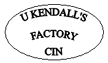 |
Kendall, Uriah,
(1834-1853),
Cincinnati, OH, United States,
Occurs on
2 bottles,
Manufactured beer bottles. Kendall was from
Maine and established his factory on the corner of Race and
Northern Row in Cincinnati. The impression appears on the
face of the bottle. |
 |
Kennedy, Henry,
(1886-1929),
Glasgow, Scotland, England,
occurs on
8 bottles,
Manufactured beer bottles. Henry Kennedy
operated the Barrowfield Pottery. The impression is
near the base of the bottle. |
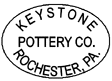 |
Keystone
Pottery Company (1890-1895),
Rochester, PA, United States,
occurs on
3 bottles,
Manufactured beer bottles. William
Miller and his sons along with John Gripp organized the
Keystone Pottery Company in 1890. The firm produced beer
and ink bottles in addition to other wares. One of their
key markets was in Maine. The works burned in 1895 and
were not reopened due to a depressed market for stoneware
bottles. William Miller & Sons then built a brick
yard on the site. The impression is
near the base of the bottle. Notes |
 |
Krumeich,
Francis J.,
(1840-approx: 1846),
Newark, N. J., United States,
occurs on
1 bottle,
Manufactured beer bottles. The
Krumeichs were a family of French Potters who settled in
Newark. Baltharsar Krumeich was the patriarch of this
family in Newark and was operating there before 1835.
Francis J. was a son and joined his father by 1840, but
Baltharsar was not listed in the summer of 1840 when the
Census was taken. It appears that Francis was operating
the business alone in 1840 until being joined by his brothers sometime
before 1848. The impression is near the base of the bottle.
Notes |
 |
Krumeich, Lawrence,
(approx: 1853-approx: 1860),
Newark, N. J., United States,
occurs on
2 bottles,
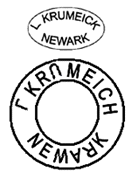
Manufactured beer bottles. The
Krumeichs were a family of French Potters who settled in
Newark. Lawrence was in New Jersey by 1844 and was most likely in a partnership with
Francis and Philip Krumeich in 1850 as they all appear to have
an 800 investment and were potters. By 1859, Philip and
Francis seem to have been at different locations and by 1862,
Lawrence appears to have gotten out of the pottery business
and was manufacturing fire or stove bricks. In 1870, he was
operating a brick yard. Philip appears to have continued
to operate a pottery and was still doing so in 1879. Lawrence
was not listed in the 1880 Census in Newark. Details of
the top mark is not verified.
Notes |
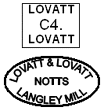 |
Lovatt &
Lovatt,
(1895-1913),
Lovatt & Lovatt, Limited, (1913-1930),
Langley Mill,
Derbyshire, England,
occurs on 22 bottles,
Manufactured beer bottles. This
pottery was established in 1865 by James Calvert for the
manufacture a stoneware utility ware and bottles. In
1883, Albert & John Lovatt joined the pottery and the name
became Calvert & Lovatt. In 1895, the Calvert family
sold its interest in the pottery to the Lovatt brother who
operated under the name of Lovatt & Lovatt. In 1913,
the firm became a limited liability company. The firm
liquated in 1930. Notes |
 |
Macomb
Stoneware
Company,
(1893-1906),
Macomb, IL, United States,
occurs on
1 bottle,
Manufactured
mineral water jugs. This pottery was established as the
Macomb Stoneware & Terra Cotta Company in 1889 by F. J. Blount
Archibald Fisher and B. F. McLean and was known throughout its
history as the Blount Pottery. The company was renamed the
Macomb Stoneware Company and its capital increased from $25,000 to
$50,000 on March 7, 1893. During its peak years, it
employed upwards of 100 workers and made a specialty of white
lined stoneware to competed with German imports. In March of 1906, this
pottery became part of the Western Stoneware Company as Plant 3.
This factory operated until a tragic fire in 1913 destroyed the
plant and took the life of a firefighter. The glazed mark is
usually on the shoulder or can be impressed on the base of the
bottle. Notes |
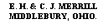 |
Merrill, E. H. & C. J.,
(1847-1861),
Middlebury, OH, United States,
occurs on
3 bottles,
Manufactured beer bottles. Edwin H. and Calvin
J. Merrill established this pottery in 1847 in Middlebury,
Ohio. The Merrills' were issued a patent for pressing
bottles in 1847 and were responsible for manufacturing many of
the early sided pottery bottles used by Midwestern
bottlers. The impression is usually near the base of the
bottle. |
 |
Metcalf, Thomas D.
(approx: 1870-approx: 1890),
Upper Augusta, PA, United States,
(1870-1880)
occurs on
1 bottle,
Purdytown, PA, United States, (1880-approx: 1888),
Manufactured beer bottles. Thomas
Metcalf grew up in Mercersburg, Pennsylvania, where he learned
the pottery trade at Hugh McConnell's pottery. After
serving in the Civil War, he ended up in Sunbury, where he
worked as a potter. There were potteries throughout the
history of Sunbury and perhaps he eventually took over
ownership of one of these, but by the 1880's he had ownership
of the pottery that produced marked stoneware beer bottles.
He died on November 23, 1889 after a yearlong illness.
In 1900, only his widow is listed. The impression is on
the shoulder of the
bottle.
Notes |
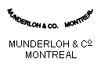 |
Munderloh & Company,
(1870-approx: 1918),
Montreal, ON, Canada,
occurs on 24 bottles,
Appears
on beer bottles. The founder of this firm, Wilhelm Christian
Munderloh, was born in Elsfleth, Germany in 1831.
He came to Montreal in 1857 and worked in the wholesale dry
goods business. Three years later he traveled back to Germany
and on his return to Montreal established his own wholesale
dry goods business in 1861. In 1865, the firm became Munderloh & Steencken
and in 1870 Munderloh & Company. In 1871, W. C.
Munderloh was appointed
consul to Germany and was instrumental in getting direct
steamship routes between Europe and Montreal. As
commission merchants, they represented many leading
manufacturers in Europe including the principle glass makers in Belgium.
They also had offices in London until at least 1915. In
1918, the first reference was found to the firm being
organized as a limited liability company. References to
Munderloh & Company continue into the 1950s. The glazed mark is
usually under the merchants mark and is much smaller.
The impressed mark is usually near the base of the
bottle.
Notes |
 |
Unknown Potter,
(approx: 1845-approx: 1870),
New Berlin, OH, United
States, occurs on
1 bottle,
Appears
on beer bottles. The village of New Berlin was a small
settlement in Plain Township, Stark County, Ohio. A
search of census and other records finds no bottlers or
brewers in the village, however there were distillers and a
cider mill there. Jacob Behl was listed in the 1850
Census as a potter there and in about 1867 Joel Stephens was
recorded as a potter. Stephens pottery was converted to
a tile and sewer pipe works two years after he started and is
not listed in the 1870 Census, but there was a brick
manufacturer there in 1870. The impressed mark is
below the shoulder of the
bottle. Notes |
 |
Pollack Brothers & Company, (approx: 1900-approx: 1920),
Montreal, QE,
Canada,
Occurs on
8 bottles,
Manufactured beer bottles. This firm was not listed in the
1895 Montreal Directory and appears on Canadian glass and
pottery bottles of the period 1900 to 1920. The firm is
reported to have had a branch in Toronto briefly. The markings appear on the base of
the bottle. |
 |
Port Dundas Pottery Company,
(1828-1932),
Glasgow, Scotland, England,
occurs on 1 bottle,
Manufactured beer bottles. This works was
started in 1828 and operated under various owners until it was
taken over by James Miller as James Miller &
Company. By 1857, it was organized as the Port Dundas
Pottery Company. In 1866, steam power was introduced to
turn the potter's wheels. During 1930 the Port Dundas Pottery
Company Limited closed down and was operated until 1932 by
some of its customers. The impression is
near the base of the bottle. |
 |
Possil Pottery,
(1917-1942),
Glasgow, Scotland,
occurs on
1 bottle,
Manufactured beer bottles.
The pottery at Possilpark in northern Glasgow was built in
1875. It went thru several owners and was known as the
Saracen Pottery until 1894 with a change of ownership. In
that year it was named the Possil Pottery. A series of
bankruptcies, starting in 1893, resulted in M'Dougall & Sons
acquiring the works in 1896 and operating it into 1910.
Until that point, various types of domestic ware were produced
and there is no evidence that stoneware bottles were in the
product line. The works went idle until 1916 when J. & R.
Tennent Limited rented the works from M'Dougall & Sons for six
years. The Tennents were brewers and were looking to
purchase a pottery and glass works to secure sources of bottles
during World War I. After extensive renovations, the works
went operation in 1917. In 1919, Tennents decided to
purchase the factory outright and in 1920 they formed a
subsidiary to operate the factory and other business interests
called the Glasgow Trading & Transport, Ltd. The works
produced various pottery products for both the brewery and other
customers. The works were closed in 1942 when the
property and plant were sold to A. & J. Main & Co. Canada
was noted as large market for their ginger beer bottles during
the early 1930s. The impression is near the base of the bottle.
Notes |
 |
Powell, (1780-1906),
Bristol, England
occurs on
4 bottle,
Manufactured beer bottles. The Powells were
producing pottery starting about 1780 and were the second
largest manufactures of stoneware bottles in Britain in
1900. William Powell invented a new form of glazing that
consisted of a cream colored body and tan colored top later
known as a "Bristol Glaze." The Powells merged
with Price, Sons & Company and the firm became Price,
Powell & Company in 1906 and operated under that name
until 1961. The impression appears
near the base of the bottle. |
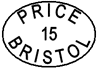 |
Price, (1884-1940),
Bristol, England,
occurs on 52 bottles,
Manufactured beer bottles.
The long history of Prices Pottery starts in 1785 with Charles
Price II, who apprenticed at the pottery of Thomas Patience
and his partner Joseph Gadd. This pottery was at 3 Counterslip and near Price's
father's tavern the Fourteen Stars. Later ads
touted the firm's start date as 1740. Patience died soon
after Price started his apprenticeship and Gadd took over the business. Charles II and
Gadd partnered as Gadd & Price in 1796 and the following
year they moved the pottery to 123 Temple. In 1798, Gadd
died and the following year Price partnered with Joseph Read
as Price & Read. Read died in 1803, but the firm
name remained until 1817, when Price was listed as the sole
proprietor. In 1803 or 1804, Price relocated to the Pottery
of Joseph Alsop at 125 Temple. In 1822, he took his son
Charles III in as a partner to form the firm of Charles Price
& Son. In 1843, another son, likely Joseph, joined
the firm now named Charles Price & Sons. Charles II
died in 1849 and the firm became Charles & Joseph
Price. In 1853, the firm purchased Bright's Pottery at 135 Temple and during the following years
the properties in between. On Charles III's retirement
in 1863, the firm became Joseph & Charles Price &
Brothers. In 1868, the firm brought the pottery of
Milsom & Melsom at 124 Temple. The construction of
Victoria Street caused much loss of property used by the firm
and a new four story factory was constructed in 1875. In
1884, the firm became Price, Sons & Company. The Powells merged
with Price, Sons & Company and the firm became Price,
Powell & Company in 1906 and operated under that name
till it closed. The pottery was destroyed by bombing during
the Blitz attack in 1940 and the firm sold in 1961.
Although the firm was know as Price, Powell & Company in
1906, the Price cartouche continued to be used until at least
the First World War. The
impression appears near the base of the bottle.
Notes |
 |
Remmey, Richard C.,
(1859-1904),
Philadelphia, PA, United States,
occurs on
6 bottles,
Manufactured beer bottles. Richard Clinton
Remmey took over his father's business in 1859. The Remmey pottery was one of the largest stoneware potteries in the U.S.
Between 1865 and 1870, the manufacture of domestic stoneware was gradually abandoned in favor of chemical and Bristol glazed stoneware.
Robert Henry Remmey, Richard Clinton's son, took over the business after his father's death in 1904 and changed the company's name to Richard C. Remmey Son Co.
The impression is usually near the base of the bottle. |
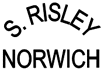 |
Risley, Sidney,
(1856-1875),
Norwich, CN, United States,
occurs on
1 bottle,

Manufactured beer bottles. Sidney
Risley came to Norwich from Hartford in 1835 work a newly
built pottery on the property of Elijah A. Bill, and Cushing Eells.
Eells sold his interest to Bill in 1845 and in 1846 Bill
advertised that he was manufacturing stoneware. In 1856,
Risley purchased the land and pottery buildings from Bill and
the following year listed himself as a pottery manufacture in
the directories. In 1865 Sidney's son, George L. joined
his father in the business. Sidney Risley died in 1875
and the control of the company passed to George L., who was subsequently
killed in a boiler explosion in 1881. The pottery then
passed to B. C. Chance who sold it to C. B. Chamberland in
1884 who in turn sold it to Otto N. Sudenberg in 1887.
The works closed in 1895. The impression is usually near the base of the
bottle. Details of mark are not verified.
Notes |
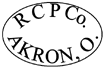 |
Robinson Clay Products Company,
(1902-approx: 1975),
Akron, OH, United States,
occurs on
6 bottles,
Manufactured beer bottles.
The Robinson-Merrill Company became the Robinson Clay Products Company sometime during
1902. The company was operating well into the
1970s. The impression is near the base of the
bottle. Details of mark are not verified.
Notes |
 |
Robinson-Merrill Pottery Company,
(1900-1902),
Akron, OH, United States,
occurs on
3 bottles,
Manufactured beer bottles. This company
was a merger of the WhitmoreRobinson Company, Markle & Son and the E, H, Merrill
Company with a capital stock of $500,000. The
application for incorporation was filed on December 30, 1899
and the merger was completed on February 13, 1900. It
became the Robinson Clay Products Company sometime during
1902. The impression is usually near the base of the
bottle. Details of mark are not verified.
Notes |
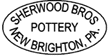 |
Sherwood Brothers,
(1879-1948),
New Brighton, PA, United States, occurs on
7 bottles,
Manufactured beer bottles. Although
building started in 1878 at Block House Run, this pottery was
not completed until 1879. George W. & William D. Sherwood
made up Sherwood Brothers. Initially they started with
one kiln and small building and steadily expanded using
Kittanney clay found on their property to manufacture a wide
variety of wares. By 1898, the firm became Sherwood
Bros. Company, but still is referred to as Sherwood
Bros. The company closed shop in 1948. The impression is near the base of
the bottle. |
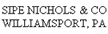 |
Sipe, Nichols & Company,
(approx. 1875-approx 1876),
Williamsport, PA, United States, occurs on
1 bottle,
Manufactured beer bottles.
William Sipe is reported to have come to Williamsport in 1863.
In 1867 he was listed as a conduction and by 1869 was
operating a pottery on W. Fourth St. He learned the
trade from his father in York County. By 1875, Sipe had
joined with Joseph Nichols, a coal dealer, and A. S. Young, a
lumber dealer, to form Sipe, Nichols and Co. This new
firm operated a pottery on Market St. at the junction of
Philadelphia & Erie Railroad. By 1877, this location
was operated by the firm of Moore, Nicholas & Co. and Sipe
had returned to the W. Fourth St location to run his old
pottery. By 1879, had brought his sons into the firm.
They continued to operate until 1893. The impression is
on the shoulder of the bottle. Notes |
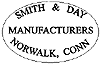 |
Smith & Day,
(approx: 1843-1848),
Norwalk, CN, United States,
occurs on
1 bottle,
Manufactured beer bottles. Asa Smith
established his pottery in South Norwalk in 1825. He
joined with Noah Selleck and the firm went under the name of Selleck & Smith
from 1837 until 1843 with Noah S. Day became Smith's
partner. Day was purported to be a poor businessman and
the firm of Smith & Day was replaced by A. E. Smith
& Sons in late 1848 or early 1849. Sometime between
1866 and 1869, the firm became A. E. Smith's Sons and in 1874
it was incorporated as the A. E. Smith's Sons Pottery
Company. The later firm failed in 1887 and the works
eventually became the property of the Norwalk Pottery Company.
The impression is below the shoulder of
the bottle. Notes |
 |
Smith, Washington,
(approx: 1839-1863),
New York, NY, United States,
occurs on
13 bottles,
Manufactured beer bottles. Smith operated the
Greenwich Pottery in New York City. It was located at 21
West 18th in 1839 and 1857. He may have been operating
before 1839. Smith manufactured pressed beer bottles,
which he claimed were manufactured by a patented process.
Smith retired from business in 1863 and it was carried on by
his son until 1870. The impression is near the base of
the bottle. |
 |
Soper, Burtis
P. (approx: 1855-1865),
Galesville, NY, United States,
occurs on
1 bottle,
Manufactured beer bottles. The exact
dates of Soper's operation is not certain. He never lists
as a potter in Census, Tax or Directory listings. He is
listed as a laborer in 1850 and according to sources he worked
at a pottery in Fort Edward at that time. According to
one source he was a member of the firm of Farrar & Soper
at Galesville from 1852 to 1854, but another states the
partner was Kingsley Soper, also a potter. About 1865 he
likely made a piece for for a Julia Soper at Fort
Edward. Soper was listed as a farmer in most records and
it seems likely he farmed during the season and worked as a
potter during the Winter months. Since the pottery at
Fort Edward was a well established firm and it is unlikely
Soper operated it, Soper was not a major operator and is
listed as a resident of North Easton in the 1850, 1860 and
1870 Censuses, Galesville had a smaller pottery that had many
operators, and North Easton is close to Galesville, it seems
likely that Soper operated the Galesville pottery for a brief
period of time, but this is speculation.
The impression is on the shoulder of
the bottle. Notes |
 |
Stier, Jacob,
(1843-approx: 1860),
Upper Mount Bethel, PA, United States,
occurs on
1 bottle,
Manufactured beer bottles. Jacob Stier
was a journeyman potter who established a large pottery at
Dills Ferry along the Delaware River in Mount Bethel
Township. In 1830, he was located in Greenwich,
New Jersey and in 1840 he was located in Nockamixon Township,
where a number of redware potters plied their trade. Purportedly
in 1843, he established the pottery at Dills Ferry. The
pottery was definably operating in 1850 and by 1864 was known
as J. Stier & Sons. In 1870, the pottery was being
operated by Joseph Sapple. The impression is on the
shoulder of the bottle.
Notes |
 |
Stiff, James,
& Sons,
(1863-1913),
Lambeth, England,
occurs on
3 bottles,
Manufactured beer bottles.
The London Pottery was established in 1751 for the manufacture
of delftware. It was purchased about 1844 by James Stiff
from John Waters. Stiff had operated a pottery on Ferry
street previously starting about 1842. The initial products
were brown stoneware and water filters. In late 1862 or
early 1863 Stiff brought his sons Ebenezer and William into a
partnership called James Stiff & Sons. The senior Stiff
retired from the daily operations of the firm in 1876 and it was
run by his two sons. He officially retired from the firm
at the end of 1892. The product line expanded greatly
during the ensuring years and included everything from sewer
pipes and bottles to chimney pots, insulators, and ornamental
vases and sculptures. James Stiff died in 1897 and that
was followed by that of his son, William, in 1899. The
firm was carried on by Ebenezer and three grandsons of James;
Sidney J., James A., and W. Frederick. Ebenezer retired
from the firm on April 1, 1903 and the business was carried on
by the three surviving partners. The business was sold to
the Dolton firm in 1913. The impression is near the base of the bottle.
Notes |
 |
Stoeckert,
John,
(1870-approx: 1905),
New Ulm, MN, United States,
occurs on
2 bottles,
Manufactured beer bottles. When the firm
of Dauffenbach, Stoeckert & Co. dissolved in about
1870, John Stoeckert left and established another pottery in
New Ulm. Sometime before 1895, brick making was
undertaken at the pottery. Even though brick making
appears to have been the only occupation of the Stoeckert
brothers in 1900, Stockert's pottery was one of four Minnesota
potteries listed in an 1896 government survey. The 1905
Minnesota Census does not list John Stoeckert and
"Sold" is marked next to the three remaining
Stoeckert brothers, who are not listed with any occupation. The impression is on the
shoulder of the bottle.
Notes |
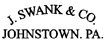 |
Swank, Jacob,
& Company,
(1856-approx: 1882),
Johnstown, PA, United States,
occurs on
1 bottle,
Manufactured beer bottles. There is a fair
amount of confusion regarding this pottery in Johnstown, at
least in the early and ending years. Josiah Swank was
operating a pottery on his father's farm near Hooversville in
the mid-1840s. By the end of the decade he had moved his
operation to Davidsville. Jacob apprenticed with his
brother on the family farm until 1848 when he left to work at
a pottery in Schellsburg for six months. Jacob returned
to operate the pottery on the family farm and was operating it
in 1850. Later he went to work at a pottery in Bedford
and by 1852 was working with his brother Josiah in
Davidsville. There were no potters listed in the 1850
Johnstown Census, but there was a brick maker listed.
Some time prior to 1856 a James Hamilton was operating the
Johnstown Pottery. In 1854 or thereafter, Jacob came to
Johnstown and by 1856, was a member of the firm of J.
Swank & Co. The other member was either his brother
Josiah or brother Hiram or both. By 1860, Hiram was a
member of the firm and in 1862, Hiram and Jacob started a
hardware company under the name J. & H. Swank. The
two business operated concurrently until 1882 or 1887, when
Hiram took full control of the pottery and Jacob the hardware
business. Hiram branched into refractory brick and
fixtures and opened a new plant in Irvonia in 1910; at which
time the firm was known as Hiram Shank's Sons. Other acquisitions
followed and the firm was sold to TYK Corporation in 1982. The impression is on the
shoulder of the bottle. Notes |
 |
Thomas & Mendell, (approx: 1839-approx:
1847),
West
Maysville, KY, United States,
occurs on
2 bottles,
Manufactured
beer bottles. The principals of this firm were Isaac
Thomas and Joseph Claghorn Mendall. Thomas and Mendell
both married daughters of Rulef Ricketts, an early Maysville
potter. One of Rulef's sons, Evan G., produced the earliest
dated Kentucky stoneware item; a pitcher dated July 4,
1833. It is believed that Thomas and Mendell worked for
Rulef Ricketts. An 1836 patent for molding pottery was
issued to J. C. Mendell and R. B. Ricketts. Isaac Thomas
is claimed to be an independent potter in 1834 and has marked
stoneware churns dated 1836 and 1837. When Mendell's
first wife, the daughter of Rulef Ricketts died, he married
the daughter of his brother-in-law Isaac Thomas' daughter in
1827. Sometime after 1837 and before an 1839 newspaper
advertisement where they were looking for potters, the firm of
Thomas & Mendell was formed. The firm is listed in
the 1840 census with 12 males residing at the pottery, which
appears to be next to Thomas' farm. This firm was known
to have made bottles for James H Durfee, who was in business
no earlier than 1845 and to about 1847-48, when the firm
became Durfee & Tobey. It appears that by 1850, the
firm was dissolved and Mendell was in the lumber
business. Thomas and his son David continued the pottery
until at after 1870 and Mendell and his son John were back in
the pottery business in 1860. The impression is below the shoulder
of the bottle and is very large. Notes |
 |
Seymour, Israel,
(1819-1852),
Troy, NY, United States,
occurs on
2 bottles,
Manufactured
beer bottles. The Troy pottery factory was started by John Gifford about 1804.
Between 1810 and 1815 he partnered with Josiah Chapman. About 1815 Gifford retired, and Chapman
operated the pottery until he sold it to Israel Seymour in 1819.
Seymour marked his ware with "Troy" and "TROY
FACTORY" in conjunction with and with out his name.
He was succeeded by his son Walter J. Seymour. The impression is on the shoulder
of the bottle. Notes |
 |
Tyler &
Company, (1859-1861),
Troy, NY, United States,
occurs on 1 bottle,
Manufactured
beer bottles. When the firm of Thompson & Tyler dissolved
in 1859, Isaac Tyler, one of the principles, partnered with Frederick Wetmore
to operate the pottery in Troy. They sold the business
to William J. Seymour in 1861. The impression is on the shoulder
of the bottle. Notes |
 |
Wallabout
Pottery,
(approx: 1845-approx: 1860),
Brooklyn, NY, United States,
occurs on
1 bottle,
Appears on beer bottles. There were
several potteries on the Wallabout Canal in Brooklyn. It
is not known which produced these bottles. |
 |
Webster, Smith
& Company,
(approx: 1894-approx: 1918),
Halifax, NS, Canada,
occurs on
6 bottles,
Appears on beer bottles. Webster,
Smith & Co. were china and crockery dealers that appeared
to have jobbed stoneware ginger beer bottles for bottlers in
the Maritime region of Canada. They also had a store at
Saint Johns, Newfoundland. Few records have been found on
this company to date. The glazed mark is
usually under the merchants mark and is much smaller or is
impressed on the reverse at the heel. Notes |
 |
Weeks,
Frederick H.,
(1890-approx: 1915),
Akron, OH, United States,
occurs on
1 bottle,
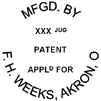
Manufactured mineral water jugs. The
Weeks pottery was established in 1882 and known as Weeks, Cook
& Weeks until 1886, when it became Weeks Brothers; the
brothers being Arthur J. and Frederick H. Weeks. In
November of 1890, Arthur left the firm and purchased the pottery works of F. W. Rockwell & Co.
Frederick continued to operate the old pottery, but spent more and
more of his time in the lumber and construction
business. He continued to advertise as late as 1913 as a
stoneware dealer. His 1891 design patent for a
distinctive shaped jug was used on several types of vessels. The
embossed mark is found on the base of the container. Notes |
 |
Wentworth,
Erastus,
(1834-1835),
Norwich, CN, United States,
occurs on
1 bottle,
Appears on beer bottles.
Peleg Armstrong and Erastus Wentworth purchased the Clinton
Avenue Pottery from William Cleveland on May 2, 1814.
There are pottery pieces that are marked with the Armstrong &
Wentworth mark. Erastus Wentworth bought out his partner
in June of 1834 and operated the pottery on his own account.
Wentworth sold his land, tools and equipment in December
of 1835. The mark is
impressed on the front heel of the bottle. Notes |
 |
West Troy Pottery,
(1863-1899),
Watervliet (West Troy), NY, United States,
occurs on 1 bottle,
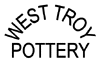
Manufactured mineral water jugs. The
West Troy pottery was established about 1863 by George Seymour,
who may have been related to earlier family of Seymour potters in
Troy, New York. The firm was operated by a number of
individuals and partnerships ending
with John L. Russell who closed the business in 1899.
The impression is on the shoulder of the jug. Notes |
 |
Western Pottery Manufacturing Company,
(approx: 1905-1919),
Denver, CO, United States,
Occurs on
2 bottles,
Manufactured
mineral water jugs. The Western Pottery Manufacturing
Company was organized with $250,000 in August of 1905 by
Denver businessmen. The firm took over the Queen City Pottery
Works and the Denver China and Pottery Company; both in
Denver. The main location was cattycorner from the Denver China and Pottery
location on Alcott Street at 16th. $100,000 in improvements
were made to the facilities. During 1919, the firm
became simply the Denver Pottery Company. The mark is on the
body of the jug. Notes |
 |
White,
Nicholas A., & Son,
(approx: 1881-1889),
Utica, NY, United States,
Occurs on 1 bottle,
Manufactured
soda jugs. The White Pottery in Utica had a long history
starting in 1826 and 1827 when two potteries were established
along the Erie Canal. Noah White eventually acquired
both of these works and it was operated by various
partnerships of Noah, his sons and his grandson. In
1881, Nicholas A. White, Noah's son, and Nicholas' son Charles
N. took control of the works under name of N. A. White &
Son. Nicholas died in 1886, but the firm continued to be
operated under this name by Charles until it ran into
financial difficulties in 1889. The firm was reorganized
as the Central New York Pottery in 1890. Impression is on the
shoulder of the jug. Notes |
 |
Wright, Franklin T., & Son,
(approx: 1870-1904),
Taunton, MA, United States,
occurs on
3 bottles,
Manufactured
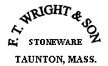
soda jugs. Franklin T. Wright started a stoneware
pottery some time between 1850 and 1859. Between 1861
and 1870, he took his son Solon into the business.
Franklin died in 1882. The company was last listed in
the 1904 Taunton Directory. The impression is on the shoulder
of the bottle. |
The following manufacturers appear on glass soda and beer bottles:
 |
Agnews &
Wilcox,
(1868-1872),
Pittsburgh, PA, United States,
Occurs on 1 bottle,
Manufactured at least one
soda bottle. This firm was formed in 1868 when Lemuel Wilcox
joined the firm of John Agnew & Company. They manufactured a
full range of bottles, many of which are marked with their mark.
Their warehouse was located on Wood Street in Pittsburgh, but
their factory was on the South Side. This firm was
dissolved in 1872 when it became John Agnew & Son. The
markings are on the reverse heel of the bottle. Notes |
 |
Alton Glass Works
Company,
(approx: 1870-approx: 1875),
Alton, IL, United States,
Occurs on 1 bottle,
Manufactured at least one beer bottle. This mark, which appears on an Illinois bottle has been attributed to the American Glass Works in Pittsburgh, but that works at that time was producing window glass and was not a company. The base appearance and mark is similar to that used by Kearns, Herdman & Gorsuch in Zanesville, Ohio. The local of the known bottle and its age indicate that it was most likely made by
one of the early attempts to establish a glass works in Alton,
Illinois. One attempt, the Alton Glass Works Company,
was organized, funded and appears to have starting building,
but it can not be confirmed that they ever blew glass. The
markings are on the base of the bottle. Notes |
 |
Albany Glass Works,
(1847-1851),
Albany, NY, United States,
Occurs on
2 bottle,
Manufactured at least one soda
bottle and marked flasks and a marked pickle bottle.
There are no known predecessor or successor firms.
Daniel O. Ketchum, who was associated with the firm in Albany,
when to Brooklyn and established the Hamilton Glass Works in
1851. The works were offered for sale during the same
year and finally auctioned in early 1852. The
markings are on the reverse side of the bottle. Notes |
 |
Alexander, Alfred, & Company,
(approx: 1884-1912),
London, ENG, England,
Occurs on
3 bottles,
Manufactured
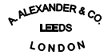
soda bottles. In 1882, this firm was know as Alexander
& Austin and by 1885 was Alfred Alexander &
Company. This company was absorbed into the United
Glass Bottle Manufacturers, Limited in 1913. The
markings are on the reverse heel of the bottle. |
 |
Alexandria Glass
Works, Incorporated, (1905-1915)
Alexandria, VA, United States,
Occurs on
4 bottles,
Manufactured
soda and beer bottles. This company was founded on May
10, 1905 with capital of $25,000. Two of its principles,
Henry Schnell and Joseph Ramsey, were associated with the
founding of the Virginia Glass Company, also of Alexandria,
and resigned from the newly formed company in the spring of
1906. The firm made a specialty of flint or clear glass.
The capital was increase to $75,000 in 1912. At that time
about 150 men and boys were employed. The company was reorganized as the Alexandria Glass Company in July of
1913. It closed in the spring of 1915 and auctioned in
September of that same year. By November of 1916, the
factory was acquired by and reopened as a plant of the Old
Dominion Glass Company. By this time Old Dominion also
had acquired the Belle-Pre factory, which was nearby. A devastating
fire destroyed the plant in February of 1917. The markings usually occur on the reverse heel
of the bottle. This same mark was used by the American
Glass Works near Pittsburgh, but this company was defunct two
years prior to the Alexandria operations starting. The
later firms bottles are mostly marked
on Southern clear or flint soda bottles and usually occur with crown
tops. American's bottles are usually aqua in color.
Notes |
 |
Allentown
Flint Bottle Company, (1902-1915),
Allentown,
PA, United States,
Occurs on 64 bottles,
Manufactured beer and soda
bottles. In 1901, the Standard Bottle & Glass
Company relocated its factory from Rochester, New York to
Allentown. Pennsylvania. During 1902, this firm ended up
in an embarrassing financial situation and was forced to
liquidate. David E. Smith, of The Smith, Comstock
Company of Bridgeport, Connecticut purchased the works in the
Fall of 1902. It appears that the factory was operating
in December of that year. The primary products were
beer, soda, whiskey bottles, flasks, and prescription
bottles. All of the bottles were manufactured of flint
glass. Most of the bottles are from the Lehigh Valley,
Pennsylvania and Bridgeport, Connecticut areas. The
plant was plagued by fires and it took years to get an adequate
water supply to the plant. In 1915, the glass works was
forced into liquidation by Frank P. Lauer of the Lauer Brewing
Company of Reading. Lauer had acquired notes issued by the
Allentown Flint Glass Company to the Reading Glass Company,
and demanded payment on these overdue notes. The company
was liquidated and sold to Lauer and Louis Rafetto, a coal
magnet from Philadelphia, for the sum of $18,650. There
is no evidence that the plant was ever reopened and the plant
burned to the ground in November of 1917. The markings are on the base of the
bottles.
Notes |
 |
American Bottle Company,
(1905-1929),
Chicago, IL, United States,
Occurs on 123 bottles,
Manufactured both beer and soda bottles.
Articles of incorporation were filed on August 22, 1905 and
issued soon after. This company was a consolidation of the Streator Bottle &
Glass Company, the Adolphus Busch Glass Manufacturing Company
and the Ohio Bottle Company, which formed in August of 1904
with the consolidation of the E. H. Everett Glass Company, Reed
& Company, the Massillon Bottle & Glass Company and
the Wooster Glass Company. The American Bottle Company
was sold to the Owens Bottle company in 1916, but the name was
retained until 1929, when it was merged into the
Owens-Illinois Glass Company. Some of the marks are proceed
with or have following the mark, marks such as
"0-SABCo" or "8-S." These marks may
indicate the plant where the bottles were blown. In
later years, the "S" indicated the Streator,
Illinois (old Streator) plant and "N" the Newark,
Ohio (old Everett) plant and the number the year of
manufacture. The markings usually occur on the reverse heel
of the bottle, but occasionally on the bottle's base. |
 |
American Glass Works, (approx:
1893-1903),
Redman Mills, PA, United States,
Occurs on 80 bottles,
Manufactured soda and beer bottles.
According to 1894 Congressional records, the predecessor to
this company was
founded on February 17, 1887. At this time the company
was called the American Glass Works Limited. Some time between 1892 and
1893, Limited was dropped and Christian F. Leng, sometimes
listed as Frederick C. Leng, became proprietor of the
firm. Two versions of the Hopkins 1896 map show Frd'k
Ling (sic) Glass House in Redman Mills. In 1899, the company employed
87 and their specialty was soda and beer bottles as well as
fruit jars. There are invoices for the firm that are dated 1902
and 1903 for beer bottles. A notice in the November 1902 Glass
& Pottery World states that the factory was sold to a railroad
company that wanted the site for track improvements. This factory was listed as
closed in 1904 and 1905 and does not appear on the 1905
Hopkins map. During 1904 and 1905 Leng appears to have been a
jobber and not a manufacturer, but was using the American
Glass Works as a firm name. Soon after and by 1905, Leng
married, moved to New York, and was a successful broker. The markings usually occur on the reverse heel
of the bottle, but occasionally on the bottle's base.
Notes |
 |
American Glass Works Limited,
(1887-approx: 1892),
Redman Mills, PA, United States,
Occurs on 78 bottles,
Manufactured soda and beer bottles. Redman Mills is currently
in Baldwin Township along the Monongahela River. According to
1894 Congressional records this company was founded on February
17, 1887 and does not appear to have been connected with any
earlier American Glass Works or Companies. At this time the
company was a limited liability company. The track of land where
the glass house was to be built was owned by William Redman and
no glass house is shown there on the 1886 Hopkins map. On this
map and within Redman's property is a lot and building owned by
John Miller. Miller was a grocer at Redman Mills as early as
1880 and postmaster there in 1883. He acquired Redman's
property soon after and became one of the founding members of
the American Glass Works Limited. His capital contribution was
likely the building site for the American Glass Works and his
store was located directly adjacent to it. The factory itself
was strategically located between the Pittsburgh, McKeesport and
Youghiogheny Railroad and the Monongahela Division of the
Pennsylvania Railroad. This company advertised in the National
Bottlers Gazette in 1887, 1889, 1890, and 1892. The 1889 ad
states that the factory was being expanded 60%. Based on
various records, the firm appears to have been liquidated about
1892 and became the American Glass Works owned
by Christian F. Leng. The markings usually occur on the
base of the bottle, but occasionally on the bottle's reverse heel.
Notes |
 |
Annapolis
Glass Company, (1885-1890),
Eastport, MD, United States,
Occurs on
4
bottles,
Manufactured at least one beer bottle.
These works were incorporated on May 12, 1885 on Horn
Point later known as the Eastport section of Annapolis with
3,000 in capital stock. The factory was operational in
the later part of 1885.
The attraction of Annapolis was a fine quality of glass sand
found on the Severn River nearby. The Annapolis Glass
Co. ceased operations in 1890 and was offered for sale in 1891,
1893, and 1894. The Severn Glass Co. was the successor
and was incorporated in 1897. The markings are on the base.
Notes |
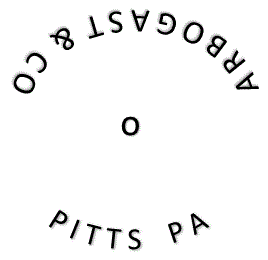 |
Arbogast &
Company, (approx:
1862-1862),
Pittsburgh, PA, United States,
Occurs on
1 bottle,
Manufactured beer bottles.
Alexander Arbogast operated the Iron City Glass Works prior to
the formmation of Arbogast & Company some timebefore
September 1862. This firm continued through December of
that year and by the end of January of 1863, Alexander once
again in sole control. The markings are on the base. Notes |
 |
Arbogast, Alexander, (approx:
1861-1862 and 1863-1864),
Pittsburgh, PA, United States,
Occurs on
3 bottles,
Manufactured soda and beer bottles.
Mark of Alexander Arbogast a Pittsburgh glass blower in
1850 and 1857 and who operated the Iron City Glass Works with
August Kapphahn as Arbogast & Kapphahn in 1860. By 1861 he
was in sole control of the works. Some time prior to
September 1862 through December of that year the firm was known
as Arbogast & Company. In January of 1863, Alexander once
again has control of the firm and retained it until the works
were sold to Pastorius, Schulz & Company on February 1, 1864.
Arbogast when on to open a window glass factory in Croton,
Pennsylvania. Alexander was the older
brother of Philip Arbogast, who invented an early automated
glass blowing machine. The markings are on the base. Notes |
 |
Atlanta Glass
Company,
(1887-1892),
Atlanta, GA, United States,
Occurs on
10 bottles,
Manufactured
beer and soda bottles. The works were established by
local Atlanta investors in 1887, the works were built during
that year and went into operations. Not long after the
works burned. After some litigation, they were rebuilt and
operated with some degree of success until they burned again in
January 1892. The
markings appear on the base of the bottles.
Notes |
 |
B.,
(1895-1910),
Unknown, United States,
Occurs on
1 bottle,
Manufactured
beer bottles. This mark appears on a champagne beer
bottle from Jamestown, New York. The
markings appear on the base of the bottle.
Notes |
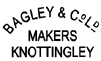 |
Bagley & Company Limited,
(1898-1975),
Knottingley, England,
Occurs on
1 bottle,
Manufactured
soda bottles. The origins of
this glass factory purportedly started in May of 1871, when
cousins John William and William Bagley and John Wild formed
Bagley, Wild & Company. John Wild died in 1884 and
purportedly in 1890 the firm became Bagley & Company. In
1898, it became a limited liability company. The company
was an early adaptor of semiand fully automated bottle making
machinery and held the European license for the Owens machine.
In 1912, it started the production of pressed glassware and a
subsidiary company was founded called the Crystal Glass Company,
but it continued to manufacture beverage bottles into the late
1960s. The company went through a series of sales, ending
with closure in 1975. It was reopened in 1995 by Stolzle
Oberglas AG, an Austrian firm. The
markings appear on the reverse heel of the bottle.
Notes |
 |
Baker Brothers & Company,
(approx: 1858-1916),
Baltimore, MD,
Occurs on
3 bottles,
Manufactured
beer bottles. Sometime during 1856 or 1857, the firm of
Baker & Brother became Baker Brothers & Company.
This firm sold window glass, glassware, bottles and
chemicals. The firm continue to be listed thru the 1917
Baltimore Directory. The
markings appear on the base of the bottle.
Notes |
 |
Barnard, William, & Sons,
(approx: 1860-approx: 1930),
London, England,
Occurs on
12 bottles,
Manufactured soda bottles. This company
advertised being in business over half a century in 1920 and
was still advertising Codd bottles in 1926. The markings
appear on the heel or base of the bottle. |
 |
Barnett & Foster,
(1858-1997),
London, England,
Occurs on
33 bottles,
Appears
on soda bottles. This company manufactured diving
apparatus and branched into bottling supplies. Operated
the Niagara Works a bottling equipment and supply house.
The company became a division of Borthwicks. The Barnett
& Foster division moved from London to Wellingborough in
1968 and was acquired by Danisco in 1997. The markings
appear on the reverse heel of the bottle. |
 |
Beaver Falls Glass Company, (1869-1879),
Beaver Falls, PA, United States,
occurs on 24 bottles,
William Modes purchased land for
this works in 1869. He had previously owned a
glasshouses in the Pittsburgh area. All references give
1879 as the final date and this is supported by the marked
bottles. Since the Beaver Falls Glass Company Limited was
organized on January 1, 1887, it is not known what the status
of the works was in the years 1880 to 1887. The Limited
must not have been successful, since a few years later in
1890, when the Canton Glass Works burned to the ground, its equipment
and 120 workers moved to the rented Beaver Falls Glass Company
for a couple of months. The Imperial Glass Works occupied the
site in 1900. The markings are on the reverse heel or the
bottle's base. |
 |
Beck, Phillips
& Company, (1865-1871),
Birmingham (Pittsburgh),
PA, United States,
Occurs on
1 bottle,
Manufactured beer
bottles. The firm of Beck, Phillips & Co. was organized
in mid-1865 by a number of Pittsburgh area
businessmen. These included Benjamin Bakewell, Jr. and
B. B. Campbell of Bakewell, Pears & Company, James and
Washington Beck, and D. C. and J. G. Phillips. The factory was built in
the Fall of that year and was in operation by November.
Originally it was designed as a window glass factory, but
bottles and hollowware were added by 1870, however exactly when
is not certain. The partners of the firm appear to be
somewhat fluid, with a new face, Ormsby Phillips, appearing to
be the owner or principle partner in mid 1871. On
September 11, 1871, with the withdraw and James and Washington
Beck, the firm became Phillips & Company who continued the
manufacture of window glass, bottles, fruit jars and etc. The markings
appear on the base of the bottle. Notes |
 |
Belle-Pre Bottle Company, (1901-1911),
Alexandria,
VA, United States,
Occurs on
8 bottles,
Manufactured beer
bottles. The Belle-Pre Bottle Co. was incorporated in
the state of Delaware in 1901 by a number of Washington
businessmen. The factory was built in Alexandria,
Virginia in 1902. Its specialty was the manufacture of
milk bottles, but they appear to have made other types of
bottles in the early years. By 1907, the factory was
manufacturing milk bottles exclusively at a rate of one
million a month and employed 250 men. The works closed
in November of 1911 and was involved in litigation until the
fall of 1912, when it was sold to the Old Dominion Glass Co. The markings
appear on the base of the bottle. Notes |
 |
Belleville Glass Company, (1882-1886),
Belleville,
IL, United States, Occurs on
5 bottles,
Manufactured soda and beer
bottles. This company was organized in the early part of
1882 with capital of $25,000 and the plant was operating in
the fall of that year employing about 75 men producing 100
gross bottles and fruit jars. Later that same, year a
second five pot furnace was in the making and would employ an
additional 50 men. By February 1886, the factory was
discovered to no longer be operating. Soon after, the
company was in receivership. According to some accounts,
Adolphus Busch, of brewing fame, purchased the works in 1886,
but the receiver reported the company had no assets in
1888. In 1889, the glass works were back in operation
employing 98 men and boys. Busch modernized and expanded
the plant in 1891, but in 1894 the factory closed because of
the depression of 1893. Busch reopened the plant in 1899
after additional modernizations. In 1905, the plant
became part of the American Bottle Company. The markings
appear on the reverse heel of the bottle. Notes |
 |
Bennett & Gompper Company,
(1900-1912),
New York, NY, United States,
Occurs on
2 bottles,
Appears
on soda bottles. This company was a soda water bottler's
supply house producing machinery with a specialty of siphon
bottles. George W. Bennett, a clerk from Brooklyn, and
Louis Gompper, a machinist from New York, formed Bennett &
Gompper in late 1884 or early 1885. Their initial location
was on Franklin near Elm, but during 1888 or 1889 they moved to
241, 243 & 245 Centre Street. About 1900, the firm was
incorporated as Bennett & Gompper Company. The firm
apparently purchased blank siphon bottles from European glass
factories including the Josef Inwald glass works, and
manufactured the siphon heads and etched these blanks for their
customers. At some point Bennett left the firm, but it
continued under the old name. In 1911, the firm claimed
forty years experience in soda water supplies and was the oldest
house of its kind in the United States. Later in the same
year, 1911, the firm ran into
financial trouble and appears to have been bankrupt.
Gompper and his son appear to have made two attempts to reopen
the business under the old name in 1913 at 42 Charles Street and
in1916 at 235 West Fourth. The outbreak of World War I
would have cut off the supply of siphon bottles from Eastern
Europe. On the known bottles, the markings
within the etching area on the front of the bottle. Notes |
 |
Berney-Bond Glass Company, (1905-1930),
Bradford, PA, United States,
Clarion, PA, United States,
Hazelhurst, PA, United States,
Smethport, PA, United States,
Occurs on
16 bottles,
Manufactured soda and beer
bottles. This company was formed in 1905 with the merger
of the Berney Glass Company and the Bond Glass Company.
The company was purchased by Owens-Illinois in 1930. The
markings are on the base and occurs with a mold number. |
 |
Binghamton Glass Works, (1882-1893),
Binghamton, NY, United States,
Occurs on 1 bottle,
Appears
on beer bottles. This glass works appears to have been
formed about 1880 by Binghamton businessmen and was known as
the Binghamton Glass Company. In 1882, William Burrows
acquired the works and it became known as the Binghamton Glass
Works. Burrows was involved in a series of other glass
factories in Brooklyn, Newburgh, Honesdale, and East
Stroudsburg. The Binghamton plant was the primary
manufacturer of bottles for Dr. Kilmer and his swamp root
empire, but also manufactured druggists, flask, beer and soda
water bottles. Burrows was involved in the works until
1893, when it was organized as the Binghamton Glass Company, a
partnership of John B. and Milton Yetter, Frank L. Dennis and William Burrows.
In 1897, the company was incorporated and continued to offer a
general line of bottles and jars. The company never
installed automatic bottle machines and was not able to
compete with the changing tide. The company shifted its focus
to specialty blown wares and as a wholesalers of glass for
other manufacturers. They continued to manufacture glass
until about 1926. The company remained active until
about 1945, when the last owners died and the property was
sold. The markings appear on the base of
the bottle. Notes |
 |
Bode, G. A., (approx: 1895-1905),
Chicago, IL, United States,
Occurs on
4 bottles,
Appears
on soda bottles. Believed to be Gustav A. Bode of
Chicago. The GAB mark appears on a Chicago Hutchinson
bottle and the BODE mark was reported on another
Hutchinson. Bode was a bottlers supplier and most likely
did not manufacture bottles but was a reseller like Karl
Hutter of New York or Twitchell & Brother of
Philadelphia. The markings appear on the reverse heel of
the bottle. |


|
Bodine, Joel, & Sons,
(1846-1855),
Bridgeton, NJ, United States,
Occurs on
7 bottles,
Manufactured beer and soda bottles. Two
different forms of the mark were used. The
Bodines purchased the works from John G. Rosenbaum in
1846. In 1855, they sold the glass works to Maul, Hebrew
& Company, who only operated it for a short period until
they failed. The works were then purchased by General
David Potter and Francis I. Bodine (Potter & Bodine) in
1857 or 1858 and
operated under the name of the Bridgeton Glass
Works. The markings appear on the reverse side of
the bottles. |
 |
Muncie Glass Company, (1888-1900),
Boldt, Charles, Glass Company, (1900-1906), Occurs on
1 bottle,
Boldt, Charles, Company, (1906-1919),
Boldt, Charles, Glass Company, (1919-1929),
Muncie, IN, United States, (1888-1910),
Cincinnati, OH, United States, (1900-1924),
Huntington, WV, United States, (1913-1929),
Manufactured beer bottles. Charles Boldt was a great example of a
self-made man. He started his career as a bookkeeper
with Drexler, Immohr & Co., who were bottlers in
Louisville. After a brief stint with the Louisville Post
Office, he organized the Muncie Glass Company on Nov. 16, 1888,
at a mere 20 years of age. In 1900, he built a second
glass factory in Cincinnati and renamed the firm The Charles
Boldt Glass Company on April 30, 1900. The Cincinnati
plant manufactured flint and amber ware. In 1901, a
branch office was opened in Louisville, which also produced
liquor labels and was headed by his old business acquaintance,
Fred J. Drexler. Soon after, new plants were built in Cincinnati
to produce boxes and corrugated paper products. As the company
expanded into bottlers supplies, corrugated paper, boxes, and
labels, they changed the name to reflect the change in
business purpose. The firm's new name became The Charles
Boldt Company on May 1, 1906. They also started to focus
on manufacturing whiskey bottles. The company acquired
one of two licenses to use the Owens machines to manufacture
liquor bottles and further focused in that area. In
1910, the Muncie plant burned to the ground, the company was incorporated
and the Owens Bottle Machine Co. bought shares in the
company. It does not appear that the Muncie plant was
rebuilt, but the company maintained an office there until
1915. In the following year, 1911, the capacity of the
Cincinnati plant was doubled and in 1913, a new plant was opened
in Huntington, West Virginia. In 1916, Boldt bought back
Owens' share in the business. Prohibitions passage in
1919, was a major blow to the Boldt Company now entrenched in
the liquor industry. In that year, the name was changed
to the Charles Boldt Glass Company on October 29, the
Louisville operation was closed down, the Owens Company bought
a controlling interest in the business, and the focus was
shifted to producing other ware including soft drink bottles
and preserve wares. In 1924, the Cincinnati plant was shut
down and operations consolidated to the Huntingdon plant. Bolt
closed a deal to sell the company to the Owens-Illinois
Company in 1929 and died the next day, leaving his wife an
estate of $10,000,00. The markings are on the base of the bottle.
Notes |
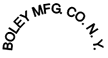 |
Boley Manufacturing Company,
(1896-1914),
New York, NY, United States,
Occurs on 56 bottles,
Manufactured
beer and soft drink bottles. Henry Boley started selling bottles
in 1871. His son Benjamin took over the business in 1881.
In 1895, he took an interest in a Brooklyn glass works.
With Boley's prospering business and his involvement in a glass
factory, he merged his Boley Bottle and Stopper Company into the
Boley Manufacturing Company in 1896. In 1899, Boley merged
his Manhattan Glass Works into the Boley Manufacturing company.
The business had also expanded to the manufacture of Demijohns.
In, 1906, the demijohn portion of the business was relocated to
Orleans, New York. The Manhattan factory was reportedly to
have been closed in 1906, but it continued to be listed in the
directories thru 1909 as the Boley Glass Works and there is
evidence that soda bottles marked Boley were being produced
until this date. The Orleans factory was defunct by 1911
and likely closed around 1909-1910. There is no evidence
that soda or beer bottles were every made at Orleans. The
last listing of the Boley Manufacturing Company was in 1914.
Benjamin Boley was
still involved in selling bottles in 1918 and he is listed as
a glass manufacturer in a 1922 Brooklyn news paper. There
was a Boley Glass Company in 1922 located at Grapeville,
Pensylvania. The markings are on the base of the bottle.
Notes. |
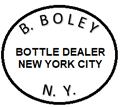 |
Boley,
Benjamin,
(1881-1895),
New York, NY, United States,
Occurs on 2 bottles,
Manufactured
beer and soft drink bottles. In 1881, Benjamin Boley
took over the bottle supply business founded in 1871 at 90-92
Sheriff by his father Henry Boley. In 1887 a second location was
established at 96 S. 5th avenue. In 1891, the 5th avenue
location was relocated to 74 W. Houston. In 1893, Boley
established the Boley Bottle and Stopper Company and
consolidated his business locations to 52 Cannon street.
During late 1894 or early 1895, Boley took an interest or built
a glass factory at the intersection of Metropolitan & Morgan
avenues in Brooklyn called the Metropolitan Glass Works.
On January 21, 1896, this business was incorporated as the
Manhattan Glass Works. This same year, 1896, The Boley
Manufacturing Company was established to reflect the increased
offering of the Boley's enterprises. As evidenced by an
early Baltimore bottle dating to 1896, bottles were marked Boley
Mfg. Co. were assuredly made at Boley's Manhattan Glass Works
until it was merged into the Boley Manufacturing Company in
1899. The markings are on the face of the bottle in a
plate. One bottle has an "H" in a heart motif on its base.
Notes. |
 |
Bottlers & Manufacturers Supply Company, (approx: 1900-1920),
Long Island City,
NY, United States,
Occurs on 21 bottles,
Manufactured beer
bottles. This company is mentioned in various documents
from 1900 to 1915. It became the Peerless Glass Company
in 1920 and later became a branch of Thatcher, in 1932, for
the manufacture of milk bottles. The markings
appear on the reverse heel of the bottle. Notes |
 |
Bratby & Hinchliffe,
(approx: 1877-approx: 1900),
Manchester, England,
Occurs on 4 bottles,
Manufactured
soda bottles. Bratby & Heinchliffe trademarked a
number of images in 1877. They were aerated
water engineers and manufacturing chemists. Later a
branch was opened in London. The markings are on the
reverse heel of the bottle. |
 |
Bratby & Hinchliffe Limited,
(approx: 1900-approx: 1985),
Manchester, England,
Occurs on
4 bottles,
Manufactured
soda bottles. Bratby & Heinchliffe were aerated
water engineers and manufacturing chemists. The markings are on the
reverse heel of the bottle. |
 |
Breffit, Edgar F., & Company, (approx: 1860-1913),
Castleford, England,
Occurs on 4 bottles,
Manufactured
beer bottles. Winterbottom & Jessop purchased four
acres of land from Lord Houghton and erected the Ryebread
Glass Works in 1834. Edgar Breffit bought the business
in 1844 and renamed it Breffits Glass Works. By 1868, E. Breffit
& Company were listed as proprietors of the Aire and
Calder Glass Bottle Works. By 1884, it became a limited
liability company. This company was absorbed into the United
Glass Bottle Manufacturers, Limited in 1913. The markings are on the base of the bottle. |
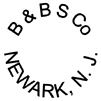 |
Brewers' & Bottlers' Supply Company, (1902-1913),
Newark, NJ, United States,
Occurs on
9 bottles,
Manufactured beer
bottles. The company was incorporated on August 14, 1902
and was located at 52 Clinton Street. It appears to have
originally been run by a Souda & Graham, who were listed
as proprietors in 1904 at 49 Academy Street. The company
appears to have struggled, but by 1907, it was taken
over by William F. Hoffmann and some associates and relocated
to 52 & 54 Lafayette Street. They greatly expanded
and advertised heavily in the directories until 1913, when it
appears to have gone inactive. Hoffman appears to have
turned his attention to the Standard Oil Supply Company,
another corporation he owned, also located at 52 Lafayette
Street. The corporation continued until at least 1918, but no
longer was listed in the directories nor did it
advertise. Hoffman also owned a company called the South
Jersey Glass Works and the Brewer's & Bottlers' Supply
Company bottles were likely made there. The markings appear on
the base of the bottles. Notes |
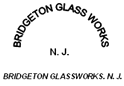 |
Bridgeton Glass Works, (1855-1870),
Bridgeton, NJ, United States,
Occurs on
10 bottles,
Manufactured beer and soda
bottles. The Bridgeton Glass Works was operated by Joel
Bodine & Sons until 1855, when they sold it to Maul, Hebrew
& Company, who only operated it for a short period until
the failed. The works were then purchased by General
David Potter and Francis I. Bodine (Potter & Bodine) in 1855 or 1856
at sheriffs sale and
operated under the name of the Bridgeton Glass
Works. In 1863, it became F. & J. Bodine, but at
least one bottle from this period indicates the name Bridgeton
Glass Works was retained. About 1870, it became the Cohansey
Glass Manufacturing company. The markings appear on the reverse side of
the bottles or across the front and reverse sides. |
 |
Bright & Sons,
(approx: 1870-approx: 1875),
Bridlington, England,
Occurs on 1 bottle,
Appears on soda bottles. No
information could be found on this firm or a glass works in
Bridlington. A marked bottle is dated 1873, so production
must have been limited.
The markings appear on the heel of the bottle and ring the base.
Each line on the illustration represents a different side to the
bottle.
Notes |
 |
British Siphon
Company,
(approx: 1905-approx: 1930),
London, England,
Occurs on 16 bottles,
Appears on soda bottles. No tangible
information could be found on this firm. It may have
been an successor of a company called the British Siphon
Manufacturing Company and the predecessor of a limited
liability company.
The markings are on the face of the bottle below the etching.
Notes |
 |
Brooke Glass Company,
(1891-approx: 1899),
Wellsboro, WV, United States,
Occurs on 1 bottle,
Appears on soda-shaped
milk bottles. This company was chartered in 1891 by the
West Virginia Legislature. The operation ran into
problems in 1897, when it was put up for auction, but appears
to have operated sporadically until about 1899. In 1908,
the plant was reopened as the Crescent Glass Company, which was in
operation until at least 1998.
The markings are on the base of the bottle.
Notes |
 |
Burdett,
Thomas,
(1895-1915),
Montreal, QC, Canada,
Occurs on 3 bottles,
Appears on
soda bottles. There is little history on Thomas
Burdett. We know he was born in England about 1844 and
that he came to Canada and operated a hotel starting about
1870. Apparently, he was married to two women and had
separate families living in different parts of Montreal and
when he was found out absconded for seven years. He
returned to Montreal and operated a hotel again in 1893.
In 1895, he patented a beer cooler and pump and this appears
to have triggered a foray into a hotel supply business..
As such he was an agent for all sorts of goods from billiard
tables to gasoline lighting systems. It also included
soda fountains and bottlers supplies and he was an agent for
the glass maker Richard Cooper & Son Ltd. of
Scotland. Burdett either died or went bankrupt in 1915
and the business came under control of his widow and G. N.
Valade as Burdett & Valade, which operated until 1927.
The markings are on the reverse of the bottle.
Notes |
 |
Burgin & Sons,
(1852-1903),
Philadelphia, PA, United States,
Occurs on 1 bottle,
Manufactured
soda bottles. This works was purported to have been
established in 1841 by Burgin, Pearsall & Hartshorne as
the Philadelphia Vial and Bottle Works. The works were
north of East Girard on what is today Montgomery Street.
During 1852 or early in 1853 the firm went from Burgin, Fowler &
Company to Burgin & Sons and remained in operation well
into the Twentieth Century. The factory burned in 1875 causing
$20,000 in damages and again 1879 and 1887, when some out
buildings burned. This factory was one of the first to
use gas powered furnaces. The name
changed to Burgin & Sons Glass Company in 1903 and was involved in a law
suit in 1910. It closed soon afterwards. The
markings are on the front of the bottles. |
 |
Burlington Glass Company,
(1877-1909),
Hamilton, ON, Canada,
Occurs on 1 bottle,
Manufactured
soda bottles. The Burlington Glass works started in 1875
and was incorporated in 1877. It was sold to the
Diamond Glass Company, of Montreal, in 1909. The markings
are on the reverse side on the heel. |
 |
Busch, Adolphus, Glass Company, (1886-1892),
Belleville, IL, United States, (1886-1892),
Saint Louis, MO, United States, (1891-1892),
Occurs on
13 bottles,
Manufactured beer
and soft drink bottles.
In 1886, Adolphus Busch
purchased the bankrupt Belleville Glass Works and formed the
Adolphus Busch Glass Company. In 1891, a new plant was opened
in Saint Louis near the AnheuserBusch brewery at 3rd &
Barton. The following year, 1892, the Adolphus Busch Glass
Manufacturing Company was organized.
The markings are on the base of the bottles. Notes |
 |
Busch, Adolphus, Glass Manufacturing Company,
(1892-1926),
Belleville, IL, United States, (1892-1905),
Saint Louis, MO, United States, (1892-1926),
Occurs on 35 bottles,
Manufactured beer
and soft drink bottles.
In 1886, Adolphus Busch
purchased the bankrupt Belleville Glass Works and formed the
Adolphus Busch Glass Company. In 1891, a new plant was opened
in Saint Louis near the Anheuser-Busch brewery at 3rd &
Barton. The following year, 1892, the Adolphus Busch Glass
Manufacturing Company was organized. The
Belleville plant closed in 1894 due to a depression and did
not reopen until 1899. In 1900, a major fire
destroyed the St. Louis works and the operations were shifted
to the closed Frederick Heitz plant closer to the AnheuserBusch
brewery at Main & Dorcas Streets. Another fire
destroyed the plant at this location in 1905. In this
same year, the
Belleville plant became part of the American Bottle
Company. Since the Saint Louis plant was in ruins at
this time, it was not part of the new consolidation. The
Belgium Pavilion from the 1904 Worlds Fair in Saint Louis was purchased
and reassembled as the new Saint Louis plant. The Saint Louis plant was closed
about 1926.
The markings are on the base of the bottles. Notes |
 |
Bushwick Glass Works,
(1864-1913),
Brooklyn,
NY, United States,
Occurs on
1 bottle,
Manufactured soda bottles.
This factory was started by James Brookfield, a seasoned glass
man, and his son William Brookfield. The family had
recently moved from Honesdale, Pennsylvania where that had a
glass factory. William paid the tax on the factory in
1865 and 1866 and his name was associated with the works in
later years. In 1898, the Brookfield Glass company was
organized and both it and the Bushwick Glass Works were
advertised concurrently until 1913 in City Directories.
It is believed that the factory in Brooklyn was closed at this
time and a plant in New Jersey operated until 1921. The marking is on the base of the
bottle. Notes |
 |
Camden Glass Works, (approx: 1850-1852),
Camden, NJ, United States,
Occurs on
4 bottles,
Manufactured soda bottles.
No information is currently available on this glass
factory. There was a Thomas Burns listed as a glass
manufacturer in Camden in 1851, who is not currently
associated with any factory. The marking is on the
reverse side of the bottle. |
 |
Campbell Glass Works, (1884-1885),
West Berkeley, CA, United States,
Occurs on 1 bottle,
Manufactured soda bottles.
John Campbell and J. H. Flickinger formed the Campbell Glass
Works and started construction in late 1884.
It was incorporated as the Campbell Glass Manufacturing
Company in 1885. This plant closed in July of
1885. The markings are on the base of the bottle. |
 |
Campbell,
Terrence, Company, (1903-1905),
Pittsburgh, PA, United States,
Occurs on
4 bottles,
Manufactured soda bottles. This factory started as the American
Glass Works, a window glass plant, located on the south side of
Pittsburgh at 21st & Mary streets. This works was started about
1866 by Page, Zellers & Duff. In 1872, the operating firm
became Duff & Campbell and in 1879, Duncan, Campbell & Company.
In 1884, it became T. Campbell & Company and finally in 1891,
simply T. Campbell Company. Property was bought at Blair
Station and a new factory erected and operations moved from the
South Side of Pittsburgh to this new location. The works two
factories operated only as a window glass plant thru all of
these years. With the formation of the conglomerate called the
American Window Glass Company, the smaller independents,
including Campbell Company were under increasing pressure. This
pressure resulted in T. Campbell Company to expand its focus to
include products other than just window glass. In June of
1903, it filed and had its charter legally modified to include
"glass bottles, vials and the products of glass" in addition to
window glass. This product expansion did not improve the
performance of the company and it closed in early 1905 and was
liquated by the middle of the year. The
markings are on the reverse of the bottle near the base. Notes |
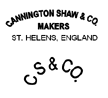 |
Cannington, Shaw & Company,
(1875-1892),
Saint Helens, ENG, England,
Occurs on
7 bottles,
Manufactured soda bottles. Edwin
Cannington and John Shaw established this works in 1875 called
the Sherdley Glass Works. The company became a limited
liability company in 1892. This company was absorbed into the United
Glass Bottle Manufacturers, Limited in 1913. The
markings are on the reverse heel or base of the bottle. |
 |
Cannington, Shaw & Company Limited,
(1892-1913),
Saint Helens, ENG, England,
Occurs on
7 bottles,
Manufactured soda bottles. Edwin
Cannington and John Shaw established this works in 1875 called
the Sherdley Glass Works. The company became a limited
liability company in 1892. This company was absorbed into the United
Glass Bottle Manufacturers, Limited in 1913. The
markings are on the reverse heel or base of the bottle. |
 |
Canton Glass Company,
(1880-1899),
Canton, OH, United States, (1880-1894),
Occurs on
2 bottles,
Marion,
IN, United States, (1894-1899),
Manufactured beer
bottles. This company's focus was on the manufacture of
tableware, but it also manufactured bottles and is famous for
its blue "Canton Domestic Fruit Jar." In 1894,
the company moved to Marion, Indiana and later, in 1899,
became part of the National Glass Syndicate. The markings are
on the reverse heel of the bottle. |
 |
Chambers, Alexander & David H.,
(1843-1888),
Pittsburgh, PA, United States,
Occurs on 434 bottles,
Manufactured beer and soda bottles.
This firm was created with the dissolution of Chambers, Agnew
& Company in 1843. David Chambers died in 1862 and
Alexander Chambers died in 1875, but the firm continued until
about 1888. The markings are on the reverse heel of the
bottle and rarely on the base. |
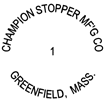 |
Champion Stopper Manufacturing Company,
(approx: 1882-approx: 1885),
Greenfield, MA, United States,
Occurs on
2 bottles,
Appears on beer and soda bottles. This
firm marketed Augustus Rich's bottle stopper, which was
patented on January 10, 1882. Since this closure never
achieved any great level of success, the company must have
been short lived. The markings are on the base of the
bottle. Notes |
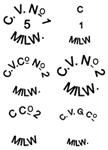 |
Chase Valley Glass Company No. 1 (1880-1881),
Chase Valley Glass Company No.
2 (1880-1881),
Milwaukee, WI, United States,
Occurs on 23 bottles,
Manufactured
soda and beer bottles. Due to the demand for beer
bottles in Milwaukee, Dr. Enoch Chase formed two glass
manufacturing companies near his farm in Chase Valley.
Company one was fully owned by Dr. Chase and did not produce
many soda or beer bottles. Dr. Chase had a controlling interest
in company number two, with a minority interest held by other
local businessmen. This company produced the bulk of the soda and beer
bottles. Some bottles are not marked with the "No
1" or "No 2" designation and it is uncertain
which of the two companies manufactured them. The
factories were built and commenced production in 1880 and were
consolidated and reorganized in the summer of 1881 as the
Wisconsin Glass Company. Dr Enoch went on to be a state senator
for the 1882-84 term. The markings are typically on the
base of the bottle. |
 |
Chattanooga Bottle & Glass Company,
Chattanooga, TN, United States (1901-1929), Occurs on
5 bottles,
Tallapoosa, GA, United States (1917-1926),
Manufactured
soda and beer bottles. Charles Reif founded this company
in 1901 to makes bottles for the brewery that his family owned
and for other southern bottlers and medicine
manufactures. The initial products were green, amber and
flint bottles and window glass. The window glass segment
of the business was soon dropped in the first year and the
focus concentrated on supplying the Southern markets with
bottles. Early on they started to supply Coca-Cola
bottlers with bottles and soda bottles became a specialty of
the firm for years to come. The company expanded in 1917
when it reopened the Tallapoosa Glass Company plant in Tallapoosa,
GA, but closed the plant in 1926. In the later years,
milk bottles and vinegar bottles were listed as specialties.
The company became the Chattanooga Glass Company in 1929 and
continues to operate today as a division of Diamond Container General.
The markings are typically on the
base of the bottle and occasionally on the heel. Notes |
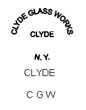 |
Clyde Glass Works,
(1864-1880, 1895-1915),
Clyde, NY, United States,
Occurs on 79 bottles,
Manufactured beer and soda
bottles. A bottle bottle blowing factory was opened in
by Southwick and Woods. This factory was merged with a
window glass factory, also in Clyde, under the name of
Southwick, Reed & Company a short time later. In
1880, the name of the plant became Ely, Son & Hoyt and in
1886, with the death of William Ely, the firm became Ely Sons
& Hoyt. (See E. S. & H.) In 1895, the firm
was incorporated as Clyde Glass Works. The works stopped
operation in 1915 and later efforts to reactivate it
failed. The markings appear on the base. |
 |
Codd & Rylands,
(1881-1884),
Barnsley,
England,
Occurs on
4 bottles,
Manufactured
soda bottles. This partnership was formed in 1877
between Ben Rylands and Hiram Codd. Rylands owned the Hope
Glass Works and Codd held the patent for a marble closure for
soda bottles. Ben Rylands died in 1881 and his son Dan
joined the firm in his place. At this time the name was
changed to "Codd & Rylands." The partnership with Codd dissolved
in late 1884. The Hope Glass Works used the mark of
"4" on its glassware to signify it products attributes of accuracy,
cleanliness, neatness and strength. The markings appear on the
reverse heel of the bottle. |
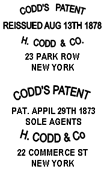 |
Codd, Hiram,
& Company, (1880-1890),
New York, NY, United States,
Occurs on
34 bottles,
Manufactured soda bottles. Hiram Codd
was awarded United States patents for his English Globe
Stoppered bottles in 1872 and 1873. At the 1876 Centennial
Exhibition at Philadelphia, Codd won a medal for his patented
bottles. Seeing potential in the American market,
between 1876 and 1880 Codd set up an American Agency to market
licenses for his patented bottles at 22 Park Row in New York
City. Initially the bottles were manufactured at the
"Patentee's own works at Barnsley." Codd &
Co. continued their English practice of licensing bottles by
geographic region. This was suppose to limit the trafficking
of the bottles as they were of no use to other bottlers.
The American licensed bottles have the licensed number
embossed within a star and numbers between 1 and 95 are
recorded. Hiram Codd held license number 1 and that may
explain the wide variety of these bottles. He likely
sold these to licensees for use while their private mold
bottles were being manufactured and shipped from
England. Number 1 bottles have been found in numbers in Pensacola,
Philadelphia, and other cities were Codd licenses were
sold. By 1886, Codd & Co. had moved to 22 Commerce
St. and had shifted the manufacture of the bottles from
England to Whitney Brothers glass factory at Glassboro, N.
J. The firm was still at 22 Commerce in 1890, but no
references could be found after that date. Codd's 1873
patent would have expired in 1890 and as Codd had died several
years earlier, it seems likely the firm was dissolved soon
after. Notes |
 |
Cohansey Glass Manufacturing Company, (1870-1911),
Bridgeton, NJ, United States (1870-1900),
Downingtown, PA, United States(1900-1911),
Occurs on
13 bottles,
Manufactured
beer and soda bottles. Also know as the Cohansey Glass
Company in later years. This company was formed with the
dissolution of F. & J. Bodine in 1870. During
the 1890s it was beseeched with strikes and a major one at the
Bridgeton plant in 1899 may have lead to its relocation from
Bridgeton, New Jersey to Downingtown, Pennsylvania in
1900. Records indicate the works were operating as late
as 1906, but were closed by 1914. Most authors quote 1911 as
the final date. The markings appear on the reverse heel oh the
bottle and are usually followed by a number. |
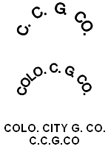 |
Colorado City Glass Company,
(1889-1893),
Colorado City, CO, United States,
Occurs on
17 bottles,
Manufactured beer and soda bottles.
This factory was formed with capital from Adolphus Busch of
Saint Louis and Jerome B. Wheeler of New York as principal
share holders. It consisted of a bottle and flint
factory. The factory sustained a major fire in 1892, but
was rebuilt. The silver panic of 1893 was partially
responsible for its closure. The markings usually appear on
the base of the bottle, but in at least one instance on the
heel. |
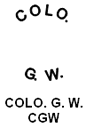 |
Colorado Glass Works, Colorado Glass Works Company,
(1887-1888),
Golden, CO, United States,
Occurs on
2 bottles,
Manufactured soda bottles. The name was
changed from the Colorado Glass Works to the Colorado Glass
Works Company after five months of operation. A furnace
collapse and labor dispute, brought the works to a halt in
December of 1888. The markings are normally on the base of
the bottle and rarely on its heel. |
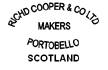 |
Cooper, Richard, & Company, Limited,
(1895-aprox: 1928),
Portobello, Scotland, England,
Occurs on
7 bottles,
Manufactured soda bottles. This
glass works was founded in 1829 as a flint glass works by
William Bailey. In 1848, Bailey converted the works to
green glass, which was more profitable. In 1857, with
the introduction of Richard Cooper, the firm became Bailey
& Cooper. With Bailey's death in 1859, Cooper's
brother-in-law, Thomas Wood joined the firm as Cooper and
Wood. This partnership split in 1866, with each partner
taking a part of the factory and running their own glass
works. The firm Richard Cooper & Company became a
limited liability company in 1895. These works were acquired
by the Wood Bottle Company about 1928. The markings are
on the reverse heel of the bottle. |
 |
Coshocton Glass Company,
(1902-1921),
Coshocton, OH, United States,
Occurs on 31 bottles,
Manufactured beer and soda
bottles. In 1899, a Board of Trade was organized to
attract new manufacturers to Coshocton. The Board sold
building lots to investors and used the proceeds to pay
bonuses to attract manufacturers to the City. Towards
the end of 1901, the Board enticed the Saltsburg Glass Co., to
open a plant in Coshocton with three acres of ground and a
$15,000 bonus. The deal was completed at the end of 1901
and building of the factory started soon after. Saltsburg
abandoned its facilities in Pennsylvania. Production
started in May of 1902 with an amber tank having 6 rings
employing 50 men and boys including 18 blowers. Beer bottlers were the
main product. The factory did not grow as expected, so
in 1904, Thomas Gainor, who managed the Everett works in
Newark and spent 7 years as a sales manager, was enticed to
invest and manage the works. Under Gainor, the works
expanded greatly, a green glass ring was added and the amber
ring expanded, and when he left two years later, the works
employed 450. Possibly due to a failure to secure
financing to increase the Coshocton plant, a substantial offer
from Everett, or knowledge of Everett's acquisition of Owens'
blowing machines that would revolutionize the industry, Gainor
returned to Everett and the Liewer brothers increased their
share to become majority shareholders. In 1908, a flint
tank was added for prescription ware and liquor bottles, but
it does not appear as this line was long-lasting and the focus
returned to beverage bottles. It appears that automatic
bottle machines were in operation by 1915 and a new modern
plant was built in 1916 in front of the old plant to meet the
growing demand for beer, soda and Coca-Cola bottles. Waning
demand for beer bottles caused by National Prohibition, a
series of equipment failures, loss of key employees and poor
quality product caused the cessation of operations in
1921. The Liewer brothers sold the works to a group of
local investors in 1923 and the new company was called the
Coshocton Glass Corporation. Although the plant was
originally supposed to manufacture bottles, numerous delays in
startup resulted in the plant producing glass tableware
instead. The works went into receivership in 1927 and
attempts to sell the works were unsuccessful. The
property was liquidated in 1930. The markings are on the
reverse heel of the
bottles.
Notes |
 |
Cream City Glass Company, (1888-1893),
Milwaukee, WI, United States,
Occurs on 20 bottles,
Manufactured beer and soda
bottles. In 1888, this company was organized to reopen
the failed Wisconsin Glass Company factory, which had sat idle
for five years. The company prospered for some time with
seven hundred employees in 1892, but the economic panic of
1893 closed its doors. The markings are on the base of the
bottles. |
 |
Cumberland Glass Manufacturing Company, (1885-1920),
Bridgeton, NJ, United States,
Occurs on
0 bottles,

Manufactured both soda and beer bottles. Joseph A. Clark
& Company were organized in August of 1880 and that same
year built a factory on Water Street in Bridgeton. The
plant was also know as the Cumberland Glass Works. The
factory was soon moved to Laurel Street and in 1885, the
company was reorganized as the Cumberland Glass Manufacturing
Company. This firm became the second largest glass works
in New Jersey and was targeted by labor bosses for
unionization, which it resisted until 1899. Up until
this settlement, there were an number of strikes and violent
confrontations starting in the late 1880s. The firm was
an early adopter of semi-automated and automated bottle
machines. Cumberland purchased a number of its Bridgeton
based competitors between 1902 and 1909. Cumberland
itself was purchased by the Illinois Glass company in April of
1920. Although no bottles are known with a
distinct Cumberland mark, a number of bottles have been
identified with known mold number markings. The markings are on the base of the
bottle. Notes |
 |
Cunningham & Company,
(1857-1866),
Pittsburgh, PA, United States,
Occurs on 1 bottle,
Manufactured at least one marked soda bottle as well as
numerous flasks and fruit jars. The company was the successor
to W. Cunningham & Company in 1857 when Dominick Ihmsen
joined the firm as a partner. Marked bottles date from
all years of operation. The company was succeeded by
Cunningham & Ihmsen. The markings are usually on the
front heel of the bottle. |
 |
Cunningham & Company, (1878-1885),
Cunningham & Company, Inc., (1900-1907),
Pittsburgh, PA, United States,
Occurs on 89 bottles,
Manufactured soda
bottles. The company was organized in 1878 with the
withdraw of Dominick Ihmsen from Cunningham &
Ihmsen. The company was made up of various Cunningham
family members until it became Cunningham & Company,
Limited in 1886. In 1900, the limited was dropped and
the firms was incorporated. The same mark was used on
these later bottles. The markings are on the reverse
heel of the bottle and occasionally on the base. The
later marks are often followed with a number with 2, 3, and 4
known. |
 |
Cunningham & Company Limited,
(1886-1900),
Pittsburgh, PA, United States,
Occurs on 119 bottles,
Manufactured beer and soda bottles.
The company was organized out of Cunningham & Company in
1886. The name Limited was dropped in 1900 when the
company was incorporated. The markings are on the
reverse heel of the bottle and are often followed by 2, NO 5,
NO 7, 9. |
 |
Cunningham & Ihmsen,
(1866-1878),
Pittsburgh, PA, United States,
Occurs on 145 bottles,
Manufactured both soda and beer bottles. The company was the
successor to Cunningham & Company in 1866. Marked
bottles date from all years of operation. The company
was succeeded by Cunningham & Company, with the retirement
of Dominick Ihmsen in 1878.
The markings are usually on the reverse heel of the bottle, but
occasionally appear on the bottle's base. |
 |
Cunningham, Domenic O'Connor,
(1882-1897),
Pittsburgh, PA, United States,
Occurs on 341 bottles,
Manufactured beer and soda bottles.
When Domenic O'Connor Cunningham inherited money he formed his
own glass manufacturing company. Previously, he had been
a member of Cunningham & Company. D. O. Cunningham
incorporated in 1897. The markings are on the reverse
heel of the bottle. |
 |
Cunningham, Dominic, Company Inc.,
(1897-1931),
Pittsburgh, PA, United States,
Occurs on 1 bottle,
Manufactured
soda bottles. Domenic O'Connor Cunningham incorporated in
1897. The markings are on the reverse heel of the
bottle. |
 |
D. Bottle
Works, (approx: 1890-approx: 1900),
Unknown, United States,
Occurs on
4 bottles,
Manufactured soda bottles. This company is currently unidentified.
A numbers of bottles marked as such were found
the Long Island Sound area and Central Pennsylvania. The markings are on the
base of the bottle. Notes. |
 |
D. Glass
Company, (approx: 1895-approx: 1900),
Unknown, United States,
Occurs on
5 bottles,
Manufactured
beer and soda bottles. This company is currently unidentified. Numbers of bottles marked as such were found
the Mid-Atlantic Costal States. The markings are on the
base of the bottle. The Dixie Glass Company and Duquesne Glass
Company used similar marks. |
 |
Dale, Brown, & Company, Limited,
(1913-1988),
Swinton, England,
Occurs on
2 bottles,
Manufactured
soda bottles. This company was still hand blowing glass
in 1928. The markings are on the
reverse heel of the bottle. |
 |
De Steiger Glass Company
(1878-approx: 1896),
Buffalo, IA, United States
(1880-approx:1882),
La Salle, IL, United States (1878-approx: 1896),
Occurs on 34 bottles,
Appears
on beer bottles. The history of this works is complex
and incomplete. Francis Stiger and his wife Elizabeth
resided in Peru Iowa, where he was a miner as early as
1845. Some time between 1860 and 1870, Francis died and
the widow Elizabeth took her children to Saint Louis.
The oldest son Philip was listed as a painter in 1870.
In 1878 Elizabeth (now De Steiger) moved with her children
Philip (32), Mary (29), Joseph (20) and Edward (18) to La
Salle, Illinois. Philip must have been the driver behind
the creation of the De Steiger Glass Company in 1878, as he
was listed as a glass manufacturer in 1880 and president of
the company in 1882. The company had capital of $50,000,
purchased the old window glass works and built modern bottle
factories as well. How this widow and her children went
from meager means to founding a large glass works is a mystery
that needs to be researched. A second plant in Buffalo,
Iowa was acquired about 1880 and remained in business for
several years. Seeing a market for "German turn
mold bottles" (a practice of placing straw or wood
shavings in the mold and turning the bottle as it was being
blown to remove the mold seams and polish the bottle), De
Steiger discharged the
existing glass workers during the summer of
1880 and a new crew of German workers were imported.
Many of their fired workers went to Streator and the influx of
bottle blowers may have been the impetus that sparked the
Streator Bottle & Glass Company to be organized in 1881.
The De Steiger plants used Sieman's continuous tanks which
were in use in Europe, but not in America. Discharging
its workers, importing lesser paid foreigners, and using new
technology that allowed bottles to be blown 24 hours a day
caused problems with the Bottle Blowers' League, an early
union. In the midst of this, the business was running
into financial difficulties and ended up in litigation which
resulted in a sheriff's sale in 1883. It was noted that
some workers went to Streator in that year as well. The
Bank of Peru appears to have been the purchaser. Later that
year, a devastating fire destroyed both factories. The
factories were rebuilt in early 1884, but appear to have been
idle later that year and were idle in 1886 and noted as to have
gone through several owners. The works appeared to have
reopened sometime before 1890 and there were advertisements
until 1896 in the National Bottlers Gazette. The
markings appear on the base of the bottle. Notes |
 |
Dean, Foster & Company,
(1874-approx: 1909),
Boston, MA, United States,
Occurs on 101 bottles,
Appears
on beer bottles. George Foster had established the New
Granite Glass Works in 1861 and moved to Boston in 1862 to
establish a glass ware house initially at 106 State Street and
later was a agent at 14 Blackstone. The E. A. Buck &
Company, of 14 Blackstone Street, operated the Westford Glass
Works and failed in 1873. Charles S. Dean, who was partner and
Elmer G. Foster, a clerk at the same address, formed Dean,
Foster & Company and briefly operated a glass works in
Westford, but also purchased wares from the Dorfling Glass
Company in White Mills, Pennsylvania. In 1875, the firm
consisted of C. L. Dean, E. G. Foster, and A. G. Smalley.
This company originally specialized in druggists' ware, but
later branched into beer bottles. In 1883 a Chicago
branch was established with Arthur Dawley, an employee since
1876, and the firm was Dean, Foster & Dawley. Dawley
sold his interest back to his partners in 1889 and in 1893,
the Chicago branch became A. M. Foster & Company. The
markings appear on the base of the bottle. |
 |
Dean, Foster & Dawley,
(1883-1889),
Chicago, IL, United States,
Occurs on
9 bottles,
Appears on beer bottles. Charles
S. Dean, who was partner and Elmer G. Foster formed Dean, Foster & Company and briefly
operated a glass works in Westford. This company originally
specialized in druggists' ware, but later branched into beer
bottles. In 1883 a Chicago branch was established with
Arthur Dawley, an employee since 1876, and the firm was Dean,
Foster & Dawley. Dawley sold his interest back to
his partners in 1889. The markings appear on the base of
the bottle. Notes |
 |
Diamond Glass Company,
(1886-1985),
Royersford, PA, United States,
Occurs on 81 bottles,
Manufactured both soda and beer bottles. In 1886 a group
of investors purchased the Penn Glass Works in Royersford and
renamed it the Diamond Glass Company. Most marked
bottles date 1886 to 1890 and have smooth bases. The
company became purchased in 1985 to become part of
Diamond-Bathurst in 1985. The markings are on the base of the bottle. |
 |
Dixie Glass Company
(Works), (1897-1907),
Tallapoosa, GA, United States,
Occurs on 72 bottles,
Manufactured soda bottles. The Dixie Glass
"Company" is recorded to have opened on a
cooperative basis in 1897 operating at the old Piedmont Glass
factory. The Tallapoosa area was a center for wine
making and the wineries need glass bottles to package their
wares. The company appears to have been
reorganized in 1900, as the Dixie Glass "Works" and
Charles H. Pancoast, formerly manager at Augusta and Atlanta
glass works, was president of the company. In 1902, the plant
was expanded with a continuous tank and E. P. C. Fowler, a
local bottler and ice dealer, was president the works.
By 1905, George W. Sheppard, the local bank president was
running the operation. In 1906 the works were expanded again
and perhaps the works could not sustain the expense, because
they were bankrupt in February of 1907. In July 1907,
the works were purchased by George M. Greely for $14,100 and the Tallapoosa Glass Manufacturing Co.
was organized to operate the facilities. The markings are on the base of the
bottle. Notes |
 |
Dobson, John W.,
(approx: 1882-approx: 1898),
Barnsley, England,
Occurs on
3 bottles,
Manufactured
soda bottles. In 1872 Sutcliff and Wade started the Oaks
Glass Bottle Works in Barnsley. In 1877 Dobson joined
the partnership. One year later the firm was known as
Wade & Dobson and continued until at least 1879. By
1884, Dobson alone was the proprietor of the Oaks Glass Bottle
Works. By 1899, it had become a limited liability
company and by 1903, it was known as Dobson & Nail,
Limited. Dobson & Nail also manufactured bottle
cases and some bottles are marked as such a way. The markings are on the
reverse heel of the bottle. |
 |
Dobson &
Nail. Limited,
(approx: 1903-1955),
Barnsley, England,
Occurs on 1 bottle,
Manufactured
soda bottles. In 1872 Sutcliff and Wade started the Oaks
Glass Bottle Works in Barnsley. In 1877 Dobson joined
the partnership. One year later the firm was known as
Wade & Dobson and continued until at least 1879. By
1884, Dobson alone was the proprietor of the Oaks Glass Bottle
Works. By 1899, it had become a limited liability
company and by 1903, it was known as Dobson & Nail,
Limited. Dobson & Nail also manufactured bottle
cases and some bottles are marked as such a way. The
company was dissolved in 1955. The markings are on the
reverse heel of the bottle. |
 |
Duquesne Glass
Company, (1905-1917),
Paden City, WV, United States,
Occurs on 24 bottles,
Manufactured
beer and soda bottles. This company was incorporated on
November 9, 1905. That same year another company named
the Duquesne Glass Company was incorporated in Pittsburgh,
Pennsylvania to manufacture insulators. These two companies
were in no way related. The Paden City firm was also
incorporated by Pittsburgh men and the driving force in its creation was August J. Rittman, an experienced factory
manager who worked at the Poughkeepsie Glass Works, the
Colonial Glass Company in Kingston, New York and before
founding Duquesne, at the Cunningham & Co. factory in
Pittsburgh. Like Cunningham & Co., the initial specialty
was soda and beer bottles. Rittman left to work at the Coshocton
Glass Company about 1907. The factory did well until
about 1912, but then the business tapered off and the focus
was shifted to medicine bottles. Eventually the plant
went idle. In August of 1917, the works were acquired by the American Glass Works of Richmond, Virginia and
the output was primarily extract bottles for the Sauer
Company. The plant is reported to have remained open
until 1935. The marks are on the reverse heel of
the bottles and are very similar to the Cunningham marks,
likely a practice copied by Rittman from his time at
Cunningham & Co., with
the initials followed by a mold number. Notes |
|
Dyottville Glass Works,
(1847-approx: 1888),
Philadelphia, PA, United States,
Occurs on 133 bottles,
Manufactured both soda and beer bottles. Most marked
bottles date 1850 to 1858 and bear improved pontils. The
markings are usually on the reverse of the bottle, but
occasionally occur either on the bottle's shoulder or base. |
 |
E. Glass
Works, (approx: 1895-approx: 1910),
Unknown, United States,
Occurs on
3 bottles,
Manufactured
soda bottles. Appears on a Hutchinson bottles from the
North Western Pennsylvania towns of Ridgway and Connellsville and may be from a
period glass works mentioned in nearby Brockwayville. The markings are on the reverse heel of the
bottle. Notes |
 |
Eagle Glass Works, (1847-1849),
Philadelphia, PA, United States,
Occurs on
2 bottles,
Manufactured beer bottles.
This works was first advertised in 1848, but is believed to
have started earlier. It continued to be listed in 1849 in
various directories and on a map. By 1850, there was no trace of this company. The one marked bottle is embossed
"Eagle Works" and appears on the lower
part of the bottle. |
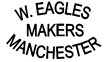 |
Eagles, W., (approx:
1890-approx: 1910),
Manchester, England,
Occurs on 3 bottles,
Manufactured
soda bottles. No information was found for this
firm. The markings are on the reverse heel of the
bottle. |
 |
East Lake
Glass Works, (1883-1904),
Bridgeton, NJ, United States,
Occurs on 36 bottles,
Manufactured beer bottles.
These works were opened in the later part of 1883 under the
proprietorship of Dr. John B. Bowen and Joseph C. Kirby.
Dr. Bowen was the brother-in-law of Kirby, who was a
successful dentist. The works employed about 80 men and
boys and were located on Manheim Avenue near East
Commerce. David McBride, a successful farmer, merchant
and ex-sheriff, bought out Bowen soon after and the firm was
known as Kirby & McBride by 1885. McBride died in 1894 and
his wife continued to function as partner until February of
1904, when they works were sold to I Whelden Moore. The markings are on the
base of the bottle and and are known with numbers 4, 5, 6, 7,
8 and 9. Notes |
 |
Ellenville Glass Works,
(1862-1896),
Ellenville, NY, United States,
Occurs on
9 bottles,
Manufactured beer bottles. This works
was founded in 1836 by a group of men from the Willington
Glass Company in Connecticut. Initially it was named the Ellenville Glass Company
and retained this name, according to sources, until after the
Civil War, when in 1866, the name became the Ellenville Glass Works. However, there were "Glass Works"
bottles recovered from a shipwreck that occurred in
1864. It is thus more likely the name changed between 1862
and 1864 from "Company" to "Works."
After a failure, the works were sold to Charles A. Edwards and
the company became the Ellenville Glass Factory.
However, it is still referred to by contemporary sources as
the "Ellenville Glass Works." This name was
retained until its closing in 1896. The markings are on
the base of the bottle. |
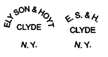 |
Ely Son & Hoyt, (1880-1886),
Ely Sons & Hoyt, (1886-1895),
Clyde, NY, United States,
Occurs on 26 bottles,
Manufactured beer and soda bottles. A bottle bottle blowing factory
was opened in by Southwick and Woods. This factory was
merged with a window glass factory, also in Clyde, under the
name of Southwick, Reed & Company a short time
later. In 1880, the name of the plant became Ely, Son
& Hoyt and in 1886, with the death of William Ely, the
firm became Ely Sons & Hoyt. In 1895, the firm was incorporated as Clyde Glass
Works. (See Clyde Glass Works.) The works stopped operation in 1915 and later
efforts to reactivate it failed. The markings appear on
the base. |
 |
Erie Glass
Company Limited, (1892-1893+),
Port Colborne,
ON, Canada,
Occurs on 8 bottles,
Manufactured
soda bottles. Natural gas discoveries near Port Colborne
were the impetus for attracting industries to the area.
Starting in 1891, negotiations were under way to build a glass
factory there. The Erie Glass Company, operated out of
Toronto, started operation in Port Colborne in 1892. A
wide range of products, included fruit jars, soda, medicine,
and mucilage bottles were manufactured. Both green and
flint wares were produced. The factory burned in
February 1893 and it is not known if it was rebuilt.
What is know is that in 1894, the Erie Glass Company was in liquidation
and there were no listings in the 1895 Port Colborne
directory. The markings are on the base of the bottle.
Notes |
 |
Everett, Edward H., (1880-1885),
Newark, OH, United States,
Occurs on 38 bottles,
Manufactured
beer and soda bottles. Everett purchased the Newark Star
Glass Works in 1880. Everett incorporated his Company in
1885. In 1904, Everett merged his factory with those in Massillon and Wooster into the $4 million Ohio Bottle Company. The following year this company sold some of its land to Everett's newly incorporated Newark Machine Bottle Company, which would install the Owens Automatic machines. In August 1905, the Ohio Bottle and Newark Machine Bottle Companies merged with others to become the American Bottle Company with $10 million in capital.
The markings are on the reverse heel of the bottle.
Often there is a number following the marking. |
 |
Everett, Edward H., & Company, (1885-1904),
Newark, OH, United States,
Occurs on 245 bottles,
Manufactured
beer and soda bottles. Everett purchased the Newark Star
Glass Works in 1880. Everett incorporated his Company in
1885. In 1904, Everett merged his factory with those in Massillon and Wooster into the $4 million Ohio Bottle Company. The following year this company sold some of its land to Everett's newly incorporated Newark Machine Bottle Company, which would install the Owens Automatic machines. In August 1905, the Ohio Bottle and Newark Machine Bottle Companies merged with others to become the American Bottle Company with $10 million in capital.
The markings are on the reverse heel of the bottle. |
 |
Everett Glass Company,
Limited, (1890-1901),
Everett, PA, United States,
Occurs on
7 bottles,
Manufactured beer
and soda bottles. In 1890, this company
reopened the Everett glass works plant that closed in 1885.
When its plant manager died in 1894, David Pugh, who managed the
Queen City Glass Company in Cumberland, Maryland took over.
He introduced the manufacture of flint beer and mineral bottles
to the output of the firm. The bottles were reported to be
so hard that they could be used to drive nails. The works
never appear to have been very profitable and the stockholders
considered selling to several syndicates that wanted to corner
the flint trade. When these deals fell thru, they closed
the plant in 1901 and sold to a new
corporation called the Everett Glass Company in mid-1902. This
company closed up shop in 1906 and the factory was never
reopened. The markings are on the
base of the
bottle. Notes |
 |
Facile Bottle Stopple Company,
(1887-1889),
New York, NY, United States,
Occurs on
4 bottles,
Appears on beer bottles. This company
marketed George Fullerton's bottle stopper and was assigned a
third of the 1888 patent. Fullerton's 1887 patent was
partially assigned to William F. Duncan of New York City and
it is likely he was involved in organizing this company.
The company had a claim in 1889 that was unsettled in 1895 and
since Duncan is not identified with this company in 1890, it
seems it went out of business during 1889. The marking
is on the base of the bottle. |
 |
Fahnestock, Albree & Company,
(approx: 1860-1871),
Pittsburgh, PA, United States,
Occurs on
29 bottles,
Manufactured soda bottles. The firm consisted of Robert C.
Albree and B. L. Fahnestock. This firm was organized in
1860 and remain in effect until 1871. The markings are usually
on the front heel of the bottle. |
 |
Fairmont Bottle
Company, (1906-approx: 1914),
Fairmont, WV, United States,
Occurs on
4 bottle,
Manufactured soda bottles. This glass factory was first chartered on October 24, 1906 and replace the firm of
Johns Brothers. The initial incorporators were James O. Watson, J. C. Hall, John O. Morgan,
C. H. Jenkins, and Thos. F. Robey, all of Fairmont, West Virginia. This plant also manufactured milk
bottles. The last found reference was in 1913. The markings are on the reverse heel of the bottle.
Notes |
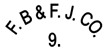 |
Fairmont Bottle & Fruit Jar Company, (1892-1893),
Fairmont, WV, United States,
Occurs on
13 bottles,
Manufactured beer bottles. This glass factory was
first chartered on April 26, 1892. The initial
incorporators were E. J. Bebee, Robert Johns, Jonathan R. Johns,
Jonathan E. Beebe, all of Finlay, Ohio and Abram Kesley of
Martins Creek, Pennsylvania. They were attracted to
Fairmont by
the low cost of natural gas offered to glass manufactures.
By
1911, five glass works operated there. The company was
purported to have
dissolved the following year and reorganized into Johns Brothers.
However, It was still operating as late as September, 1893.
Still later, the firm was known as the Fairmont Bottle Company.
The markings are on the
base of the bottle. |
 |
Fairmount Glass Works,
(1897-1945),
Fairmount, IN, United States, (1898-1906),
Occurs on
13 bottles,
Indianapolis, IN, United States, (1904-1945),
Manufactured soda bottles. The Fairmount Glass Company
was founded in 1889 by John Rau, a practical glass man, W.
C. Winslow, a banker, and a third party. On Winslow's
death in 1894, his son Palmer Winslow became president of the
firm. Palmer Winslow sold his interest to John Rau in
1897 or 1898. Winslow went on to
establish a new works at Matthews, Indiana and John Rau
renamed the factory the Fairmount Glass Works. Possibly
because of the lack of a reliable source of fuel, in 1904, a new
factory was built in Indianapolis and eventually all
operations shifted to this location. The company was
incorporated in 1945 as the Fairmount Glass Works, Inc., in
1960 became the Fairmount Glass Corp., in 1964 Fairmount Glass
Co., and in 1968 it became a subsidiary of the the Glass
Containers, Inc. The markings are on the reverse heel of the bottle. Notes |
 |
Falls City Glass Company, (1884-1892),
Louisville, KY, United States,
Occurs on
5 bottles,
Manufactured beer and soda bottles. This glass factory was
first listed in 1884 and last appears on a 1892 insurance map.
It was located on Lytle Street between 26th and 27th in the
Portland section of Louisville. The markings are on the
reverse heel or base of the bottle. |
 |
Findlay Bottle
Company, (1888-1893),
Findley, OH, United States,
Occurs on
2 bottle,
Manufactured beer bottles. The Findlay bottle company was
organized in 1888 to take advantage of cheap natural gas that
was found in and around Findlay, Ohio. It was one of many
glassworks that opened there in the closing years of the 1880s
who were enticed with five year contracts with marginal gas
rates. Green glass bottles and fruit jars were its specialty.
The company employed about 125 workers and operated eight
pots. The demand of all the factories stressed the gas
supply and factories were limited to only use gas in the
furnaces and to use oil for auxiliary operations like
annealing ovens. An inspection in the spring of 1893
found Findlay in violation of the this regulation and they
were required to pay the highest rates. The went into
receivership soon after and never recovered. The markings are on the
base of the bottle. Notes |
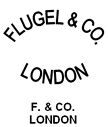 |
Flugel & Company, (approx: 1890-approx:
1950),
London, ENG, England,
Occurs on 1 bottle,
Appears
on soda bottles. Flugel & Company appear to be
suppliers to the soda water trade and most likely were jobbers
for the bottles that bear their mark. The markings
appear on the reverse heel and the base of bottles. |
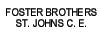 |
Foster Brothers, (approx: 1855-approx: 1874),
Saint Johns, QC, Canada,
Occurs on
1 bottle,
Manufactured soda bottles. This works traces its origin to
the Champlain Glass Company, a window glass works, which
moved its operations from Burlington, Vermont to St. Johns,
Canada East (Quebec) in 1846. This enterprise was a
failure, but this window glass works appears to have continued
as the Canada Glass Works until 1854, when it was purchased by
Joseph Foster and retooled as a bottle factory. This firm
produced bottles and insulators, one of which is dated 1858. The
exact end of the Foster Brothers tenure is not certain, but it
clearly occurred by 1875, when James Macpherson organized the
St. John Glass Company, which went bankrupt in 1878. The Yuile Brothers purchased the works and were operating the
factory in 1879 as the Excelsior Glass Company. They moved
the factory to Montreal in 1880. Through a series of name
changes and acquisitions it became the Dominion Glass Company. The markings are on the face of
the bottle. Notes |
 |
Frank,
William, (1866-1869),
Pittsburgh, PA, United States,
Occurs on
3 bottle,
Manufactured soda bottles. William Frank immigrated from
Germany to the United States in 1840 and at some point lived
in Ohio. In 1846, he came to Pittsburgh, became a
naturalized citizen and ran a dry goods business. He was introduced
to the glass business by his brother-in-law Ephraim Wormser.
In 1858, the pair purchased some land four miles east of
downtown Pittsburgh and built a glass factory. The firm name was
E. Wormser & Company. Frank continued to operate the
dry goods business as W. Frank & Co. until 1861. In March
of 1866, William Frank gained full control of the business.
Wormser turned his attention to an oil business founded a year
earlier, in which Frank was also an investor. In 1870,
the firm became W. Frank & Son. The markings are on the reverse heel or base of the bottle. Notes |
 |
Frank, William, & Sons,
(1870-1876),
Pittsburgh, PA, United States,
Occurs on
5 bottles,
Manufactured soda bottles. Previous sources indicated that
this firm was established in 1866, but this is not supported
by directory listings, marked bottles, some of which bear
William Frank's initials alone, and the fact that his sons
would have been too young (20 & 18 years old) to have been
partners in 1866. In 1870, Hiram and Samuel joined their
father as W. Frank & Sons. This is the first year
this firm appears in the directories. Later Abraham joined his
brothers and father. The factory burned in 1874 and was
rebuilt. 1876 is the last year the Frankstown Glass Works.
This same listing has them also operating as auctioneers and
the firm of W. Frank & Sons continued to operate the dry
goods business until 1880, when William retired. The
markings are on the reverse heel or base of the bottle. Notes |
 |
Franklin
Industrial Company, (1906-approx: 1909),
Warwick,
OH, United States,
Occurs on 5 bottles,
Manufactured beer and soda bottles. The Franklin
Industrial Company was a conglomerate founded by investors
from Massillon, Ohio. They purchased a number of industries in
and around Warwick, Ohio. The company was named after
Franklin Township, where Warwick is located. Most of
these industries were related to mining sand, clay, stone and
gravel, but also included a furnace company and the Warwick
Glass Company. The firm advertised as a specialty beer
bottles and produced mainly amber glass, but an aqua soda
bottle is known. A fire in 1909 may have spelled the end
of this factory as a Franklin enterprise. It could not
be found as an inspected factory in the 1910 or 1911 Ohio
reports. When
the factory was reopened in 1913 as the Warwick Glass Company, accounts stated
the it was "long close." The other
segments of the Franklin Industrial Company operated for
decades. The markings are on the reverse heel of the bottle.
Notes |

 |
Franzen, William, & Son, Milwaukee, (1901-1926),
Milwaukee, WI, United States,
Occurs on 47 bottles,
Manufactured
beer and soda bottles. William Frazen took over the financially
failing Northern Glass Company in 1896. The company put
a focus on producing beer bottles for Milwaukee's brewers and
this would eventually lead to its downfall. Frazen
incorporated the works as William Frazen & Son in 1901 and
became Wisconsin's most successful glass manufacturer.
However, when Prohibition fell in 1919, the need for beer
bottles dried up. The Board of Directors voted to scale
back operations in 1921 and the plant was closed in 1926.
The markings appear on the base of the bottle and occasionally on
the heel. |
 |
G. & Company, (approx: 1895-1905),
Unknown, United States,
Occurs on 1 bottle,
Manufactured soda bottles. Appears on at least one
Hutchinson shaped soda bottle from the Midwest. Could be
an error for "C. & Co." The markings appear on the reverse
side on the heel of the bottle. |
 |
Gayner Glass Works,
(1898-1956),
Salem, NJ, United States,
Occurs on
3 bottles,
Manufactured mineral water bottles. John Gayner was born
in England and learned the trade from his father while growing
up there. He came to the United States with his wife and
four children. After several failed attempts both in
England and the United States, he succeeded in Salem. The firm name of the
Gayner Glass Works was adopted in 1898. The works specialized
in large wares and specialty items and continued to have hand
blown operations, in addition to automated blowing machines,
well after hand blowing shops were closed at other works. The business was sold to Star City Glass
Company in 1956, but the Gayner name continued to be used for
the Salem plant until 1975 when it was closed. It was
briefly reopened in 1977, but closed permanently in 1979. The markings appear on the base of the bottle. Notes |
 |
Glenshaw Glass
Company, (1895-2007),
Glenshaw, PA, United States,
Occurs on
13 bottles,
Manufactured soda bottles. The Glenshaw Glass Company was
started in 1895 by a group of Pittsburgh glass blowers.
One of it specialties was the manufacture of siphon
bottles. The company became Kelman Bottles LLC in 2008. Notes |
 |
Greenbank Glass Works,
(approx: 1840-1850, 1857-1858),
Green Bank, NJ, United States,
Occurs on
2 bottles,
Manufactured beer bottles. William Coffin Sr. established
this glass house in about 1840. Coffin died in 1844 and
John H. Coffin took over management of the works. He
closed the works in 1850. It was reopened in 1857 and
operated for one year as a cooperative by a group of
glassblowers and was permanently closed in 1858 on their
failure. The markings appear on the reverse side of the
bottle. |
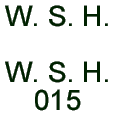
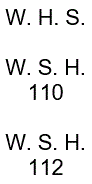 |
H., W. S., (approx:
1890-approx: 1905),
Diamond Glass Co., Royersford, PA, United States,
Occurs on 22 bottles,
Allentown Flint Bottle Co., Allentown, PA, United States,
Occurs on 2 bottles,
Manufactured soda bottles. The mark appears on the base of
Hutchinson bottles mainly from Lehigh Valley and surrounding
areas of Pennsylvania. A bottle with this marking of "W.
H. S." on the base has surfaced from the firm of O'Brien &
Keenan of Pottsville, Pennsylvania. This exact bottle
is illustrated in the catalogue of the Diamond Glass Company of
Royersford, Pennsylvania. The known bottles with this
exact mark have a distribution that matches other bottles
produced by this company. Several of these bottles exhibit
a slanted "AND" in the firm names, which is embolic of known
bottles produced by the Diamond Glass Company. It is
believed that the "W. H. S." comes form the first user of this
specific mold who was William H. Shipley of Frederick, Maryland.
An alternative mold reverses the "H" and "S" and adds the number
15 to the base. The known bottles with this mark are from
Eastern Pennsylvania and North Eastern, New Jersey. Two
firms, J. C. Boyer of Lebanon and the Hellertown Bottling Works has bottles with
both of these marks, so it is being attributed to Diamond
also. Two Hellertown bottles buck the trend of these bottles as
they are flint glass. It is known that Diamond did not
produce this style of glass during the era Hutchinson bottles
were manufactured. However, Hellertown is very
close to Allentown and the Allentown Flint Bottle Company, which
exclusively produced flint glass. Known marks for this
firm include the numbers 110 on Hutchinson bottles with round
bases and 112 on Hutchinson bottles fluted bases. These
numbers correspond to the rounded base and fluted based bottles
from the Hellertown firm. So these bottles are being
attributed to the Allentown works. Hellertown also has a
mark that does not fit into this pattern. It remains unassigned
and is likely just a mark they requested from another
manufacturer. Why was Hellertown Bottling Works so tied to
this mark? Likely because Hutchinson bottles were placed
upside down in cases of 24 bottles and seeing the "W. S. H." or
"W. H. S." on the base identified them as their bottles and not
ones of a competitor, which they could not legally use. The markings appear on the base of the bottle. |
 |
Hagerty
Brothers & Company, (approx: 1869-1953),
New York, NY, United States,
Occurs on
9 bottles,
Appears on beer bottles. They were glass jobbers. The business started as Hagerty
& Lear (Bernard B. Hagerty & Harry Lear), who were suppliers of
druggists glassware and were in business as early as 1851 and
possibly 1849, the date claimed in later advertisements.
The firm became B. B. & J Hagerty by 1857 and remain so to at
least 1862. They were located at 8 & 10 Platt Street in
New York City and remained at this address for the next 70 plus
years. By 1867 the firm became Hagerty Brothers and
remained so until 1869 when it became Hagerty Brothers &
Company, which it retained until 1953 when the business closed.
For many years they represented the Haggerty Glass
Works. This factory on Smith Street was known as the Hamilton Glass
Works in 1851. By 1868, it was known as the Brooklyn Green
Glass Works operated by a partnership between B. B. Hagerty, Wm. W.
Gardiner and Wm. Burrows with Hagerty Brothers as agents.
Later the works, now called the Hagerty Glass Works, were under
the control of B. B. Hagerty & Co. with Hagerty Bros. & Co. as
agents. By 1888, Annie J., Bernard's wife, was in control
of the works as A. J. Hagerty & Co. and remained so until
at least 1896 and Hagerty Bros & Co. were agents. The
works were still in operation in 1900, but were closed by 1904.
The markings appear on the base of the bottle. |
 |
Hagerty Glass Works, (approx:
1870-approx: 1902),
New York, NY, United States,
Occurs on 1 bottle,
Manufactured beer bottles. These works were located in
Brooklyn. There were two distinct businesses associated
with this glass factory at 531 Smith Street between 9th Street
and Hamilton Avenue. The older business started as Hagerty
& Lear (Bernard B. Hagerty & Harry Lear), who were suppliers of
druggists glassware and were in business as early as 1851 and
possibly 1849, the date claimed in later advertisements.
The firm became B. B. & J Hagerty by 1857 and remain so to at
least 1862. They were located at 8 & 10 Platt Street in
New York City and remained at this address for the next 70 plus
years. By 1867 the firm became Hagerty Brothers and
remained so until 1869 when it became Hagerty Brothers &
Company, which it retained until 1953 when the business closed.
The factory on Smith Street was known as the Hamilton Glass
Works in 1851. By 1868, it was known as the Brooklyn Green
Glass Works operated by a partnership between B. B. Hagerty, Wm. W.
Gardiner and Wm. Burrows with Hagerty Brothers as agents.
Later the works, now called the Hagerty Glass Works, were under
the control of B. B. Hagerty & Co. with Hagerty Bros. & Co. as
agents. By 1888, Annie J., Bernard's wife, was in control
of the works as A. J. Hagerty & Co. and remained so until
at least 1896 and Hagerty Bros & Co. were agents. The
works were still in operation in 1900, but were closed by 1904.
The markings appear on the base of the bottle. |
 |
Hahn & Foster, (1888-1889),
New York, NY, United States,
Occurs on
13 bottles,
Appears on beer bottles. The mark appears on the base of pint
and quart champagne beer bottles mainly from Northeast
Pennsylvania, Northern New Jersey, New York City and Long
Island. This short lived firm was a partnership between the
experienced bottle jobber Thomas J. Hahn, who was associated
with Hastings and Hahn, and Henry G. Foster, a grocer. It would
appear that Hahn was looking for a partner who could infuse
capital into the business. The new firm moved to a more
prestigious location on Murray Street and may have had the molds
made for beer bottles allowing them to be more competitive
offering individualized bottles to their clients. The firm was
dissolved by the end of March, 1889. Foster went back to the
grocery business and Hahn continued the bottle jobbing business
and likely continued to use the two molds made for the previous
firm. The markings appear on the base of the bottle. Notes |
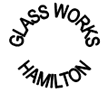 |
Hamilton Glass Works, (1864-1891),
Hamilton, ON, Canada,
Occurs on
15 bottles,
Manufactured soda bottles. According to the Hamilton
Spectator, this factory started operation on September 12, 1864
and was owned by Gatchell, Moore & Company. The works were
located on James Street North and there were about 50 employees half
of which were glass blowers. The production was to
consist of small bottles. In 1872, George Rutherford &
Company took over the works and retained ownership until 1891,
when the works were sold to the Diamond Glass Co., which closed
the plant in 1898. The plant was refurbished and Diamond
installed Owens Automatic bottle machines in this plant in 1906
and operated it as their Hamilton Plant until 1913, when it was
sold to the Dominion Glass Company Limited. The markings are
on the base of the bottle. |
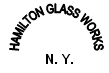 |
Hamilton Glass Works, (1851-1854),
New York, NY, United States,
Occurs on 1 bottle,
Manufactured soda bottles. This works was located on the
corner of Hamilton Avenue and Smith Street in Brooklyn.
The works were advertised on September 12, 1851 in an Albany
newspaper right above a notice for the sale of the Albany Glass
works. Daniel O. Ketchum & Company were listed as the
proprietors. Ketchum had been the agent for the Albany
Glass Works prior to its closing in 1851. The last listing
for Ketchum & Company was in the 1854 New York Directory. In later years the works
became the Brooklyn Green Glass Works and still later the
Hagerty Glass Works. By 1859, Ketchum was in the oil
business at Smith near Hamilton. The markings are on the
reverse side of the bottle.
Notes |
 |
Hamilton,
James T & Albert, (1879-1943),
Pittsburgh,
PA, United States,
Occurs on
6 bottle,
Manufactured beer bottles. James T. and Albert were
associated with the W. H. Hamilton glass works until 1879,
when they established their own glass works at 26th and
Railroad Streets. Their specialty was flint glass bottles, which
included beer, whiskey, and milk bottles in addition to prescription
wares. In 1887 a plant was established at Butler and in
1902 a third plant was opened at Blairsville. Albert was murdered in 1902 and James continued
the works incorporating on December 11, 1916. The milk
bottle business was to be sold to Thatcher in 1920, but
Hamilton was advertising machine made milk bottles in 1922 and
in later years before the business was sold to Knox in
1943. At this time the factory was renamed the Seaboard Glass Bottle Co.
The makers mark was filed in 1912 and was issued a trade
Marked in 1915. The application claimed it to be in use
in 1900. The markings are on the base of the bottle.
Notes |
 |
Hastings & Hahn, (1877-1892),
New York, NY, United States,
Occurs on
5 bottles,
Appears on beer bottles. Andrew K. Hastings and Philip
J. Hahn formed the company of Hastings & Hahn in
1877. the company was located at various addresses on
Murray street over the years. They were glass jobbers,
but advertised as manufactures in trade magazines. However there
is no evidence that they every manufactured glass.
Hastings retired from the firm in 1892 and the firm was succeeded
by Philip J. Hahn & Son. The markings appear on base of the bottle.
Notes |
 |
Hawley Glass Company, (1885-1942),
Hawley,
PA, United States,
Occurs on
10 bottles,
Manufactured soda bottles. In 1882, the Hawley Glass
Company Limited was built on Crystal Street in Hawley along
with several company houses, which were rented to the factory�s
workers. The initial workers were strikers from the
Honesdale Glass Works and William F. Dorflinger was their
agent. It was incorporated in 1885 as the
Hawley Glass Company. The factory may have closed in
1887 due to labor troubles. It is possible that the
factory was reopened between 1902 and 1906 as the Harloe
Insulator Company. The Hawley Glass Company was listed
in a 1928 phone book and a 1936 Directory. The factory
and surrounding buildings were destroyed by a flood in
1942. The markings appear on base of the bottle. |
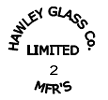 |
Hawley Glass Company Limited,
(1882-1885),
Hawley, PA, United States,
Occurs on
6 bottles,
Manufactured soda bottles. In 1882, the Hawley Glass
Company Limited was built on Crystal Street in Hawley along
with several company houses, which were rented to the factory�s
workers. The initial workers were strikers from the
Honesdale Glass Works and William F. Dorflinger was their
agent. It was incorporated in 1885 as the Hawley Glass
Company. The factory may have closed in 1887 due to
labor troubles. It is possible that the factory was
reopened between 1902 and 1906 as the Harloe Insulator
Company. The Hawley Glass Company was listed in a 1928
phone book and a 1936 Directory. The factory and
surrounding buildings were destroyed by a flood in 1942.
The markings appear on base of the bottle. |
 |
Heitz, Frederick Glass Works, (1882-1897),
Saint
Louis, MO, United States,
Occurs on
14 bottles,
Manufactured beer bottles. Frederick Heitz came to the
United States from Germany in 1860 and eventually settled in
Saint Louis where he was a grocer and operated a saloon.
In a mystery yet to be unraveled, he ended up the operator of
a glass works at the Northwest corner of Main & Dorcas
Streets in 1883. This location was unoccupied according
to a 1875 map so the factory must have been newly built.
This property was extremely close to the Anheuser-Busch
brewery and it is believed that most of the production went to
that enterprise. Heitz is last listed in 1897 as a glass
maker and returned to the grocery business. He is not
listed in the 1910 Census. During 1900, the
Adolphus Busch Glass Manufacturing Company had control of the
works and was producing beer bottles for the Anheuser-Busch
Brewery. The markings appear on
the base of bottles. Notes |
 |
Hemingray Glass Company, (1882-1933),
Covington, KY, United States, (1882-1890),
Occurs on 20 bottles,
Muncie, IN, United States, (1888-1933),
Manufactured soda bottles.
Hemingray started as Gray and Hemingray in 1848 and was listed listed in the 1850
federal Industrial Census. The original plant was located in Cincinnati,
Ohio, but in 1851 was moved to Covington, Kentucky. In
1864, Gray left the firm and it became Hemingray Brothers &
Company. The
company was widely known for its early production of insulators
and fruit jars, although it is attributed for the manufacture of
many of the early blue soda bottles from Cincinnati. In
1882, The Hemingray Glass Company was organized. In 1888,
the company established a plant in Muncie, Indiana and phased
out the Covington Works. The Company was acquired by
Owens-Illinois Glass Company in 1933. The markings appear on
the base of bottles. |
 |
Holt Glass Works, (1893-1906),
West Berkeley, CA, United States,
Occurs on 32 bottles,
Manufactured soda and beer bottles. This factory was built
on the site of the ill-fated Campbell Glass Works. The
initial company operated for three years until it ended it went
bankrupt. It reopened under new management and was
growing, when it was destroyed by the 1906 San Francisco
earthquake. The markings are on the base of the bottle,
usually preceded by a number in the 300-399 range, and made in a
four part mold. |
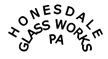 |
Honesdale Glass Works, (1847-1861),
Honesdale, PA, United States,
Occurs on
14 bottles,
Manufactured soda and beer bottles. A window glass plant,
called the Bethany Glass Works, was established in Bethany,
which is northwest of Honesdale, in 1818 by Christopher Faatz
and several others. The works eventually failed and was
reopened by Jacob Faatz in 1829. He operated the factory
until 1839, when it failed as well. On June 4, 1847, Jacob
Faatz broke ground for a new glass works at the mouth of Carley
Brook east of Honesdale at Traceyville, now known as East
Honesdale. Soon after, it was taken over by Henry Dark and
James Dickson, who failed when they shipped a large order of
window glass overland to California. The works were
briefly owned by by R. F. Lord and T. H. R. Tracey who sold the
works to James Brookfield in 1849 . Brookfield and E. V.
White patented an anthracite fired glass furnace and installed
it in their factory in 1851. As a result, at one point
this factory was named the Anthracite Glass Company.
In 1861, due to a flooding storm, a dam to one of the feeder ponds for the Delaware & Hudson Canal gave way
and the water rushed down Carley Brook destroying the glass factory.
Brookfield moved his glass making operation to Brooklyn, New
York and became a celebrated manufacturer of insulators.
In 1872, the works were restored and incorporated by
Christian Dorflinger, W.W.
Weston, C. S. Minor, Wm. Weiss, W. H. Ham, and J. A. Terrel.
Dorflinger had established a
glass factory in White Mills, about six miles south of
Honesdale, in 1865 to manufacture fancy cut glass ware. The
Honesdale Glass Works were incorporated in 1887 and became the
Honesdale Glass Company in 1897. In 1902, the works were
dismantled and the usable material was taken to White Mills to
be incorporated into an expansion of the Dorflinger plant.
The markings are on the reverse of the bottle. |
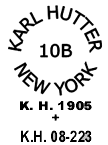 |
Hutter, Karl, (1877-1913),
New York, NY, United States,
Occurs on 684 bottles,
Appears on soda and beer bottles. Hutter started out his
career as a beer bottler and ended up in the bottler supply
business. His main claim to fame was being assigned sole
rights to Charles De Quillfeldt's beer bottle closure, when it
was reissued in 1877. Hutter renamed it the "Lightning
Stopper" and it quickly became the standard for the beer
bottling industry. He survived several patent infringement
lawsuits during the early 1880s when his office was at 185
Bowery Street in New York and a manufactory in Bennington,
Vermont. At that time, he had a large trade with glass
houses acting as a "representative character" between the
bottler and glass works. In 1892, Hutter's office at 32
Reade Street sustained fire damage. In 1893, he patented an improvement to
the Lightning, which consisted of a ceramic plug with a rubber
washer to replace the metallic head of the Lightning. In
1904, the business was still located at 32 Reade Street. Hutter committed suicide after a long illness at his apartment
overlooking Central Park on June 15, 1913. He was 62. At
that time, the business was located at 241 Lafayette Street in
New York City. The
firm later became Karl Hutter, Inc. and was still in business as
late as 1930 at 241 Reade Street location. The
markings are on the base or the reverse heel of the bottle. |
 |
Ihmsen Glass Company, Limited, (1878-1899),
Pittsburgh, PA, United States,
Occurs on 23 bottles,
Manufactured beer bottles. This company was founded by
Christian Ihmsen Jr. in 1878 as a window glass factory. In 1878
or 1879, it took over the Christian Ihmsen & Sons, a bottle
making plants, and had a factory at 14th and Neville
The company was still advertising the manufacture of soda and
beer bottles in 1896 and is last listed in a 1897 Pittsburgh
Directory as a Limited Company, after which the Limited was
dropped. The firm was purportedly sold to the American
Window Glass Company in 1899, but was listed in a 1900
Pittsburgh Directory. It was not listed as a glass plant
in a 1904 glass trade directory. The markings appear on
the base of the bottle. |
 |
Ihmsen, Christian, & Company, (1854-1860),
Pittsburgh, PA, United States,
Occurs on
5 bottles,
Manufactured soda bottles. This
company was the successor to C. Ihmsen by 1854 and consisted of
Christian, Charles T., and William Ihmsen and Franklin McGowin.
A disastrous 1854 fire destroyed the company's packing house and
black bottle factory. In 1857 the firm's offices were
located at 104 Second Street and 133 and 135 First Street and
advertised that they operated five distinct glass factories and
produced window glass, flint glass, vials, black porter and
mineral water bottles. The firm became C. Ihmsen & Sons in
1860, when McGowin left the firm. The markings are either
in the front or reverse heel of the bottle. |
 |
Ihmsen, Christian, & Sons, (1860-1876),
Pittsburgh, PA, United States,
Occurs on
4 bottles,
Manufactured beer bottles. The firm was organized in 1860
and consisted of Christian, Charles T., M. O'Connor, and
William Ihmsen. Christian Ihmsen died in 1862. In 1864,
their officers were located at 104 Second Street and 133 and 135
First Street and the factory was at WIlkin's near Neville in
Birmingham and produced window glass, vials, black porter and
mineral water bottles. The firm was listed in the 1875
directory and was noted as being in the hands of an estate and
not operating in 1876. Other than Dominic,
no Ihmsens were listed 1877 Pittsburgh directory. The
factory was absorbed by the Ihmsen Glass Company Limited in 1878
or 1879. The markings are on the base of the bottle. |
 |
Illinois Glass Company, (1873-1929),
Alton, IL, United States,
(1873-1929)
Occurs on 488 bottles,
Gas City, IN, United States, (1900-1929),
Chicago Heights, IL, United States, (1913-1929),
Bridgeton, NJ, United States, (1920-1929),
Manufactured soda and beer bottles. In 1873, William Smith
and Edward Levis organized the Illinois Glass Company and built
a one furnace glass factory on Bell Street in Alton, Illinois.
Four years later, they purchased land on the Mississippi River
and built a new plant there with two large furnaces. In
1879, a third furnace was added and by 1909, there were eleven.
In 1905, over one million gross bottles were produced by hand.
In 1909 the plant had to be rebuilt to accommodate the Owens
Automatic bottle making machines. In 1876, there were 63
crew men and boys working in the plant and by 1915, there were
2,400 workers managing 31 automatic bottle making machines.
In 1900, Illinois expanded by opening a plant in Gas City,
Indiana and two years later, the Illinois Pacific Glass Company
was established. In 1929, when it merged with the Owens
Bottle Company to form the Owens-Illinois Glass Company At
that time, Illinois had plants in Alton, Chicago Heights, Gas
City, and Bridgeton, New Jersey. The markings appear on base
or the reverse heel of the bottle. Notes |
 |
Illinois Pacific Glass Company, (1902-1926),
San Francisco, CA, United States,
(1902-1926),
Occurs on
3 bottles,
Los Angeles, CA, United States, (1903-1926),
Manufactured soda and beer bottles. This firm was founded
n 1902 when Illinois Glass Company consolidated holding and
interests in several businesses in California. In 1904, a
second factory was established in Los Angles. The 1906 San
Francisco earthquake destroyed the offices and warehouses, but
spared the factory. In 1926, the company incorporated.
In 1930, they merged with the Pacific Coast Glass Company to
form the Illinois Pacific Coast Company. The marking
appear on the reverse heel or base of the bottle. |
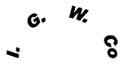 |
Indianapolis Glass
Works Company, (1869-1877),
Indianapolis, IN, United States,
Occurs on
2 bottle,
Manufactured beer bottles. Company was reported to have
been started by six Germans in 1869. The company was
organized with $100,000 in capital and employed upwards of eighthly-one
workers. In 1878, all of the principles were no longer listed
in the directories, and neither is the glass works.
Bottles and fruit jars were listed among its products.
In 1880 the company was in receivership and in litigation. The markings are on the
base of the bottle. Notes |
 |
Interstate Glass Company, (1902-1903),
Kansas
City, MO, United States,
Occurs on
6 bottles,
Manufactured soda bottles. Company was reported to have
operated for two short years. The markings are on the
reverse heal of the bottle. |
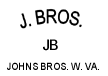 |
Johns Brothers, (1893-1907),
Fairmont, WV, United States,
Occurs on 31 bottles,
Manufactured soda and beer bottles. This glass factory was
established as the Fairmont Bottle & Fruit Jar Company in 1892.
The Johns Brothers, Robert and Jonathan, were among the initial
founders. The initial company dissolved and reorganized into the
Johns Brothers. They remained in business until about
1907, when they were listed in a catalogue, but became the
Fairmont Bottle Company soon after. Robert Johns remained
the manager of the new company. The markings are on the
base or the front heel of the bottle of the bottle. |
 |
K. Glass
Company,
(Approx: 1893-1897),
Unknown, United States,
Occurs on
6 bottles,
Manufactured soda and beer bottles. The firm that produced
these bottles is not confirmed. The manufacturer was
likely in Pittsburgh vicinity or the Ohio Rive Valley. The markings are on the reverse
heel or base of the bottle. |
 |
Kearns-Gorsuch Bottle Company,
(1894-1937),
Zanesville, OH, United States,
Occurs on
4 bottles,
Barnesville, OH, United States, (1912-1921),
Manufactured soda bottles. The company was reorganized as
the Kearns-Gorsuch Bottle Company in 1894, with $30,000 it
received from the Zanesville Board. Its predecessor
was the Kearns, Gorsuch Glass Company, which was incorporated on
February 10, 1886. The offices and primary plant (plant # 1) were located at 126 Market Street, and a second plant
(plant #2) was at Ridge Avenue and the Terminal Railway
In 1912, a plant was added at Barnesville, Ohio when it
purchased the Barnesville Bottle Company. This plant was not
rebuilt after it was destroyed by a fire in 1921. In 1920, the Hazel-Atlas Glass Company purchased the
company and it became a division. In 1937, the Kearns-Gorsuch
Bottle Co. was dissolved and absorbed into Hazel-Atlas.
Plant # 1 was closed in 1957 and in 1964 plant # 2 was purchased by the
Brockway Glass Company. The markings are on the reverse
heel of the bottle. |
 |
Kearns, Herdman & Gorsuch,
(1876-1886),
Zanesville, OH, United States,
Occurs on
3 bottles,
Manufactured soda bottles. This company is purported to
have started in 1876. They published a catalogue in that
year. The predecessor company was Gorge W. Kearns &
Company, which went back to 1842. On February 10, 1886,
the firm was incorporated as the Kearns, Gorsuch Glass
Company. The markings are on the reverse
heel of the bottle. |
 |
Kensington Glass Works, (1842-1846),
Philadelphia, PA, United States,
Occurs on
3 bottles,
Manufactured beer bottles. Henry Seybert, a wealthy chemist
and investor, rented one of the closed Dyottville factories in
1842, primarily to manufacture soda bottles for Eugene Roussel.
He listed the factory as the Kensington Glass Works in a
Philadelphia Directory. The works were sold to Benners,
Smith and Campbell, who operated it as the Dyottville Glass
Works in 1846. The markings are on the front of the
bottle. |

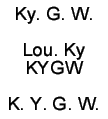 |
Kentucky Glass Works Company, (1879-1889),
Louisville, KY, United States,
Occurs on
13 bottles.,
Manufactured soda and beer bottles. The Kentucky Glass
Works Company was incorporated on July 23, 1879 by Edward Bull,
William Cromey and John Stanger, Sr. This works and the
Southern Glass Works were leased starting in 1886 by T. H.
Sherley & Company, who were whiskey dealers and were last listed
in 1889. Research indicates that this firm used marks
without "Co" designator in its earlier years. The markings appear on the base or the reverse
heel of the bottle. |
 |
Keystone
Bottle Manufacturing Company, (1907-1920),
Uniontown, PA, United States,
Occurs on
14 bottles,
Manufactured soda and beer bottles. The
Keystone Bottle Manufacturing Company was founded by the Sharp
Brothers in 1907 in Uniontown at the location of the closed
Uniontown Flint Glass Company. The Sharps were experienced
glass men who worked with their father at the Ellenville Glass
Works in New York. After a fire that destroyed the factory
on December 30, 1907, it was rebuilt and incorporated in
July of 1908. Herman Gross was an investor and elected
secretary of the firm. He also represented the works as a
glass jobber in
Hartford, Connecticut. He appears to have withdrawn from
the firm about 1913. Conrad L. Meyer in New York City then
picked up representation of the works. The works continued
to grow, but was limited by ground to expand. Eventually they purchased
more property, but the decease in demand for beer bottles due to
Prohibition, cheaper machine made bottles, loosing a lawsuit, and a devastating
fire in 1920 sealed the fate of this works. The company
was listed in 1921, but appears to have been defunct. The markings appear on
the reverse heel of the bottle. The works were often
referred to as the Keystone Bottle Company, which matches the
makers mark on the known bottles. Notes |
 |
Koscherak Siphon Bottle Works, (1913-approx: 1927),
Hoboken, NJ, United States,
Occurs on
3 bottles,
Manufactured soda bottles.
This company had its origins in 1887 when Emanuel Koscherak
emigrated from Austria to New York City. Apparently he had
some connection to glass manufactures in his homeland and a
contract with Carl H. Schultz, the large mineral water
manufacturer, in 1889 put the business on a good footing.
Emanuel joined forces with Ignatz Koscherak in 1890 or 1891 as
Koscherak Brothers. In 1899 Ignatz moved into the bottle stopper
business and Emanuel was the sole proprietor of Koscherak
Brothers. Emanuel brought two of his sons, Otto L. and
Ernst B., into the business soon after. When Emanuel died
in 1907, his widow Emma, and sons Otto and Ernest took over the
business. The business had two major branches; siphon
bottles and supplies and china and glassware. In 1911,
Ernest had control of the Koscherak Brothers and appears to be
focused on the china and glassware business, whereas Otto
appeared to be focused on the siphon business. This
resulted in the establishment of the Koscherak Siphon Bottle
Works, a New Jersey corporation, in 1913 with $100,000 in
capital and Charles A. Riegemann, Herman Engel and Otto L.
Koscherak as incorporators. The firm was chartered to
manufacture siphon bottles and siphon heads and a factory was
established in Hoboken, New Jersey. Otto had a number of
different business running during the 1920s and the Siphon Works
appears to have been absorbed into the Koscherak Bottlers
Equipment Company and the Seal-Again Bottle Stopper Company
sometime after 1926 and by 1928. The markings appear on
the base of the bottle. Notes |
 |
L., H.,
(approx: 1900-approx: 1910),
New York, NY, United States,
Occurs on
8 bottles,
Appears on soda bottles. Mark appears on the base a
Hutchinson bottle and is likely of a New York City glass
jobber. The markings are on the base of the bottle. |
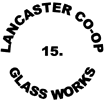 |
Lancaster Cooperative Glass Works,
(1888-96 & 1898-1903 & 1907-08),
Lancaster, NY, United States,
Occurs on
7 bottles,
Manufactured beer bottles. The Lancaster Glass Works was
founded in 1849. Dr. James eventually gained control of
the works and when he retired from the glass making business in
1888, a group of workmen took over the plant and
formed the Lancaster Co-operative Glass Works. It may have
been briefly known as the Lancaster Cooperative Glass Works
Company in 1895 and 1896, but records are contradictory.
In 1897 and 1898, it was listed
as a "limited" liability company, but reverted back by
1899. It is purported
to have closed in 1903 or 1904, but reopened in 1907 and operated
under this name during 1908. By 1909, the works was
converted to a flint factory and reverted to the Lancaster
Glass Works name. The markings are on the base of the bottle. Notes |
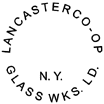 |
Lancaster Cooperative Glass
Works Limited,
(1897-1898),
Lancaster, NY, United States,
Occurs on
3 bottle,
Manufactured beer bottles. The Lancaster Cooperative Glass Works
was briefly reorganized as a limited liability company in
about 1897 and was listed as such by various period
sources. Some time during the following year, the
limited liability company was dissolved. The markings are on the base of the bottle. Notes |
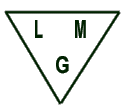 |
L. M. G.,
(approx: 1895approx: 1910),
Unknown, United States,
Occurs on
4 bottles,
Manufactured beer bottles. Unknown manufacturer or
jobber who made at least four different bottles for Long Island
bottlers. The markings are on the base of the
bottle. Notes |
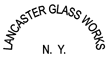 |
Lancaster Glass Works,
(1849-1861),
Lancaster, NY, United States,
Occurs on
10 bottles,
Manufactured soda and beer bottles. The works was formed
in 1849, when eight glass workers from Pittsburg formed the company Reed,
Allen, Cox & Company. By 1859, it became Reed, Shinn &
Company. In 1862, James, Gatchell & Company bought the
works at auction.
Later, in 1864, Dr. James and N. B. Gatchell bought out their
partners and the firm became James & Gatchell. In
1873, Gatchell
left and the works became the James Glass Works. Gatchell
ended up running the Rochester Glass Works the following year. When James
retired in 1888, a group of workmen took over the plant and
formed the Lancaster Co-operative Glass Works and was still
operating under that name in 1895. between 1897 and 1898, it was listed
as a "limited" company, but this was dropped by 1899
The works continued to about 1903, closed and briefly reopened
in 1907 and 1908. In 1909 it was operated as a flint
glass works and reverted back to the name of Lancaster Glass
Works. The works were razed in 1920.
The markings are on the front or reverse side of the bottle. |
 |
Lindell Glass Company, (approx:
1873-1890),
Saint Louis, MO, United States,
Occurs on 36 bottles,
Manufactured soda and beer bottles. It was listed as
having be established within the three years prior to 1875
according to proceedings at the National Railroad Convention in
1875. Additionally, it appears on a 1875 map of Saint
Louis and lists William Gray as the president. It was
listed as operating in October 19, 1885 New York Times article.
Prior to 1886, when it established its own glass manufactory,
the Adolphus Busch Brewing Company was supplied beer bottles by
Lindell. It was purported to have been absorbed by the
United States Glass Company in 1890. The markings appear
on the base or reverse heel of the bottle. |
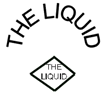 |
Liquid
Carbonic Acid Manufacturing Company, (1888-1902),
Liquid Carbonic Company (The), (1903-1984),
Chicago,
IL, United States,
Occurs on
14 bottles,
Appears on soda bottles. The firm was a jobber of
bottles. Jacob Baur, an Indiana
druggist, came to Chicago and established the Liquid Carbonic
Acid manufacturing Company in 1888. The business was
slow to start, but gradually the concept of using liquefied
CO2 gas caught on and the company grew significantly.
The firm branched into manufacturing soda fountains and
supplies and then moved into bottlers supplies. During 1902,
the name was shortened to The Liquid Carbonic Company.
As early as 1900, the firm used the moniker "The
Liquid" which is found on the base of bottles.
Aggressive advertising fueled their growth and they purchased
many of their competitors. They were acquired by CBI
Industries in 1984. The markings appear
on the base of the bottle. Notes |
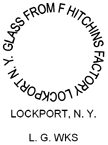 |
Lockport Glass Works, (1843-1872),
Lockport, NY, United States,
Occurs on 4 bottles,
Manufactured soda and beer bottles. The Lockport Glass
Works was established in 1843 by a Mr. Twogood in a building
that was a tallow chandlery at Gooding and Grand. He sold
the works to Parsons & Moss in 1844. In 1845, the works
are purchased by Hildreth & Company. In 1846, they started
to build a new factory in the Northeast section of Lockport.
In 1850 Francis Hitchins purchased one of the partners' interest
in Hilreth & Company. In 1851, Hitchins leased the glass
factory and in 1853, he purchased the works and operated them
until 1866. In that year, it was incorporated as the
Lockport Glass Manufacturing Company by a group of glassworkers.
In 1869, the works were sold to Samuel B. Rowley, a Philadelphia
based fruit jar manufacturer. Rawley made major
improvements to the factory and sold it to Alonzo Mansfield in
1872 as A. J. Mansfield & Company. In 1904, it was
reorganized into the Mansfield Glass Works, was listed as closed
in 1905 and sold at auction in 1908. The markings appear on the
base of the bottle. |
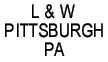 |
Lorenz & Wightman, (1851-1854),
Pittsburgh, PA, United States,
Occurs on
1 bottle,
Manufactured soda bottles. This
firm was formed in 1851 by Frederick Lorenz and Thomas Wightman
to operate the Pittsburgh Glass Works, which was Pittsburgh's
first glass house founded in 1797 by Craig & O'Hara. When
Frederick Lorenz died in October 28, 1854, Wightman retired and Lorenz's son Frederick R. Lorenz
operated the works. Frederick R. Lorenz became ill and retired
before 1860 and the factory was rented to Fahnstock,
Albree & Company. The markings are on the reverse side of the
bottle. |
 |
Lorenz & Wightman, (1862-1873),
Pittsburgh, PA,
United States,
Occurs on 63 bottles,
Manufactured soda and beer bottles. This was a new company
that took over the glass works from Fahnstock, Albree & Company,
when their lease ended. The partnership was between Moses
A. Lorenz, Thomas Wightman and Alexander Nimick. In 1870
their office was at 32 Wood Street in Pittsburgh. The firm
dissolved in 1873, when Moses Lorenz died, and became Thomas
Wightman & Company. The markings are on the reverse heel or
base of the bottle. |
 |
Lorenz, Frederick R.,
(1854-1859),
Pittsburgh, PA, United States,
Occurs on
10 bottles,
Manufactured soda bottles. Lorenz took of the
business of Lorenz & Wightman when his father died in 1854.
He operated the works through 1857 as the Penn Glass Works.
By 1860, the works were leased by Fahnstock, Albee & Company.
The markings appear on the the front or back of the bottles. |
 |
M. Glass Company,
(1895-1900),
Unknown, United States,
Occurs on
2 bottles,
Manufactured beer bottles. This unknown company made a
bottle for a Buffalo concern that operated in the latter part
of the Nineteenth Century. The markings are on the base of the bottle.
Notes |
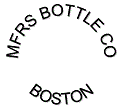 |
Manufacturers' Bottle Company,
(1899-1912),
Boston, MA, United States,
Occurs on
2 bottles,
Manufactured beer bottles. This company
was founded by the Kaplans, who were Russian immigrants that
settled in Boston. Barnard Kaplan was working at the Boston
Bottle Company located at 412 Commercial in 1898 and Benjamin
Kaplan was employed as a clerk in a bottling works. Likely
the West End Bottling Company being run by Joseph Kaplan.
In 1899, Barnard formed the Manufacturers' Bottle Company at 406
Commercial, a few doors down from his previous employer.
It becomes confusing, but by 1901 Benjamin was operating the
Bottle Company and Bernard was bottling with his father Hyman
as Hyman Kaplan & Son. There is some evidence that Bernard
and Benjamin may have been one in the same. In any case,
Benjamin was the sole proprietor by 1903 when the operation
moved to 111 North Street. By 1905, Benjamin acquired a
controlling stake in the Elk Flint Bottle Company and this
company shared the 110 North Street address while its factory
was located at Shinglehouse, PA. Earlier it is known that
the Bottle Company purchased bottles from the Taylor-Stites
Glass Company. In later 1911, both the Bottle Company and Elk
Flint moved into quarters vacated by Gould & Cutler at 105 North
Street. In August 1912, the Bottle Company was dissolved
and Elk Flint was sold to partnership that included Benjamin's
father Hyman Kaplan. Benjamin appears to have retired. The markings are on the base of the bottle.
Notes |
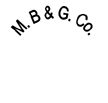 |
Massillon Bottle & Glass Company, (1900-1904),
Massillon, OH, United States,
Occurs on 34 bottles,
Manufactured beer bottles. This company was incorporated
in June, 1900 with capital of $40,000 and was short-lived.
It is listed in a 1902 Directory as a beer bottle manufacturer.
In 1904, it merged with the E. H. Everett Company, Reed & Company and
the Wooster Glass Company to form the Ohio Bottle Company with capital of $4,000,000. The following year, this
new company was merged into the American Bottle Company to
become the largest manufacturer of machine made beer bottles of
its time. The markings are on the base of the bottle. |
 |
Massillon Glass Works,
(1881-approx: 1895),
Massillon, OH, United States,
Occurs on
14 bottles,
Manufactured soda and beer bottles. The works were operated
Reed & Company and more information is available under
that name. The earliest bottles of this firm used the
"M G W" mark, while later bottles used the "R
& Co" mark. The exact date of transition is not
certain, but it appears that the transition happened in the
early 1890s. The markings is on the base of the
bottle. Notes |
 |
Matthews, John, Apparatus Company,
(1891-1905),
New York, NY, United States,
Occurs on
6 bottles,
Marked soda bottles. The John Matthews Apparatus company
was established in 1891, as a spin off of the firm of John
Matthews. The Apparatus company was part of a trust know
as the American Soda Fountain Company and focused on the soda
fountain and bottling supply aspect of the business. The
"firm of" John Matthews continued selling soda and
mineral waters and syrups. These two companies operated
concurrently for the next fifteen years. The American
Soda Fountain Company started to falter and by 1906 was out of
business. The Matthews family picked up the pieces and
formed the John Matthews Inc in 1906. This company was
bankrupt by 1911. Soon after it became the Matthews Soda
Water Company and by 1915 it was The Firm of John Matthews
Inc., which closed by 1922. Notes |
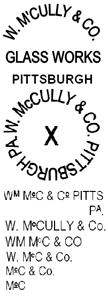 |
McCully, William, & Company, (1851-1888
1892),
Pittsburgh, PA, United States,
Occurs on 161 bottles,
Manufactured soda and beer bottles. This firm was the
second incarnation of William McCully & Company and was formed
when the old company dissolved in 1851. The previous
company included Lorenz & Wightman, who went off and established
a new firm by that name. McCully & Company operated up to
5 glass houses at their peak and produced both bottle and window
glass. In 1870, these works included the Phoenix, Sligo,
Pittsburgh, Empire, and Mastodon Glass Works. Each glass
house had a specialty product. McCully died in 1869, but
the company retained his name. Production waned and in
1886, there was one factory with two furnaces. The company
was still operating in 1901 and was identified, in 1898, as a
window glass company. The markings are on the reverse side,
the heel of the reverse side or base of the bottle. |
 |
McKee, Samuel, & Company,
(1836-1886),
Pittsburgh, PA, United States,
Occurs on
5 bottles,
Manufactured beer bottles. Samuel McKee and James
Salisbury were operating the Sligo Window Glass Works in
1834. In 1836, Samuel McKee and his brothers formed S.
McKee & Company and James Salisbury went on to operate the
old O'Hara works. S. McKee & Co eventually operated
two large window glass factories and a smaller bottle
plant. Samuel McKee died in late 1876 or early
1877. His sons Christian I. and Daniel took over the
firm, but retained the old name. S. McKee & Co. were
last listed as bottle manufacturers in the summer of 1885 and
likely stopped bottle production after the 1885/1886
season. S. McKee & Co. continued to manufacture
window glass until late 1908 or 1909. What happened to the
firm after that point is not known, but it appears to have
been sold as the factory suffered a fire in 1911 and
large quantity of stored window glass was destroyed. The
markings are on the base of the
bottle. Notes |
 |
Meyer, Conrad L., (1893-1925),
New York,
NY, United States,
Occurs on
9 bottles,
Appears on beer and soft drink bottles. Conrad L. Mayer
ran a bottlers supply business in New York City. He was
born in 1858 and in his early career was in the starch
business. About 1884, he started in the bottling supply
business; a career that would last over 40 years. About 1893
he went into business for himself on Murray Street; a location
of many glass makers and agents. His early business was
rocky, being sued and loosing to William Brookfield. He
quickly recovered and later represented the Standard Bottle
& Glass Company of Rochester, the North Baltimore Bottle
Glass Company, the Modes-Turner, and
the Cumberland Glass Manufacturing Companies. He died in
1925 and was still listed as a glass salesman during that
year. The base markings of "06" and
"14" on beer bottles and "10" on
Hutchinson soda bottles are known. Notes |
 |
Milford Glass Works, (1838-1855),
Milford, NJ, United States,
Occurs on 1 bottle,
Manufactured beer bottles. This works was founded in 1838
by Matthias Simmerman as the Pendleton Glass Works. By
1844, it was owned by Lippincott, Wisham & Company. Prior
to 1854, Cox and Whitman were the operating partners and in that
year Jacob Iszard was admitted. In 1855, Thomas Whitman
was admitted as a full partner. Soon after, the firm was in bankruptcy and the works
was sold at sheriffs
sale in 1856. The property was purchased by Joseph Iszard
and Samuel Iszard & Company was formed to operate the works for
a short time. They were closed prior to 1860. The
markings are on the reverse side of the bottle. |
 |
Millville Bottle Works, (1903-1930),
Millville, NJ, United States,
Occurs on
2 bottles,
Manufactured soda bottles. This company was founded
in 1903 by James Mitchell and purportedly by W. Scott Wheaton
executives of the T. C. Wheaton Company in the same town.
The company primarily manufactured druggists ware. After
W. Scott Wheaton's death in 1925, it was acquired by T. C.
Wheaton Company in 1926, and appears to have operated as a
subsidiary until 1930. The markings are on the base
of the bottle. |
 |
Millville Glass Works, (1832-1854),
Millville, NJ, United States,
Occurs on 2 bottles,
Manufactured soda bottles. This is believed to be the
glass works established in South Millville in 1832 by Frederick
Schetter. In 1844, Schetter failed and and the works were
purchased by Mulford, Hay & Company. Since one of the
later bottles is marked "L. M. & Co.," it is probable that Lewis
Mulford gained a controlling interest in the business. The
works were purportedly purchased in 1854 by Whitall, Brother &
Company, who operated the Phoenix Glass Works in Millville.
The markings are on the front or reverse of the bottle. |
 |
Mississippi Glass Company, (approx: 1874-1988),
Saint Louis, MO, United States,
Occurs on 20 bottles,
Manufactured soda and beer bottles. Most likely the
mark of the Mississippi Glass Company from Saint Louis.
George D. Humphreys moved from Connecticut to Saint Louis and
established this company. This plant started
as a bottle plant and was one of the primary manufacturers of
bottles for Adolphus Busch. Busch purchased his own plants
in 1886 and soon before in 1885, Mississippi retooled to a
rolled plate glass plant. In later years it was renowned
for wire glass The markings appear on the reverse heel or the
base of the bottle. |
 |
Modes Glass Company,
(1894-1898),
Cicero, IN, United States,
Occurs on
1 bottle,
Manufactured beer bottles. The Modes Glass Company built
a new glass factory in Cicero, Indiana and began operation in
February of 1894. During 1898, the firm became the
Modes-Turner Glass Company. The
markings are on the base of the bottle.
Notes |
 |
Modes-Turner Glass Company,
(1898-1909),
Cicero, IN, United States, (1898-1902),
Occurs on
9 bottles,
Terre Haute, IN, United States, (1901-1909),
Manufactured beer bottles. The Modes Glass Company built
a new glass factory in Cicero, Indiana and began operation in
February of 1894. During 1898, the firm became the
Modes-Turner Glass Company. The Terre Haute Commercial
Cub enticed the company to come there and take over the plant
of the short lived Hays Glass Company. The operation
started in a small way in 1901, but a preferred stock offering
in 1902 was made to expand the Terre Haute plant at 25th
& Locust Streets. The capacity at Terre Haute nearly
tripled and the plant in Cicero was closed that year.
The Cicero plant was reopened in the Fall of 1902 as the
Indiana Bottle & Glass Company and operated until 1908,
when it burned to the ground. The Modes-Turner Glass
Company in Terre Haute came under full control of Mr. Turner
as the Turner Brothers Company in 1910. The
markings are on the base of the bottle.
Notes |
 |
Montreal Bottle & Glass Company, (approx: 1880-1888),
Montreal, QE, Canada,
Occurs on 1 bottle,
Manufactured beer bottles. Little is currently known about this
company other than it was liquidated in April of 1888. The
markings are on the base of the bottle. |
 |
National
Bottlers' Supply Company, (1906-approx: 1908),
New
York, NY, United States,
Occurs on
5 bottles,
Manufactured soda bottles. This firm was incorporated on July 11, 1906, with capital stock of $50,000, and Richard Sands, President.
The company was located at 26 W Broadway in New York City.
Two years later, the company went into bankruptcy and one of
its officers arrested. The fall off in business was attributed
to the spread of prohibition in several of its markets. The
markings are on the base of the bottle. |
 |
Neptune Glass Works, (approx:
1857-approx: 1861),
Crowleytown, NJ, United States,
Occurs on 1 bottle,
Manufactured soda bottles. Little is know about this
works. The works are reported to have opened in 1851 by Samuel Crowley
on the banks of the Mullica River below Basto. In 1852,
the works were know as the Atlantic Glass Works and
represented by Samuel Huffsey of Philadelphia. This name
seems to have continued until 1857 or 1858 as an undeliverable
letter to this firm was published in the latter year.
About this time, Daniel Burling appears to have control of the
works. Burling was in Camden, New Jersey in 1850 and
likely became familiar with the works. He is briefly listed as
a merchant on Cliff Street in New York City in 1859. In
the 1860 New York Census, he is listed as being in the glass
business and he is also listed in the Washington Township with
the other glass workers in Crowleyville. Soon after the
works closed and were reopened in 1863 as the Crowleyville Glass Company.
It was reorganized in 1865 as the Burlington Atlantic Cape May and Philadelphia Glass Manufacturing Company.
This works appears to have failed by 1869 and the works is
reported to have blown over during a storm in 1874. In addition to its soda bottles a schnapps-type
bottle is known and there is a reference to a porter bottle with
an eagle motif embossed. Bottles come both pontiled and smooth
based. The
markings are on the front of the bottle. Notes |
 |
New Albany
Glass Works,
(bottles: 1868-1871, window glass: 1867-1871),
New Albany, IN, United States,
Occurs on
1 bottle,
Manufactured beer bottles. A large deposit of remarkably
pure sand near Providence, Indiana about 20 miles from New
Albany inspired Captain John B. and his son Emery L. Ford to get
into the glass business. The first firm went under the name of
Montgomery, Ford & Co. with Captain Samuel Montgomery being the
leading partner, the younger Ford a lesser partner, and Henry Hennegan as an
unnamed partner. The
planned product of the works was window glass. Construction
of the works started in August of 1866 and were completed in
January of 1867. The first glass was blown soon after and first
glass manufactured in Indiana was installed at dry goods store
of J. F. Lindley & Brothers in New Albany the first week of
February. A few weeks later the works burn down and being
insured were rebuilt in April of the same year. Montgomery
traded his interest in the works to John B. Ford for the hull of
a boat being built by Ford and soon after, the elder Ford also
bought out Hennegan's interest. At this time the works were
totally under the control of J. B. Ford & Son and reopened in
June of 1867 for the manufacture of window glass. In August,
construction of a bottle house was initiated and September, John
R. McKee of Pittsburgh, with thirty years of experience, joined
the firm as foreman and manager. This started the manufacture of
hollow ware at New Albany, but it appears that only lamp
chimneys
were made, the bottle factory appears to have been converted to make
window glass. Quickly thereafter, the works were idle. The
Fords reopened in
March of 1868. In September 1868, a new bottle houses was opened
and twenty-two bottle blowers were employed. On January 11, 1869, Ford
and Son sold one-half interest in the enterprise to Jesse J.
Brown, Morris McDonald, and William N. Mahon and the firm became
Ford, Mahon & Co. The new capital was used to extend the works
including the conversion of the cutting house to a window
factory, a large warehouse, and a saw and planning mill. In
June, Ford sold the remaining interest in the New Albany Works
to John A. McDonald and Mrs. Mary Lapsley for $50,000. McDonald
sold his house to Ford for $25,000 as part of the deal. The new
Firm was known as W. N. Mahon & Co. In July, Edmund A.
Maginness, of the drug firm Scribner & Maginness purchased a
one-eighth interest in the works, and withdrew from the drug
business leaving Scribner & Son as the surviving firm. Ford went
on to start erecting a new glass works for the manufacture of
plate glass, window glass, and hollow ware that would be the J.
B. Ford & Sons' Star Glass Works, which went operational in
October of 1869. In February of 1870, articles of incorporation
were filed with John S. McDonald, Jesse J. Brown, Morris
McDonald, Mary A. Lapsley, Rueben P. Main, W. N. Mehan, and E.
A. McGinness as directors. Capital was $100,000 and the firm
employed 160 hands. In May, a new factory building was erected. Ben
McConnell, superintendent of the work, resigned in August of
1870, to join the newly erected Terra Haute bottle factory. 1871
was a year of decline for the works, likely due to overexpansion
and loss of their foreman. An attempt was made to form an
association with the workers, but that was rejected by the
workers, who struck and a day after a strike was settled, the
works were sold at sheriff's sale to John S. and Morris McDonald
for $86,000. Some failed attempts to operated the works occurred
until they were sold to the neighboring Star Glass Company in
1871 for
$13,000. Several later attempts to reopen the works also failed. Notes |
 |
New England Glass
Bottle Company,
(1826-approx:1840),
East Cambridge, MA, United States,
Occurs on
2 bottles,
Manufactured beer bottles. This company was organized in February
of 1826 by act of the Massachusetts Legislature. The specialty
of the works were "junk" or black glass and green
cider, porter, wine bottles and demijohns. The works are
reported to have operated until 1840 by various sources, but
the last record I was able to find was in 1838 when the
company's warehouse burned. The markings are on the base of the
bottle. Notes |
 |
Newark Star Glass Works,
(1871-1878),
Newark, OH, United States,
Occurs on
5 bottles,
Manufactured beer bottles. The works were organized in the
Fall of 1871 by Shields, King & Company. In 1876, the
company displayed at the Centennial Exhibition in Philadelphia.
In the Spring of 1878, the workers went on strike and the works
were closed for two years. On April 28, 1880, E. H.
Everett took over the plant. In 1885 it became the E.
H. Everett Company. The markings are on the base of the
bottle. |
 |
Newburgh Glass Company,
(1867-1873),
New Windsor, NY, United States,
Occurs on
1 bottle,
Manufactured beer bottles. The works commenced operation
in January of 1867. The works utilized
"glass-ore" instead of sand in the production of
glass and was manufactured under patent 52,917 issued on
February 27, 1866. By 1871, Burrows, Regan & Roche
were in control of the works. William Burrows, was
associated with the Haggerty Glass Works in Brooklyn in 1866,
but disappears from Brooklyn by the following year. the
firm is listed in directories in Orange county in 1872 and in
New York City in 1873. Burrows was involved in a drunken
altercation in June of 1873 and ends up working for the
Honesdale Glass Works in the fall of the same year. It
appears that the works were closed by the summer of 1873. By
1892, Burrows was operating glass factories in Birmingham, New
York and Stroudsburg, Pennsylvania. The markings are on the base of the
bottle. Notes |
 |
North Baltimore Bottle Glass Company, (1888-1933),
North Baltimore, OH, United States,
(1888-1895)
Occurs on 236 bottles,
Albany, IN, United States, (1895-approx: 1903),
Terre Haute,
IN, United States, (approx: 1900-1933),
Manufactured soda and
beer bottles. The company was organized in 1887 by
John Geegan due to the cheap natural gas that was found in the
area. A. L. Pfue provided much of the capital and I. W.
Richardson the technical expertise. The works prospered
until the gas became scarce. The company contemplated
moving, but switched to oil fired furnaces instead. In
1895, they moved to Albany, Indiana, enticed by the abundant
supplies of natural gas there. A few years later a plant
was built in Terre Haute, Indiana. Since the company
focused on the manufacture of beer and soda bottles, it was hit
hard by national Prohibition and struggled to remain in business
until 1933. The markings are on the reverse heel of the
bottle. |
 |
Northern Glass Company, (1894-1896),
Milwaukee, WI, United States,
Occurs on
3 bottles,
Manufactured
soda bottles. This company took over the old idle Cream
City Glass Company works in 1894. Due to poor management
and poor quality glass, the works was sold to William Franzen
in 1896. It is not known if Franzen continued to use
this mark or if it was solely used the company prior to his acquisition.
He did not incorporate the name of William Franzen & Son
until 1900. Known marked bottles date to the
1894-96 period of the failed works and support he fact it was
not used by Franzen. The markings appear on the front heel of the
bottle. |
 |
Nuttall &
Company,
(1842-1913),
Edge
Hill Station, Liverpool, England, (1842-approx: 1850),
Thatto Heath, Liverpool, England, (approx: 1850-approx: 1872),
Saint Helens, England,
(approx: 1872-1913), Occurs on
3 bottles,
Manufactured
soda and beer bottles. The company was founded by
Francis Dixon and John Merson in the 1840s. Nuttall
& Company claimed to be founded in 1842. The first
factory was built near Edge Hill Station near Liverpool.
By 1852. it had moved to Thatto Heath. In 1872, a modern
factory was built at Saint Helens. This company was absorbed into the United
Glass Bottle Manufacturers, Limited in 1913, but the firm
continued to use its brand name. The markings
are on the reverse heel of the bottle. |
 |
Nuttall &
Company Limited,
(1913-2001),
Saint Helens, England, Occurs on
4 bottles,
Manufactured
soda bottles. The company was founded by
Francis Dixon and John Merson in the 1840s. Nuttall
& Company claimed to be founded in 1842. The first
factory was built near Edge Hill Station near Liverpool.
By 1852. it had moved to Thatto Heath. In 1872, a modern
factory was built at Saint Helens. This company was absorbed into the United
Glass Bottle Manufacturers, Limited in 1913, but continued to
use its brand name. The markings
are on the reverse heel of the bottle. Notes |
 |
O, (approx: 1895-approx: 1905),
Unknown, United States,
Occurs on
3 bottles,
Manufactured beer bottles. This unknown
manufacturer made beer bottles for a New York firm and Charles Joly, a Philadelphia
based bottler, who dabbled with bottling supplies as a side
line. The markings are on the base of the bottle. |
 |
O, (approx:
1900-approx: 1910),
Unknown, United States,
Occurs on
4 bottle,
Manufactured
soft drink bottles. This unknown
manufacturer made mineral water bottles for the Mount Holyoke Lithia Spring Water Company. The markings are on the base of the bottle. |
 |
Ohio Bottle Company, (1904-1905),
Newark, OH, United States,
Occurs on 32 bottles,
Massillon, OH, United States, (1904-1905),
Wooster, OH, United States, (1904-1905),
Manufactured soda bottles.
The company was formed on August 4, 1904 by Edward H. Everett,
Lorenz S. Stoehr, David Reed, James F. Pocock and Jacob C.
Haring. It consolidate the glass factories of the E. H. Everett
Glass Company in Newark, Reed & Company in Massillon, the
Massillon Bottle & Glass Company in Massillon and the Wooster
Glass Company of Wooster. The Ohio Bottle Company held an
exclusive contract to manufacture soda and beer bottles on the
Owens Automatic Bottle Machine. On August 22, 1905,
incorporation papers were filed and these works were
consolidated into the American Bottle Company in September.
The markings appear on the reverse heel of the bottle. |
 |
Old Dominion Glass Company, (1901-1928+),
Alexandria, VA, United States,
Occurs on
12 bottles,
Manufactured
beer and soda bottles.
The company was formed in April of 1901 by Henry K. Field, Lorenzo Walford, G. D. Hopkins, O. R. Hopkins, M. L.
Pierce, jr., and H. E. Downham. A factory was built at
the outlet lock of the old Alexandria Canal during the summer
of 1901 and the factory commenced operations on September 3rd
with sand from the Severn River; its source for many
years. This factory proved to be the most successful of
the four contemporary factories in Alexandria. Even with
a series of disastrous fires, this company eventually
purchased and operated the plants of the Bella Pre, Virginia,
and Alexandria glass works. Its main products were flint
bottles including pint and quart flasks and beer and soda
water bottles. The company and plant continued to be
listed until 1928 in the Alexandria directories. Its
status in 1929 is not known, but by 1930 it was no longer in
business. The The markings appear on the
base of the bottle.
Notes |
 |
Olean Glass Company,
(1883-1913),
Olean, NY, United States,
Occurs on
3 bottle,
Port
Allegheny, PA, United States, (1896-1913),
Manufactured
beer and soda bottles.
The company was established in 1883 by Eastern glass blowers and
local investors encouraged by a board of trade. The
availability of a good quality of sand rock and fuel made
Olean a good place to locate a glass factory. The
business failed within a year. The Union Glass Works was
organized in 1884 to restart the operation, but this firm soon
failed as well. The Olean Glass company continued to own
the works until May of 1887, when S. W. Pancoast, who left the
original operation in 1883, returned to operate the
factory. He started out with one blower and gradually
built a successful business. The plant was purported to
be the first to use natural gas as a fuel. The company
became a stock company in 1894. In 1896, a second plant,
specializing in flint bottles, was established in Port
Allegheny due to an abundant gas supply. S. W.
Pancoast and his sons withdrew from the firm starting in
1900. One son, Vernon, went on to establish the
New York Glass Works. The Olean works continued to
expand until 1913, when it was sold to the Acme Glass Company
also in Olean. During 1913, the firm experienced a
run of bad luck: a flood, a fire, loss of revenue due to a
bankrupt customer, failure of the gas supply at the Port
Allegheny plant, and difficulty in securing boys to work in
the factory. The Port Allegheny plant was sold to a
group of its blowers, who likely had some local funding.
Acme only operated the plant for a short time and it was
abandoned as a manufactory in 1914. Small businesses
operated in some of the buildings while others went derelict.
In 1925, the property was sold to a local firm looking for oil
and using it as a coal depot. The Acme company was
purchased by the Eastern Glass company in 1926. The owners,
from New York City, fled the country in 1929 after perpetrating
fraud. The company was run by a receiver, and sold
within that same year to local investors. It was named
the Olean Glass Company, Incorporated, and
purchased by Thatcher Manufacturing company in 1935. Thatcher
closed the plant in 1948. The markings appear on the base of the bottle.
Presentation of the mark is an estimation of the appearance.
Notes |
 |
O'Neil, Thomas
A., (1890-1895),
Boston, MA,
United States,
Occurs on
2 bottle,
Manufactured beer bottles. Thomas O'Neil was a glass
jobber and dealer in crockery who started his business in
1890. An 1891 ad called out bottlers ware as a specialty.
By 1896, he was a part of the firm of John Conlon & Co.
who were wholesale liquor dealers. Notes |
 |
Owens Bottle Company,
(1919-1929),
Toledo, OH, United States,
Occurs on
7 bottles,
Manufactured soda bottles. The Owens Bottle company was formed
on May 1, 1919 with a name change from the Owens Bottle
Machine Company. At the time they were the largest
manufactures of bottles in the world.
The company merged with the Illinois Glass Company in 1929 to
form the Owens-Illinois Glass Company. The markings appear on
the base of the bottle.
Notes |
 |
Owens-Illinois
Glass Company, (1929-1966),
Toledo, OH, United States,
Occurs on
2 bottles,
Manufactured soda and beer bottles. The company was formed
with the merger of the Owens and Illinois glass companies in
1929. The company became Owens-Illinois Incorporated in
1966. The OI over a diamond marking was used from 1929
to 1954 when it was replaced with an I in an O. The markings appear on
the base of the bottle. |
 |
Pacific Coast Glass Works, (1900-1925),
San Francisco, CA, United States,
Occurs on 66 bottles,
Manufactured soda and beer bottles. After they sold the
San Francisco & Pacific Glass Company, George Newman and Carlton
Davis reentered the glass business and by 1900 had established
the Pacific Coast Glass Works. There is mention of an
accident at the "San Francisco & Pacific Coast Glass Works" on
Thanksgiving Day in 1900 at the Berkley-Sanford football game.
About 300 spectators had assembled on the roof of the new and
partially completed works when the roof collapsed, thirteen
were killed and over a hundred others were seriously injured.
The newspaper account stated the game continued and Sanford won
5 to 0. One employee who left the company in 1916, claimed
he worked there for 16 years, starting as an apprentice and
placing the company in business in 1900. The company
survived the 1906 San Francisco Earthquake, even though some of
its facilities at 7th & Irwin Streets were destroyed by the
ensuing fires. The company was renamed the Pacific Coast
Glass Company in 1925. Later in 1930, it became part of
the Illinois-Pacific Coast Company. The markings appear on
the base or the reverse heel of the bottle. |
 |
Pacific Glass Works, (1862-1876),
San Francisco, CA, United States,
Occurs on
3 bottles,
Manufactured soda bottles. This company was organized in
1862 and glass was first blown in 1863. Carlton Newman
left the company and established another glass house in 1865.
The company passed hands several times and was eventually
purchased by Carlton Newman and merged with the San Francisco
Glass Works to form the San Francisco & Pacific Glass works in
1876. The markings are on the face or base of the bottle. |
 |
Packham,
Eldridge, Jr., & Company, (1895-1902),
Baltimore, MD, United States, Occurs on
2 bottles,
Manufactured beer bottles. This jobber of bottles started as
partnership between Eldridge Packham and Charles De Witt, that
started in late 1886 or early 1887 as as cork cutters, but
quickly morphed into a brewers and bottlers supply. Eldridge
purchased De Witt's interest in April of 1891, but the
partnership was reformed in December of the same year. The
partners were at odds and sought legal assistance to split up,
which occurred in June of 1895. At this time, Packham
purchased the Business from De Witt and brought in his
brothers, George K., Harry, Lewes, and William A. T., into a
partnership called E. Packham, Jr., & Company. The firm
successfully bid on contracts to supply bottles and supplies to
the newly formed South Carolina Dispensary. At the end of 1897,
Eldridge bought out his brothers interest in the firm. His
brothers remained with the firm until 1899, when George and
William when out on their own and formed Packham Brothers.
Soon after, the other two brothers joined the firm, while
Eldridge worked alone. By 1902 the elder brother's firm
was dissolved and he entered a venture called the Parham Glass
Company. This was followed a number of short lived
business in and out of the bottling supply business. The markings appear on the base of the bottle.
Notes |
 |
Pastorius, Schulz & Company, (1864-1864),
Pittsburgh, PA, United States, Occurs on
1 bottle,
Manufactured beer bottles.
This short lived firm purchased the Iron City Glass Works from
Alexander Arbogast on February 1, 1864. The partners were
John Pastorius, Adolphus C. Schulz, and William F. Modes.
The works were burned on August 23, 1864 and the entire frame
factory destroyed. The works were rebuilt using the
insurance money received. For unknown reasons the works
were sold to O'Hare, Schulz & Company at the end of the year.
Schulz remained with the new firm, Pastorius remained a glass
blower until the end of his life, and Modes went on to operate
the Aetna Glass Works, Beaver Falls Glass Company, managed the
De Steiger Glass Company, founded the Modes-Turner Glass company
and the Indiana Bottle & Glass Company. The markings appear on the base of the bottle.
Notes |
 |
Pennsylvania Glass Company, (1887-1925),
Meadville, PA, United States, (1887-1889) Occurs on
1 bottle,
Anderson, IN, United States, (1889-1915),
Dunbar, WV, United States, (1915-1922),
Manufactured beer bottles.
This company was attracted from Rochester, Pa. to Meadville in
1887 by the Meadville Board of Industry. The factory
employed about 100 men and was burned to the ground in early
1889. The company them moved to Anderson, IN, attracted
by free land and gas. When the gas ran out, the company
relocated to Dunbar West, WV. In the early days it was
also known as works as well as company. The markings appear on the base of the bottle.
Notes |
 |
Phoenix Glass Works, (1838-approx: 1849),
Philadelphia, PA, United States,
Occurs on
3 bottles,
Manufactured beer bottles. This
glass works was founded in 1806 by James Lee in Millville, New
Jersey. After going through several owners, Burgin & Wood
of Philadelphia took over the works in 1827. Their offices
were in Philadelphia and remained there through several owners.
In 1829, it was Burgin, Wood & Pearsall and starting in 1833
Burgin & Pearsall. In 1836, Scattergood, Booth & Company
operated the works. From, 1838 to 1844 Scattergood,
Haverstick & Company operated the works. It is during this
time, in 1840, that the Phoenix Glass Works name is first
recorded. In 1844 the firm became Scattergood & Whitall
and remained so until 1845, when it became Whitall & Brother.
In 1850, it became Whitall Brothers & Company. The Phoenix
name continued to be used during this period. In 1854,
they acquired the Millville Glass Works. During 1857 the
firm became Whitall, Tatum & Company and 1901, Whitall Tatum
Company. The focus in later years was druggists ware, but
an 1880 catalogue still listed mineral water bottles as a
product. Phoenix was used until 1875, but was dropped by
1880. The markings appear on the base of the bottle. |
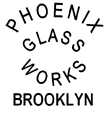 |
Phoenix Glass Works,
(1848-approx: 1855),
New York, NY, United States,
Occurs on 1 bottle,
Manufactured soda bottles. The Phoenix Glass Company was incorporated
in December of 1848 with capital of $7,500, according to court
documents, and were listed in 1850 at John near Hudson avenue in
Brooklyn with an office at 38 Burling Slip in New York with
Robert B.
Clark as Secretary. The company was noted as still being
in business in 1852 after a suspension of three months. The markings are on the face of the
bottle. Notes |
 |
Pollack Brothers & Company, (approx: 1900-approx: 1920),
Montreal, QE,
Canada,
Occurs on
8 bottles,
Manufactured beer bottles. This firm was not listed in the
1895 Montreal Directory and appears on Canadian glass and
pottery bottles of the period 1900 to 1920. The firm is
reported to have had a branch in Toronto briefly. The markings appear on the base of
the bottle. |
 |
Poughkeepsie
Glass Works, (1880-1914),
Poughkeepsie, NY, United States,
Occurs on 15 bottles,
Appears on beer bottles. This glass factory was formed in
1880 to take over the failed Anglo-American Glass Company,
which was formed in 1879 to make glass bottles from iron slag
of an adjacent iron works. Instead of the traditional
pot furnaces, the company installed a continuous tank; the
first in the United States. The company manufactured a general
line of bottles and fruit jars, which were a specialty. Its
manufacture in the later years was heavily focused on milk
bottles made under contract for the Empire Bottle and Supply Company.
Empire pushed major expansions in the facilities and this
proved to be a risky business proposition as the company could
not repay its debts. The company files for bankruptcy in
1912, from which it recovered, only to fall into a final
bankruptcy in 1914, which resulted in liquidation. The
markings appear on the base of the bottle. The mark is
actually the label of the local glass makers union. Notes |
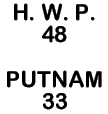 |
Putnam, Henry William, (approx: 1878-approx: 1947),
New York, NY, United States,
Occurs on 119 bottles,
Appears on soda and beer bottles. Charles De Quillfeldt
assigned rights to his stopper for beer bottles to Karl Hutter
in 1875 and William Putnam in 1877. Putnam trade marked
the stopper "Lightning" and applied this patent to fruit jars in
1882. Putnam and Karl Hutter were codefendants in at least
one law suit defending the 1877 reissue of De Quillfeldt 1874
patent. Putnam appears to have been involved in the
bottlers supply business as a jobber. Putnam turned the
business over to his son, William Henry Putnam, Jr., in 1898 and
moved to San Diego. The business was worth about $5 million at
that time. A trade mark was reissued in 1947 to the
company. The
markings appear on the base of the bottle. |
 |
Queen City Glass Company, (1890-1905),
Cumberland, MD, United States,
Occurs on
7 bottle,
Manufactured beer bottles. The Warren Glass Company was
established on Queen & Railroad Streets in Cumberland in
1880 to primarily manufacture milk bottles. This works closed
in 1888 and was reopened in 1889 as the South Cumberland Glass
Company. In 1890, the Queen City Glass Company was
organized and operated until about 1905, when it ran into
financial difficulties and an overstock of bottles in its
warehouse. It works were idle until 1909, when a group
of Pennsylvanian investors reopened the works as the Eastern
Glass Company. The works manufactured flint bottles.
The markings appears on the base of the bottle. Notes |
 |
Reed & Company,
(1881-1904),
Massillon, OH, United States,
Occurs on 31 bottles,
Manufactured beer and soda bottles. David Reed and Joseph S. Reed
were born in New Jersey and in 1880 worked at the Clyde Glass
works. In 1881 they organized the Reed & Company
glass works in Massillon, Ohio. The specialty of this
works was beer bottles and they supplied the major brewers,
but also manufactured fruit jars and flint ware. In 1898
they made over 10 million bottles and in the same year started
shipping to Mexico, which developed into a large trade. In
1904, Reed & Company became part of the Ohio Bottle
Company. The markings appear on the base of the bottle.
Notes |
 |
Reed, E. P., & Company,
(1889-1894),
Rochester, NY, United States,
Occurs on
3 bottles,
Manufactured beer bottles. The Rochester Glass Works was
reopened in 1881 by former members of the Clyde Glass
Works. In January, 1889, the firm became E. P. Reed & Company. In 1894, with
the death of E. P. Reed, the firm became F. E. Reed. The
markings appear on the base of the bottle. Notes |
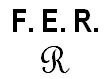 |
Reed, Frank
E., (1894-approx: 1901),
Rochester, NY, United States,
Occurs on
5 bottles,
Manufactured beer bottles. With the death of E. P. Reed in
1894, the Rochester Glass Works went under the name of Frank
E. Reed, who operated the works until about 1901, when it the
firm became a co-partnership known as Frank E. Reed &
Company. The firm specialized in bottles for brewers.
The markings appear on the base of the bottle. Notes |
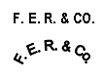 |
Reed, Frank E., & Company, (approx: 1901-1908),
Rochester, NY, United States,
Occurs on
4 bottles,
Manufactured beer bottles. About 1901, Frank E. Reed
formed a partnership know as the Frank E. Reed & Company.
Later in 1908, the firm was incorporated as the Frank E. Reed
Glass Company with capital of $165,000. The
markings appear on the base of the bottle. Notes |
 |
Reed, Frank E.,
Glass Company, (1908-1957),
Rochester, NY, United States,
Occurs on
3 bottle,
Manufactured beer and soft drink bottles. In 1908, the Frank E. Reed
& Company incorporated as the Frank E. Reed
Glass Company with capital of $165,000. By 1933, the
company incorporated. The company was in bankruptcy in
1957. The
markings appear on the base of the bottle. Notes |
 |
Rhodes Glass & Bottle Company, (1901-approx: 1919),
Massillon, OH, United States,
Occurs on 22 bottles,
Manufactured beer bottles. This company was organized in
January of 1901 with F. R. Shepley as president. There is
mention of a strike that occurred in October of 1901. The
firm is listed in Johnson's 1902 business directory as a
manufacturer of light green and amber bottles, of which beer
bottles were a specialty. Several references in 1913 were found.
The company is purported to have closed about 1919 and with beer
bottles a primary product, national Prohibition would have been devastating to
the business. The markings appear on the reverse heel or
base of the bottle. |
 |
Henry Ricketts & Company, (1811-1851),
Bristol, England, Occurs on
1 bottle,
Manufactured mineral water bottles. In 1785, a flint glass works was
built on the site of the �Phoenix Inn� in Temple Gate by James and George Taylor.
This Phoenix Glass Works was acquired by John Wadham, Jacob Wilcox and Richard Ricketts
in August of 1789. In 1811, the partnership was reorganized and consisted of Jacob
Wilcox Ricketts, his son Henry Ricketts, David Evans and John Cave. At this time,
they expanded by acquiring a bottle factory at Cheese Lane, St Philips. Henry Ricketts
December 5, 1821 patent for molding Bottles for wine, porter, beer, or cider, revolutionized
the industry. Ricketts� patent popularized the three mold and his bottles with �PATENT�
on the shoulder became the often copied acme of the industry. Richard Ricketts took
over business when Henry retired in 1851 and the firm became Richard Ricketts &
Company. In 1853, Richard joined with William & Thomas Powell and Richard Filer,
who owned the Hooper�s Glasshouse, to form Powell, Ricketts & Filer. This firm
operated until 1857, when it became Powell & Ricketts. This business closed
in 1923. The markings appear on the
base of the bottle. |
 |
Rochester Glass Works, (approx:
1881-1888),
Rochester, NY, United States,
Occurs on
13 bottles,
Manufactured soda and beer bottles. C. B. Woodworth & Son were
proprietors of the Rochester Glass Works in 1869. In 1876,
Nathan Gatchell, of Gatchell & Company, was operating the works.
He was from Lockport, New York. The plant was
idle for a number of years, when in 1881 several former members
of the Clyde Glass Works reopened the works under the name of
Kelly & Company. In January, 1889, the firm became E. P. Reed & Company. In 1894, with
the death of E. P. Reed, the firm became Frank E. Reed and about
1901 became the Frank E. Reed & Company. In 1903, it was still referred to as the Rochester
Glass Works. In 1908, the firm incorporated as the Frank
E. Reed Glass Company. In, 1925, with the death of Frank E. Reed, control passed to
his sons and in 1927, it became the Reed Glass Company.
The business went idle in 1957. Later the plant was
operated by Castle-Hanson Glass Company. The
markings are on the base of the bottle. The Rochester mark
is similar to the Clyde mark. Notes |
 |
Root Glass Company, (1901-1932),
Terre Haute, IN, United States,
Occurs on 91 bottles,
Manufactured beer and soda bottles. Chapman J. Root
established two glass works in Terre Haute: one for beverage
bottles and the second for fruit jars. Root had worked for
the North Baltimore Bottle Glass Company, which had relocated to
Terre Haute in 1900. The beverage plant
started operation in 1901 and the fruit jar plant the following
year. Ball Brothers purchased the fruit jar plant in 1909,
but the beverage plant operated until 1932, when it was
purchased by Owens-Illinois, so the family could focus on its
Coca-Cola bottling business. Root was famous for creating
the design of the Coca-Cola bottle in 1915. The markings
are on the base of the bottle or on the heel. |
 |
Rylands & Codd,
(1877-1881),
Barnsley,
England,
Occurs on
11 bottles,
Manufactured
soda bottles. This partnership was formed in 1877
between Ben Rylands and Hiram Codd. Rylands owned the Hope
Glass Works and Codd held the patent for a marble closure for
soda bottles. Ben Rylands died in 1881 and his son Dan
joined the firm in his place. At this time the name was
changed to "Codd & Rylands" The partnership with Codd dissolved
in late 1884. The Hope Glass Works used the mark of
"4" on its glassware to signify it products attributes of accuracy,
cleanliness, neatness and strength. The markings appear on the
reverse heel of the bottle. |
 |
Rylands, Dan,
(1884-1897),
Barnsley,
England, Occurs
on 15 bottles,
Manufactured
soda bottles. This company was formed with the breakup
of Codd & Rylands in late 1884. Rylands became a limited
liability company, Dan Rylands Limited, in 1888, but appears
to have still used the Dan Rylands identifier. In 1897,
the company was reorganized as the Rylands Glass and
Engineering Company Limited. Bottles after this date are
marked "THE RYLANDS." The company went out of
business in 1928 partially due to it focus on manufacturing
Codd bottles, which were being phased out in England due to
sanitary concerns. The markings appear on the reverse
heel of the bottle. |
 |
S,
(approx: 1897-approx: 1903),
Unknown, United States,
Occurs on
5 bottles,
Manufactured beer bottles. A second bottle with this mark
surfaced from Terre Haute, Indiana. It is believed that
this mark is for the Streeter Glass Company that was located
in Greenfield and then Terre Haute. There is interesting
collaborating information, but there is not any conclusive
evidence at this point. This firm primarily made fruit
jars, but was known to make bottles. The marking,
an "S" in a shield, appears on
the base of the bottle. Notes |
 |
S., A. C.,
& Company,
(approx: 1905-approx: 1915),
Unknown, United States,
Occurs on
1 bottle,
Manufactured soda bottles. Two bottles are know with this
marking; a soft drink bottle from Providence and a whiskey
flask from Philadelphia. One possibility would be A. G.
Smalley & Co., but the middle initial on both bottle
appears to be a "C." The "A. C. S &
Co." mark appears on
the base of the bottle. Notes |
 |
San Francisco & Pacific Glass Works, (1876-1899),
San Francisco, CA, United States,
Occurs on
16 bottles,
Manufactured beer bottles. Was formed by Carlton Newman's
merger of the San Francisco and Pacific Glass Works in 1876.
Carlton Newman died on March 8, 1889 and control passed to his
son George Newman. The business deteriorated and was sold
to the Abramson, Heunish Glass Company in 1899. The markings
appear on the base of the bottle. |
 |
San Francisco Glass Works, (1869-1876),
San Francisco, CA, United States,
Occurs on
1 bottle,
Manufactured soda bottles. After it
was destroyed by fire in 1869, Carlton Newman rebuilt his flint
glass plant and renamed it from the San Francisco Flint Glass
Works to the San Francisco Glass Works. He took in Charles
Duvall as a partner a year later. Duvall retired in 1873.
In 1876 with the death of John Bennett, Newman purchased the
Pacific Glass Works and renamed the combined company the San
Francisco & Pacific Glass Works. The markings appear on the face
of the bottle. |
 |
Schaum, F. & L., (1850-1852),
Baltimore, MD, United States,
Occurs on 1 bottle,
Manufactured beer bottles. The Baltimore Glass Works was being operated by Schaum, Reitz & Company in 1849. By
1851, it was being operated by F. & L. Schaum. Purportedly
they closed the plant and it was later operated by Baker
Brothers & Company. The markings are on the front shoulder
of the bottle. |
 |
Schwenker,
William M., (1883-1916),
New York, NY, United States,
Occurs on
10 bottles,
Appears on beer bottles. Schwenker was a supplier of
brewers materials. He started out selling belting, then
rubber hoses and other rubber goods and onto a general list of
brewers supplies. At some point during his career he
dealt in beer bottles. He died in late 1912 or early
1913 and his estate carried on the business. Between 1916 and
1918, the firm incorporated and was still operating in 1922. The markings are on the
base of the bottle. Notes |
 |
Scranton Glass Company,
(1907-approx: 1930),
Dunmore, PA, United States,
Occurs on
1 bottle,
Appears on beer bottles. There were several glass
companies in Scranton. The Scranton Glass Company Limited
operated from 1881 to 1887, when it incorporated as the Scranton
Glass Company. At its height the Scranton Glass Company
employed 800 men and boys; however, it experienced financial
difficulties in 1895 and ceased to operate in 1896. A Scranton
Glass Manufacturing Company was incorporated in 1899 and
appears to have operated until about 1903. About 1907,
Anthony Francis McDonnell operated a second Scranton Glass
Company at 1341 Jefferson St, Dunmore PA. This was his
parents' home, therefore it is likely that his business was
that of a glass jobber rather than a manufacturer.
McDonnell also patented and trade marked the Sanitop Bottle
closure and operated into the 1920s if not later. The markings appear on the
base of
the bottle. Notes |
 |
Severn Glass Company,
(1897-1902),
Annapolis, VA, United States,
Occurs on 20 bottles,
Manufactured beer bottles. This works was the successor to
the Annapolis Glass Company, which was founded in 1885 on Horn
Point later known as the Eastport section of Annapolis.
The attraction of Annapolis was a fine quality of glass sand
found on the Severn River nearby. The Annapolis Glass
Co. was offered for sale in 1891 and a glass works was listed
in a 1893 report. The Severn Glass Co. was incorporated
in the state of Maryland on July 23, 1897 with $10,000 in
capital stock, but may have been operating earlier. They
had a branch office in Baltimore, where most of the marked
bottles occur. The works were operating successfully in
1901 and are purported to have closed in 1902. They were
not listed in a 1910 directory. The markings appear on the reverse heel of
the bottle. Notes |
 |
Sleeman, Henry Bedford,
(approx: 1889-approx: 1902),
Manchester, England,
Occurs on 1 bottle,
Appears
on soda bottles. H. B. Sleeman was involved in the East
India trade starting in about 1866 and continued well into the Twentieth
Century. The firm was mainly involved in selling
druggists supplies and sundries. In the later part of
the Nineteenth Century, he expanded into the West Indian
and North American markets. From his start until about 1888, the
firm was known as H. B. Sleeman & Company. After
that date and until at least 1902, he appears to be operating on his own. By 1905, the firm was H. B. Sleeman &
Co. again. Henry withdrew from the firm in 1910 and died
in 1912, but his firm was still listed in 1939 as a limited
liability company. The markings are on the
reverse heel of the bottle. Notes |
 |
Smalley,
Albert G., & Company, (1877-1906),
Boston,
MA, United States,
Occurs on
2 bottles,
Appears on beer bottles. Albert G. Smalley was born in
Belfast, Maine in about 1851. Sometime prior to 1870, he
moved to Boston and found employment as a bookkeeper. In
1873, he a member of the firm of Lovell & Smalley, who
were glass manufacturer agents. The following year,
1874, he worked for E. A. Buck & Company, who were engaged
in the same business. E. A. Buck & Co. appear
to have been sold to the newly formed Dean, Foster & Co.
in 1875 and Smalley was a member of this new firm.
However in 1876, E. A. Buck & Co. appears to have been
reconstituted just two doors up from Dean, Foster & Co.
and Smalley was now a principle in this firm. The
following year, 1877, E. A. Buck & Co. became A. G.
Smalley & Co. Smalley & Co. were initially
jobbers for druggist ware and sundries, but as indicated by
ads, sold beer bottles and stoppers. In later years, the
firm seems to have dropped the bottlers line and focused on
fruit jars and milk bottles in addition to druggist
ware. On November 1, 1906 the firm was incorporated,
Smalley died in 1907, and
1917 the firm was dissolved. The markings appear on the
base of the bottle. Notes |
 |
Smith, Addis & Company,
(1900-1902),
Bridgeport, CT, United States,
Occurs on
4 bottle,
Manufactured beer
and soda bottles. This firm succeeded the firm of Smith &
Addis in 1900. The firm specialized in the wholesaling of rope,
twine, paper goods, oil cans, glass barware, screens, and fruit
jars. They also were jobbing soda and beer bottles
and were likely ordering from the Standard Bottle & Glass
Company of Rochester, New York, which in 1901 relocated to
Allentown, Pennsylvania. In 1902, this glass company ran
into financial trouble and was purchased by Comstock, Smith &
Company, which succeeded Smith, Addis & Company in 1902. The markings appear on the base of
the bottles. Notes |
 |
S., P.,
(1847-1857),
Unknown, United States,
Occurs on
1 bottle,
Manufactured beer bottles. This mark appears on the base
of a porter bottle and has all of the characteristics of a New
England manufacturer. The markings appear on the base of
the bottle and may be obscured by the pontil. Notes |
 |
Societa Artistico Vetraria,
(1856-1978),
Altare, Savona, Italy
Occurs on
2 bottles,
Manufactured
soda bottles. Glass was blown at Altare since the Roman
times. Prior to the formation of this company, work was
done at small neighborhood factories scattered across the city.
On Christmas Eve, 1856, these factories were consolidated into
the la Societa Artistico Vetraria. Products of the factory
include not only custom artistic work and laboratory glassware,
but also bottles and glassware for everyday use. It was noted that this works manufactured Codd
bottles from 1914 to 1938. The factory was destroyed
during the Second World War and when rebuild, mechanization
replace hand blowing. The company went bankrupt in 1978
and was purchased by the local government and is operated today
as a museum and glass factory for artistic endevors. Notes |
 |
Southern Glass Works,
(1877-1889),
Louisville, KY, United States,
Occurs on
1 bottle,
Manufactured beer and soda bottles. This works was
started in the fall of 1877 by the experiences glassman John
Stanger as John Stanger & Company. The works
concurrently where known as the Southern Glass Company for about
one year and then appears to be simply known as the Southern
Glass Works. The works was initially a success, but John
Stanger's son, the company's business manager absconded with the
company funds in March of 1879 and reportedly fled to Leadville,
Colorado, where a boom was taking place. The company went into a
receivership and was shortly thereafter was taken over by
Sherley & McCulloch, who owned it thru 1885. According to
reports, the factory does not appear to have been in operation
in 1884 and may not have been in operation during 1885, when it
was sold to the newly formed Louisville Glass Works Company.
This works quickly went out of business in 1886 and the factory
was vacant until lease by T. H. Sherley & Company, Sherley was
the previous proprietor and needed bottles for his whiskey
distribution business. Sherley & Company leased the
factory until 1889, when the factory was closed for good. The markings appear on the base of
the bottle. Notes |
 |
Southern Indiana Glass Works, (1907-1913),
Loogootee, IN, United States,
Occurs on 2 bottles,
Manufactured soda bottles. Incorporated on
December 5, 1907 with a name change from the Lythgoe Bottle
Company, which was established in 1901 when natural gas was
discovered near Loogootee. In 1913, it became the Graham
Glass Company and was merged into the Owens-Illinois Glass
Company in 1929. The markings appear on the reverse heel of
the bottle. |
 |
Spring City Glass Works, Limited,
(1890-1921),
Spring City, PA, United States,
Occurs on
7 bottles,
Manufactured soda and beer bottles. When a group of 19
glass blowers from Salem, New Jersey were locked out due to wage
disputed in 1889, they met with representatives from Spring
City, PA to establish a glass factory there. The blowers put up
$11,400 and the townspeople loaned them an additional $8,000.
The Spring City Glass Works, Limited was incorporated soon after
with capital of $20,000 and was a cooperative factory. The
factory was completed in March of 1890 and a force of 60 hands
was employed producing green hollow ware. After the
factory was closed for the summer of its first season, it was
estimated that the firm would sell about $80,000 a year worth of
wares. In 1891, the factory was shipping 5 box cars worth
of wares a week. The works made some flasks for the South
Carolina Dispensary in 1898 with its "S C" mark. During
the Summer of 1901, the pot furnace was replaced with a 70 ton
continuous tank furnace. Although the factory was plagued
by several small fires during its history, a fire on November
23, 1911 completely destroyed it. A fire-proof building
was built in its place and was operational the first week of
April the following year. Electricity was installed throughout
the complex in 1913. Business was good thru 1916, but
automatic bottle machines were pressuring those that still blew
by hand and the firms orders were starting to wane.
Prohibition was another blow to producers of beer bottles in
1920. The firm changed its name to the Spring City Bottle
Co., Inc. in August of 1921. The factory operated thru
1922, but was out of business when the buildings were demolished
in 1928. This works is not to be confused with a second
factory in Spring City that exclusively manufactured window
glass during the same time period. The markings appear on the base of
the bottle. Notes |
 |
Standard
Bottlers' Supply Company,
(1909-1922),
Newark, NJ, United States,
Occurs on
1 bottle,
Appears on beer bottles. This company was first listed
in the 1909 Newark Directory and was located at 49 William
Street as a seller of bar supplies. The next year, Joseph T. Davey
was listed as the manager and the listing was for bottlers
supplies. The company was not only
listed as suppliers of bottles and bottlers supplies, but also
milk bottles and prescription wares. In 1914, the firm
relocated to Mulberry Street. By 1923 the company
was incorporated and by 1928, changed its name to The Standard
Equipment Company, Incorporated. The markings appear on the base of
the bottle. Notes |
 |
Star Glass Works, (1869-1879),
New Albany, IN, United States,
Occurs on
15 bottles,
Manufactured beer bottles. This company was formed in
1869, primarily for the manufacture of plate glass by John B.
Ford, but bottles were also a product as demonstrated by this
1870 description "The Star Glass Company have extensive houses
and machinery for making all sizes of fine finished plate glass
and mirrors, and are, also, largely engaged in the manufacture
of window glass and bottles." In that same year, 1870, W.
C. DePauw acquired a half interest in the company. In 1879 W. C.
DePauw acquired all of the stock of the Star Glass Company and
renamed it the W. C. DePauw Glass Company. The markings
are on the base of the bottle. |
 |
Streator Bottle & Glass Company, (1881-1905),
Streator, IL, United States,
Occurs on 229 bottles,
Manufactured soda and beer bottles. This company was
formed in June of 1881 and the factory was operational in
October of that year. The works were generally successful
and expanded over the years. The company became part of
the American Bottle Company in 1905 The markings are on
the reverse heel or base of the bottle. |
 |
A. T. G., (approx: 1895-approx: 1905),
Unknown, United States,
Occurs on 1 bottle,
Manufactured soda bottles. Appears on a Hutchinson bottle.
The markings is on the reverse heel of the bottle. |
 |
Twitchell, Selden, & Brother, (1880-1892),
Philadelphia, PA, United States,
Occurs on 30 bottles,
Appears on soda bottles. Selden and Oscar Twitchell were
one of the largest bottlers supply houses in the United States.
They were the sons of the famous George S. Twitchell, who was an
early and well to do mead and mineral water manufacturer in
Philadelphia. The company became S. Twitchell Company
about 1891 and later opened a branch in Camden, New Jersey, and
still later moved its headquarters there. The company was still in business in 1991.
The markings are on the base of the bottle and are associated
with the Roorback's two 1885 patents, which were marketed as the "Twitchell
Floating Ball" closure and often marked "F. B. S."
for "Floating Ball Stopper." |
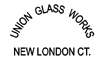 |
Union Glass Works, (1856-1858),
New London, CN, United States,
Occurs on 1 bottle,
Manufactured soda bottles. This company was organized on
August 27, 1856. By 1859, it was operating as the New
London Glass Company. The markings are on the front face
of the bottle. |
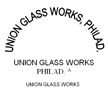 |
Union Glass Works, (1847-1857),
Philadelphia, PA, United States,
Occurs on
175 Bottles,
Manufactured soda and beer bottles. William Hartell & J.
Lancaster reopened the Union Glass Works, on the Delaware River
and in the Kensington section of Philadelphia, in 1847 and
operated the factory there until Hartell's death in 1857.
Thomas Hartell joined the firm in 1850. The works were
closed and Thomas Hartell partnered with John Letchworth in the
firm of Hartell & Letchworth in 1858 with a factory located at 24th
and George Street, near the Schuylkill River. The
markings are on the reverse side of the bottle or on the reverse
heel. |
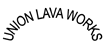 |
Union Lava Works, (approx: 1852-approx: 1855),
Conshohocken, PA, United States,
Occurs on
6 bottles,
Manufactured soda and beer bottles. William H. Smith of
Philadelphia patented a method of using slag from iron furnaces
as a base for the manufacture of "lava-ware" in 1852. As
there were no glass workers listed in the 1850 census for
Conshohocken, the works must have stated in that year and appear
to be short lived. The markings are on the reverse
side of the bottle. |
 |
VanKeuren
& Stone Bottle Company, (1913-1923),
Roulette,
PA, United States,
Occurs on
2 bottles,
Manufactured soda and beer bottles. Roulette was on very
productive gas field in Potter county. With rail connections
to more populated areas, it was only natural that a glass
works would be established in the local. A window glass
works plant, called the Roulette Glass Company, was
established in 1903 and burned about 1908. In 1912,
the Roulette Bottle Manufacturing Company was in
operation. It went bankrupt by January of the following
year. In 1913, W. G Vankueren and John T. Stone, local
business men, acquired the works and operated it as the
VanKueren & Stone Bottle Company or the V & M Bottle
company. The works produced flint bottles, which are know to
have a particular tint to the glass. During the next ten
years the firm was owned by several different entities, but
retained the V & S name. The firm's mark have also
been found on flint flasks and prescription bottles. In
1923, the plant was purchased by investors from Buffalo to
manufacture fruit jars. The company was called initially
called Roulette Glass Company and then a short time later, the
Vacuum Bottle Company. It suddenly went insolvent in May
of the following year. The markings are on the base of the bottle. Notes |
 |
Virginia Glass
Company, (approx: 1897-1914),
Alexandria, VA, United States,
Occurs on
3 bottles,
Manufactured beer bottles. The Virginia Glass Works was
established in Alexandria, Virginia in 1893 by eight
experienced glass blowers. The works were listed in 1897
as incorporated with seven members. Over the years,
various members of the firm split off to form the Old Dominion
Glass Company and the Belle Pre Glass Company, also of
Alexandria. By 1905 only two of the original partners, John S. Bordner and Peter Astryke,
remained. These two also invested in the Southern Glass
Company in Richmond starting in 1899. As they turned
their attention to the Richmond Works, with a major fire at
the Virginia Works in 1905, and with Astryke in failing
health, the Virginia Glass Company suffered. It was sold
at auction in 1909 to W. E. Gilbert and W. Gwynn, who
incorporated the works in September of that year. In
1911, the plant closed down again, but was reopened by 36
glass blowers on a cooperative plan in January of 1912.
June of 1914 may have been the last the plant operated.
It was involved in several litigations, did not pay its
corporate fees in 1916 and was dissolved in 1918 due to two
years of nonpayment. The markings are on the reverse
side of the bottle. Notes |
 |
Western Glass Manufacturing Company, (1900-1909),
Denver, CO, United States,
Occurs on 51 bottles,
Manufactured beer and soda
bottles. The Western Flint Glass Company was reorganized
into the Western Glass Manufacturing Company in November of
1900. A facsimile mark of the corporate seal was
registered in January of 1901 and became the mark that
identifies most of the bottles manufactured by this
company. It is often called the
"buckle." This mark is found on many bottles
form the Rocky Mountain states. In December of 1909 a
fire destroyed the factory buildings and the plant closed
operation. The markings are on the base of the bottle.
Distinctive numbers can be observed on the front heel of some
of the bottles and known numbers include 10, 15, 20 and 40 on
soda bottles and 5, 30, 50 and 70 on beer bottles. |
 |
Whitall-Tatum
Company, (1901-1938),
Philadelphia, PA, United States,
Occurs on
3 bottles,
Appears on syrup bottles. This works was founded in
1806 by James Lee as a window glass factory in Millville, New
Jersey. It went through a series of owners including:
Gideon Smith, Nathanial & Solomon, Burgin & Wood (1829),
Burgin, Wood & Pearsall (1830-32), Burgin & Pearsall
(1833-1835), Scattergood, Booth & Co. (1836-1838),
Scattergood, Haverstick & Co. (1839-1844), Scattergood
& Whitall (1845), Whitall & Brother (1846-1849),
Whitall, Brother & Co. (1850-1857), Whitall, Tatum &
Co. (1858-1900). Starting in 1901, the firm became
Whitall-Tatum & Company. Starting with Burgin & Wood, the early
owners were Philadelphia druggists and these firms specialized
in druggists wares. The Whitall's being Quakers, refused
to manufacture bottles for whiskey, wine or malt beverages,
nor would they sell glass to the army or navy. The main
output of Whitall-Tatum Co. were druggists bottles and
insulators, although they manufactured syrup bottles for use
at soda fountains. The firm was sold to the Armstrong Cork
Co. in 1938 and sold again to the A. H. Kerr & Co. in
1968, subsequent owners were Foster-Forbes Glass and American
Can. The plant closed in 1999. The markings are on the base of the
bottle. Notes |
 |
Whitehead, Ihmsen & Phillips,
(1836-1837),
Pittsburgh,
PA, United States,
Occurs on 2 bottles,
Manufactured beer bottles. These works were established in
about 1836 by Thomas Whitehead, Charles Ihmsen and William Phillips
and called the Pennsylvania Glass Works. There was a flint
glass factory and a black glass factory, which was about a
quarter of the size of the flint operation. The firm was
dissolved by 1838 and each of the partners went on to
establish other works. The markings are on the base of the
bottle. Notes |
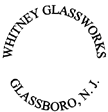 |
Whitney Glass Works, (1839-1918),
Glassboro, NJ, United States,
Occurs on
3 bottles,
Manufactured soda bottles. These works were established in
1775 by glass men from Wistar's Glassworks in Alloways Creek.
In 1839, the Whitney Brothers were in control of the Harmony
Glass Works. By 1861, the works were known as the Whitney
Glass Works as seen on bottles, even though the company was
known as Whitney Brothers. In 1887, the name was
officially changed to Whitney Glass Works. Later, by 1909,
it became the Whitney Glass Works Company. The plant was
purchased by Owens Bottle Company in 1918 and was operated as a
division. The markings are on the base of the bottle. |
 |
Wightman, Thomas, & Company, (1873-1883),
Pittsburgh, PA, United States,
Occurs on
29 bottles,
Manufactured soda and beer bottles. The firm became a
limited company in 1883 and in 1896, it became the Thomas Wightman Glass Company, but was
dissolved in early in the twentieth century. The markings appear on the base of the bottle. |
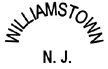 |
Williamstown Glass Works, (approx: 1851-approx: 1894),
Williamstown, NJ, United States,
Occurs on
3 bottles,
Manufactured soda bottles. This works
started in 1835. From 1842 to 1846 Joel Bodine was the sole owner.
Later, it was Joel Bodine & Sons. The Bodines
operated the factory as the Washington Glass Works, but in the
early 1850 it became the Williamstown Glass Works and is listed
on a 1853 price list. In 1855 it was operated by Bodine
Brothers and in 1867 it became Bodine, Thomas & Company.
Sometime between 1887 and 1894, the name changed to the Bodine
Glass Company. From 1899 to after 1920, it was the
Williamstown Glass Company to 1899-1920. The markings are on
the front face of the bottle |
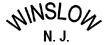 |
Winslow Glass Works, (approx: 1831-1892),
Winslow, NJ, United States,
Occurs on 1 bottle,
Manufactured beer bottles. These works were established by
the Coffins, who established the Hammonton Glass Works.
Later the firm became Coffin & Hay. By 1847, it became
Coffin, Hay & Bowdle. The works was operated by Andrew &
John Hay or their heirs until 1884, when the works was leased
to Tillyer Brothers. The works burned in 1892 and was not
rebuilt. The markings are on the reverse of the bottle. |
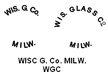 |
Wisconsin Glass Company,
(1881-1886),
Milwaukee, WI, United States,
Occurs on
38 bottles,
Manufactured beer and soda bottles.
The company was organized to purchase the Chase Valley Glass
Companies from Dr. Enoch Chase and other investors in
1881. The company's production a wide variety
of bottle and glassware, and competition from Indiana plants
fueled by cheap natural gas led to its undoing. The
company faced significant financial problems that led to a
labor strike when the company reduced wages. This closed
the factory in 1886. The markings appear on the base and
occasionally on the heel of the bottle. |
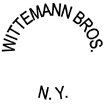 |
Wittemann
Brothers, (1876-approx: 1929),
New York, NY, United States,
(1876-approx: 1920) Occurs on
19 bottles,
Buffalo, NY, United States, (approx: 1920-approx: 1929)
Appears on beer bottles. This firm was founded in 1876
by Adolf, Rudolph, and Jacob Wittemann as a lithography
company. Producing images of photographs that Adolf had
taken around the United States and Canada. They started
making labels for bottlers and moved into the bottling supply
business. With two different businesses being operated,
in 1887, Adolf withdrew to form the Albertype Company, which
focused on lithography, and Wittemann Brothers concentrated on
the bottling and brewing supply business. The company
grew to a large extent, but was affected by quarrelling and
National Prohibition. It was incorporated in 1908, but seemed
to use the same name. It was moved to Buffalo in about
1920. The firm was still operating in 1929. The markings are on the base of the
bottle. Notes |
 |
Wormser, Ephraim, & Company, (1857-1876),
Pittsburgh, PA, United States,
Occurs on 1 bottle,
Manufactured soda bottles. In 1854, Wormser, Burgraff &
Company established a glass factory known as the Pittsburgh
Green Glass Company. During the 1857 depression, the firm
became E. Wormser & Company with the introduction of William
Frank, Ephraim's brother-in-law. The two also established
another factory under the name of W. Frank & Company in 1858.
Both were partners in the other's named works. In 1876,
with the withdraw of William Frank, the firm became the Wormser
Glass Company. The markings are on the face of the bottle. |
 |
Worsmer Glass Company,
(1876-1929),
Pittsburgh, PA, United States,
Occurs on
8 bottles,
Manufactured soda bottles. This company was formed with
the dissolution of Ephraim Wormser & Company in 1876. Beer
and wine bottles were listed as a specialty in 1908. The
works were listed as idle in 1929. The markings appear on the
base of the bottle. |
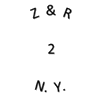 |
Zink & Roth,
(1895-1895),
New York, NY, United States,
Occurs on
2 bottles,
Manufactured beer bottles. This was a brief partnership that
barely lasted a year. Charles L. Zink and Richard F. Roth
opened a bottling supply business at 74 Warren street in early
1895. Neither individual was in the City directories prior to
the partnership. Perhaps the pair were hoping to capitalize on
the traffic of the established Price Flavoring Extract Company
also located at 74 Warren Street. In any case the firm was
bankruptcy by January 4, 1896. Both partners were listed at
clerks at other concerns afterwards. Zink went on to be a
leather designer. The markings appear on the
base of the bottle. Notes |
|
|





